
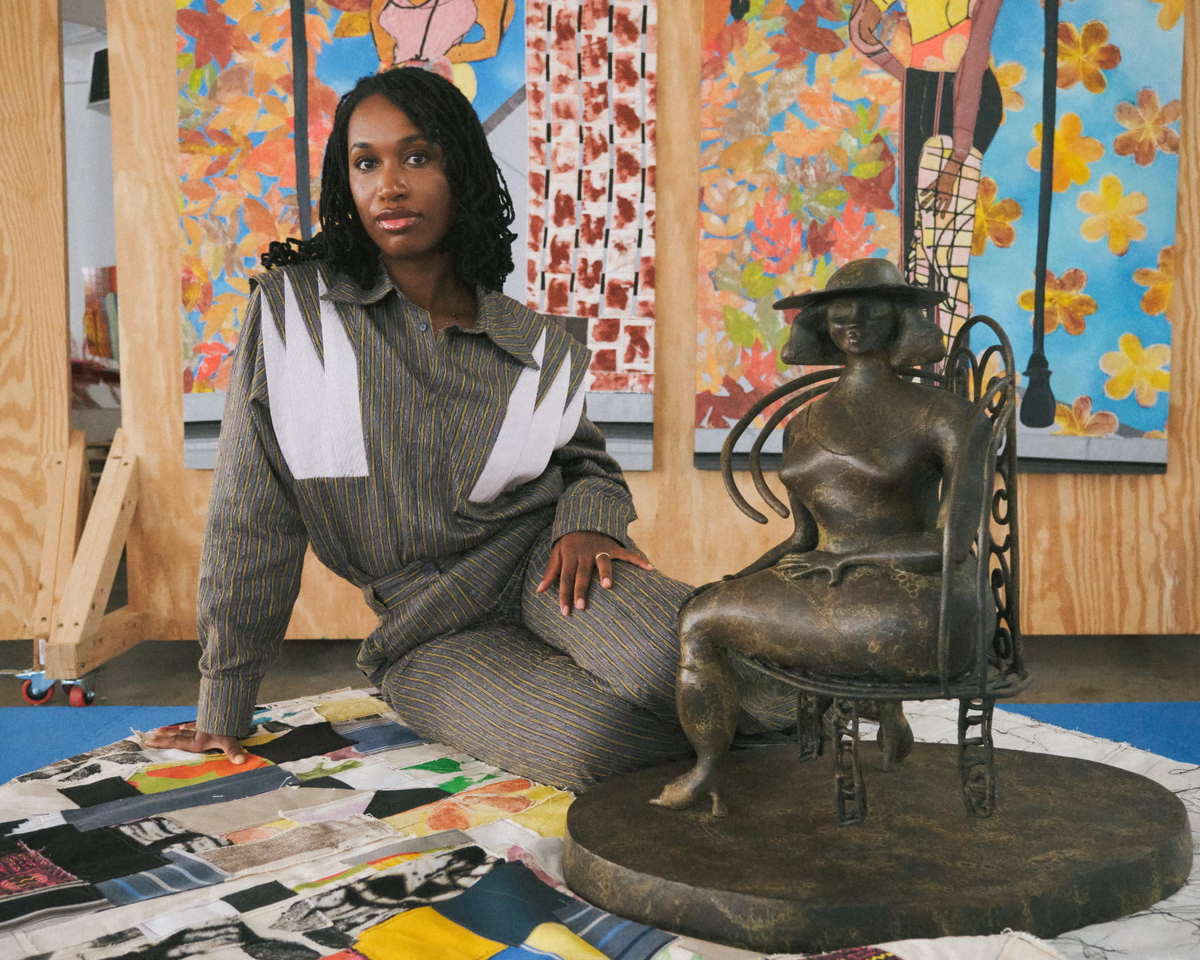
Tschabalala Self, a celebrated American artist known for her vibrant approach to pop figuration, is preparing to unveil her latest public workLady in Blueat London’s Trafalgar Square. The towering, brightly painted bronze sculpture depicts a black woman striding forward, embodying a spirit of optimism and future-facing momentum. Despite the high-profile nature of the Fourth Plinth, Self remains remarkably composed about the upcoming installation.
Her resilience is notable given her previous experience with public art in the United Kingdom. In 2022, Self debutedSeatedat Coal Drops Yard in King’s Cross, London. The sculpture, which featured a black woman seated on a chair, was later moved to the De La Warr Pavilion in Bexhill-on-Sea. Within the first week of its arrival at the seaside venue, the work was targeted by vandals who spray-painted the skin of the sculpture white. Self described the act as “completely racist,” noting that while she had experienced racism before, it was the first time her art had been defaced in such a pointed manner.
Rather than allowing the incident to spark a protest, Self advocated for a community-led cleanup. The effort proved cathartic, with hundreds of local residents joining in to remove the paint, ultimately leaving the sculpture restored by the end of the day. This experience remains a significant memory for the artist, though she insists she is not nervous about the much larger audience at Trafalgar Square.
Born in Harlem in 1990, Self has rapidly ascended the art world, with her work featured in major institutions like the Museum of Modern Art, the Guggenheim, and the Whitney. Her practice is deeply rooted in the belief that all individuals should feel empowered and comfortable within their own bodies. She views her work as a celebration of everyday physicality, drawing comparisons to the exuberant style of French modernist Niki de Saint Phalle.
While some critics often categorize her work primarily as a celebration of black bodies, Self finds this perspective limiting. She argues that her figures reflect her own physical experience but are intended to represent a broader human experience. She notes that while audiences have long accepted Antony Gormley’s use of his own body as a universal stand-in, viewing a black woman as an “everyperson” remains a significant intellectual leap for many. She emphasizes that if viewers struggle to identify with the figure due to her race, it reflects a wider social phenomenon that warrants further examination.
Self’s approach to the Fourth Plinth contrasts with the more overtly conceptual or critical works often displayed there. She rejects the notion that simplicity in art lacks rigour, arguing that true skill lies in creating work that is legible and moving to people across diverse educational and class backgrounds. For her, the goal is not merely to be liked or loved, but for the artwork to perform its function by challenging viewers to confront their own beliefs.
Reflecting on the role of public art, Self expresses a desire for everyone to have the physical, mental, and political space to live freely. She sees the Fourth Plinth as a site for replacing antiquated belief systems with a more inclusive vision. As she prepares for the unveiling, she remains open to the full spectrum of public reaction, viewing each response as a reflection of the current social reality. The report also notes that t schabalala Self is relentlessly positive and unstoppably optimistic. The report also notes that which is pretty impressive considering what happened to her last public sculpture in the UK, self seems resolutely hopeful about the work. The report also notes that “Yeah,” she says, speaking from her home in upstate New York. The report also notes that “The first feeling I had was just pain that my sculpture had been harmed. The report also notes that that someone had enacted violence on an object I had imbued with love and affection.”. The report also notes that she has had exhibitions at the Hammer Museum in Los Angeles and the ICA Boston and is represented by some of the world’s chicest commercial galleries. The report also notes that vivid, super-colourful, mega-joyful celebration of everyday bodies, her work is a lurid.









Comments