
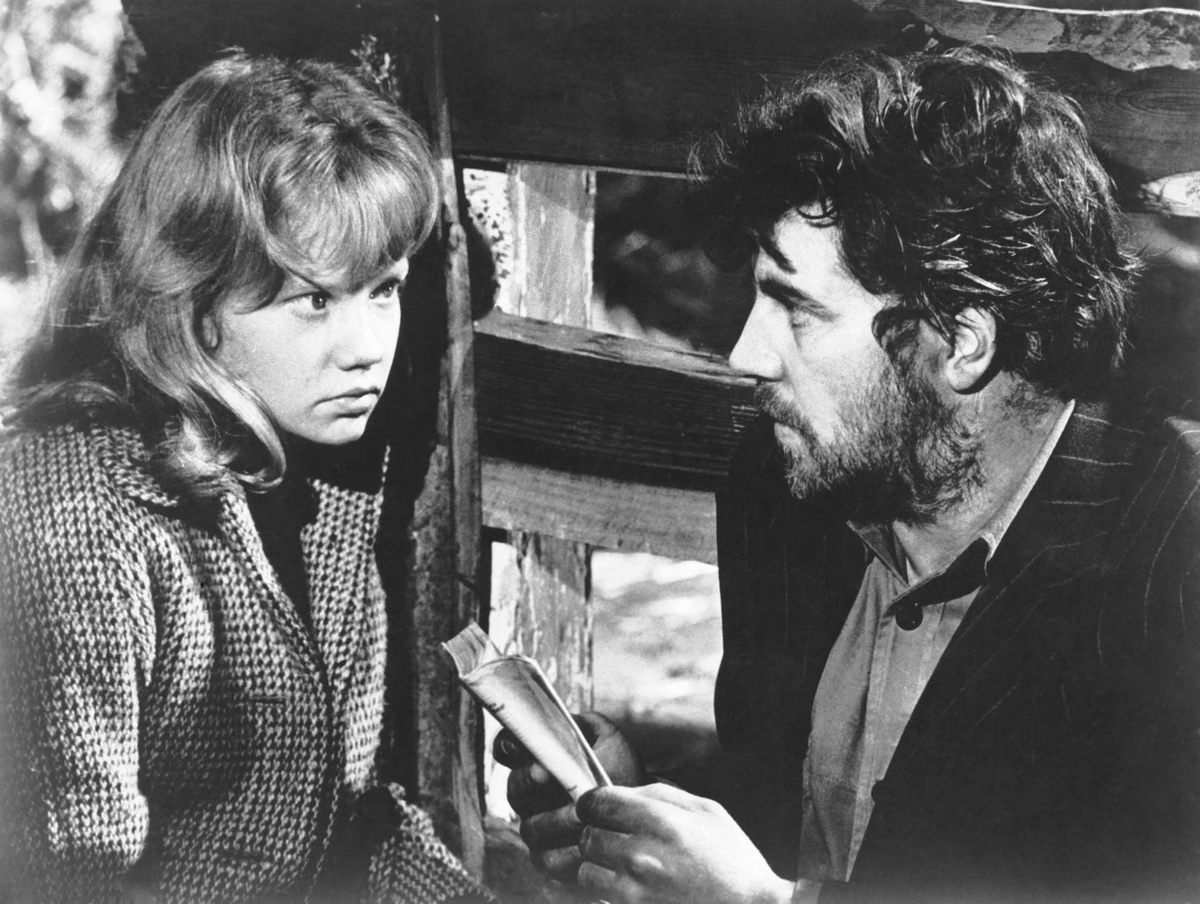
Whistle Down the Wind originated as a novel by my mother, Mary Hayley Bell, centered on three children on a Sussex farm who discover a man in their barn. Believing him to be Jesus, they attempt to shield him from adults to prevent a repeat of his past troubles. The characters were loosely inspired by my siblings, Jonathan and Juliet, and myself.
Richard Attenborough championed the story, convincing my parents to produce it through the company he co-founded with Bryan Forbes. When the original director, Guy Green, stepped down, Forbes took over at the 11th hour. Despite his lack of directing experience, when Attenborough asked if he could handle the project, Forbes famously replied, “I’ve no idea. We’ll soon find out!”
Writers Keith Waterhouse and Willis Hall relocated the narrative to a remote area of Lancashire, settling on the village of Downham near Pendle Hill. Most of the children cast were local, with Roy Holder and myself being the only experienced child actors. At 14, I was significantly taller than the other children, which made my costume sleeves appear comically short.
Having just completed two films in America for Disney, the transition to a muddy Lancashire farm in winter was stark. We navigated the site on duckboards and sustained ourselves on simple fare like dripping, jam butties, and fried eggs in buns. Forbes excelled at guiding the children; in one scene where a boy slaps me, the hand in the close-up was actually his. He struck me with such force that I only allowed myself to cry once the cameras stopped rolling.
Arthur Ibbetson’s black-and-white cinematography captured a haunting, film-noir atmosphere, while Malcolm Arnold’s score added a nostalgic, poignant touch. The music for the scene where the children leap like hares on the hillside is particularly memorable, featuring Richard Attenborough himself whistling on the main theme.
Young Alan Barnes, who played my brother Charles, was a standout. On our first day, he noticed the director’s chairs and, seeing Alan Bates’s name, quipped, “Ey up, they’ve spelled me name wrong.” The props department promptly built him a miniature chair. His delivery of the line, “It isn’t Jesus. It’s just a fella,” became the film’s most iconic moment.
My involvement began when Forbes and Attenborough visited my school when I was 10. I was unaware of their identities until Attenborough arrived at our home the following day, much to my mother’s distress as it was a Wednesday—a day she usually reserved for scrubbing the front step. My screen test involved a simple scene looking around a stone wall, which I found straightforward given my previous experience in school plays.
Bryan Forbes intentionally kept some of our natural mistakes in the final cut, such as my mispronunciation of “Christmas” and misspelling of “Bible,” which added to the film’s authenticity. We even used the actual back door from the farmhouse, which my father had a driver from his haulage firm deliver to the Pinewood set. Seeing the footage during production was a revelation for us; it was the moment we realized the gravity of the project.
Alan Bates, who was incredibly gentle and softly spoken, surprised us during the scene where he shouts at the “disciples.” At the London premiere, he swung me around, and I initially failed to recognize him because he had shaved off his beard. Although I was sent to Harrods to select a dress for the event, I insisted on wearing a frock my grandmother had bought me.
The scene I hold most dear is when Kathy tells Nan about the man in the barn while they are in bed. It was the final sequence I filmed at Pinewood, and by then, I felt fully settled into the role. Looking back at that performance, I feel a sense of pride in what I achieved as a young actor. The report also notes that but not to bother about it, the head teacher just said two men would be coming to the playground to watch us play. The report also notes that afterwards, a few of us were grouped together and told the men were looking for children to be in a film. The report also notes that they decide to hide him and protect him from the adults because they don’t want the same thing to happen to him as before, thinking he’s Jesus. The report also notes that at the foot of Pendle Hill, famous for the witch hunts, the perfect location was found in the village of Downham. The report also notes that the sleeves on my coat were too short and my arms stuck out like a scarecrow’s. The report also notes that and we often had to walk very carefully on duckboards, shooting on a Lancashire farm in winter was very different: there was mud everywhere. The report also notes that but I always loved filming in England.

Comments