
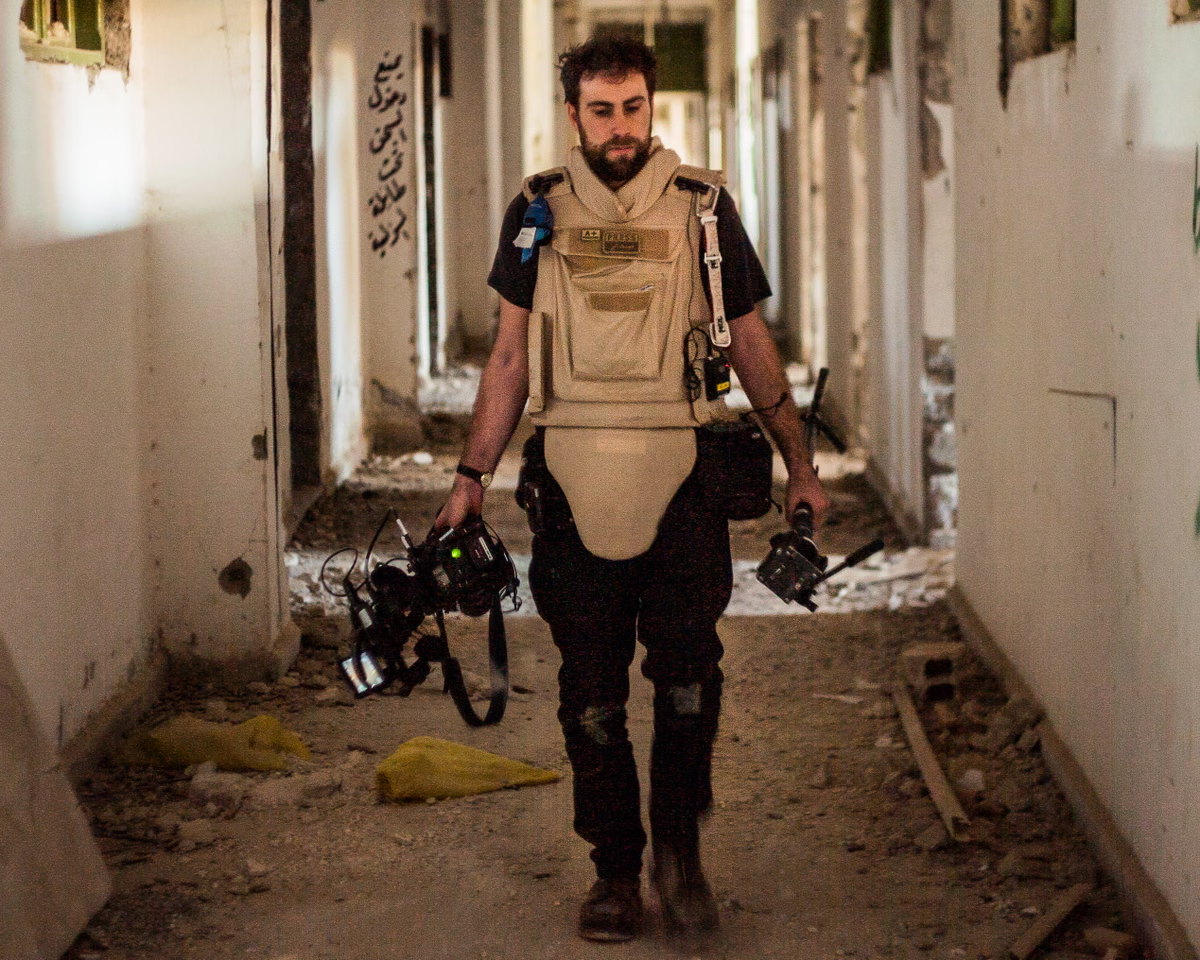
Journalist Josh Baker is returning to the airwaves with his latest investigation for the BBC, aiming to uncover the truth behind the 2012 disappearance of Austin Tice. Tice, a US Marine turned freelance foreign correspondent, vanished in Syria 14 years ago. If he remains alive, he would be considered the world’s second-longest detained journalist. Baker initially approached the project as a missing person case, but soon found himself navigating a complex landscape of espionage, state-sponsored disappearances, and international intrigue.
Baker explains that the podcast serves as a lens into the last 14 years of the Syrian civil war, providing a detailed look at the regime’s industrial-scale torture and detention facilities. The investigation into Tice’s whereabouts and the pursuit of those responsible for atrocities in the region are deeply intertwined. Baker notes that he has received an unprecedented volume of leaks from various sources regarding the case, describing the flow of information as extraordinary.
This project marks the third installment of Baker’s “I’m Not a Monster” series. His previous work includes investigations into an American woman who joined the Islamic State with her children and the story of Shamima Begum. Baker’s career path has been shaped by his time as a night editor at The Times and his work on “Battle for Iraq,” a co-production between and PBS. While embedded with Iraqi special forces, he witnessed the reality of the conflict firsthand, noting that the coalition’s progress against ISIS often looked very different on the ground than it did in official reports.
During his time in Mosul, Baker’s team was targeted by an ISIS car bomb. The explosion destroyed the building where he was staying, resulting in a broken back. While recovering in England, he was contacted by a source who provided a home video from inside Raqqa. The footage showed a young American boy named Matthew being forced to assemble a suicide bomb. Baker, driven by the discovery, successfully located the child seven months later.
The series on Shamima Begum also stemmed from his earlier reporting. A Dutch IS bride, who had been in Mosul at the same time as Baker, contacted him to share details about life in a refugee camp. Baker had previously worked as an assistant producer on “Welcome to the Mosque” and was present at the London mosque the day Begum and her friends disappeared in 2015. His research eventually uncovered the role of Canadian intelligence in facilitating Begum’s border crossing, a finding that adds significant nuance to the debate surrounding her status and the effectiveness of current state policies regarding citizenship.
Reflecting on his methodology, Baker contrasts the accessibility of intelligence sources in Washington with the more guarded environment in Britain. He acknowledges that while he gains significant access, much of the information he receives cannot be verified or used publicly. He also observes that the political climate under the Trump administration made sources notably more reluctant to speak.
The Austin Tice investigation is described as being exceptionally close to the source, maintaining a sense of urgency despite the passage of 14 years. As Baker highlights, the scale of the crisis is immense, with estimates suggesting that at least 100,000 people have been forcibly disappeared. For Baker, the human cost of these events remains a central focus, noting that he often thinks of the families left behind while covering these harrowing stories. The report also notes that that, says Josh Baker (speaking to me from Wales), was the podcast he thought he was making: “We thought we were looking for a missing person, and what we fell into was almost like a Bourne novel, utterly extraordinary. The report also notes that it’s also a story of American exceptionalism – the way the US saw itself in relation to the rest of the world. The report also notes that as episode two begins, Assad is gone, and we enter into these facilities.”. The report also notes that “A lot of my work for the last decade has involved intelligence and espionage and dealing with intelligence agencies, and I have never received so many leaks from so many different places as I have with Austin Tice – from every direction imaginable. The report also notes that but just as extraordinary is the backstory of how they came about. The report also notes that now 37, Baker started as a night editor on the foreign desk of the Times, and did “a little bit of reporting on the Serbian refugee crisis, and from the Middle East”. The report also notes that explosions and fighting happening all around, and the reality was quite different.” He got caught in the centre of Mosul and by nightfall had been offered a place to stay by a family.





Comments