
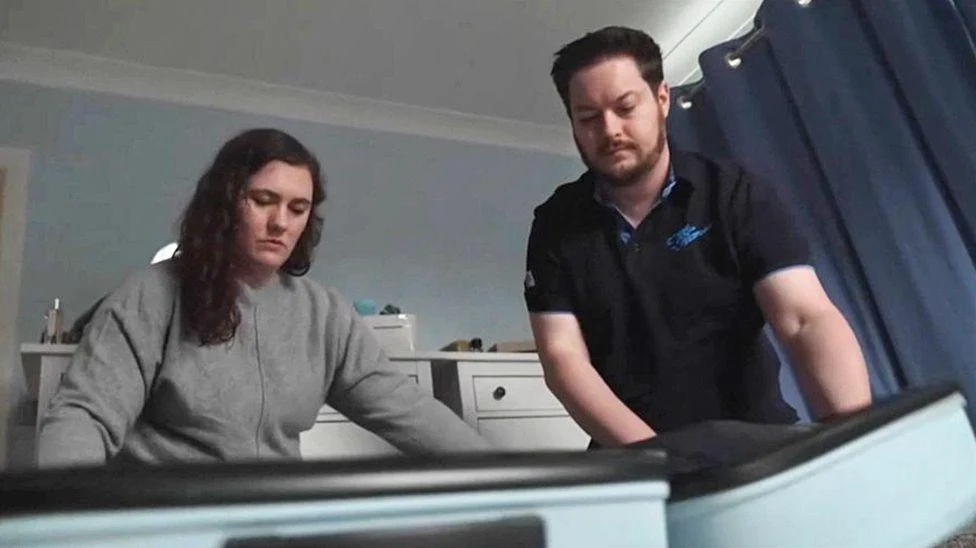
Catie and Phil Allen, aged 30 and 34, recently saw their long-awaited holiday to Slovenia collapse following a four-hour shutdown of the UK’s air traffic control system on Tuesday. While British Airways provided a refund for their flight, the couple estimates they are out of pocket by roughly £1,300 due to non-refundable accommodation and excursion bookings. The pair, who had been looking forward to the trip for years, expressed frustration that their efforts to save money ultimately left them penalized.
The disruption, caused by a failure at the air traffic control provider Nats, left thousands of passengers stranded, with some forced to sleep on airport floors. Aviation Minister Keir Mather labeled the incident unacceptable while speaking to MPs on Thursday, noting that the capacity at some airports struggled to manage the surge of displaced travelers. An independent review of the event is set to be conducted by the Civil Aviation Authority.
For travelers caught in similar situations, flight cancellation rules dictate that airlines must transport customers to their destinations as quickly as possible at no extra cost, even using rival carriers. Passengers are also eligible for refunds if a flight is canceled or delayed for more than five hours. In the Allens’ case, the alternative flight offered by the airline would not have arrived until Saturday morning, cutting their week-long vacation to just a few days, leading them to opt for a refund instead.
However, securing that refund proved difficult. Catie described a tedious process involving a chatbot that pushed for rebooking and a lengthy wait on the phone to confirm the return of funds. Because the air traffic control failure was considered beyond the airlines’ control, travelers are not entitled to additional compensation under UK and EU regulations. Consequently, while British Airways refunded the car hire booked through them, the couple lost money on separately booked hotel stays and activities that refused to offer late-cancellation refunds.
The financial impact has been compounded by insurance limitations. Despite being long-term, loyal customers of their insurance provider, the couple was informed that their claim for lost funds would be rejected because the air traffic issue fell outside their policy scope. Others affected by the chaos have attempted to seek reimbursement through credit card providers, though outcomes vary based on individual terms and conditions.
Regarding passengers stranded at airports, airlines are required to provide food and hotel accommodations depending on the length of their wait. If an airline fails to provide these services, travelers are advised to keep receipts to claim back reasonable expenses later. Nevertheless, many passengers were unable to find nearby accommodation during the surge. Experts caution that booking luxury stays is unlikely to result in a successful claim, as reimbursement is limited strictly to reasonable costs.
By Thursday, the situation began to improve as the aviation system stabilized. Data firm Cirium reported that the system had significantly recovered, with only 54 of 3,028 scheduled arrivals and 47 of 3,033 scheduled departures cancelled or non-operational by that point. While the broader aviation network is returning to normal, the incident highlights persistent vulnerabilities in managing mass travel disruptions. The report also notes that instead, they are at home ringing round for refunds that won’t be paid. The report also notes that it’s not the first time – and won’t be the last – when passengers are left flying on a wing and a prayer after problems at UK airports. The report also notes that so, here is how their case relates to others, and why they have taken such a big hit. The report also notes that and what doesn’t, what gets repaid. The report also notes that catie, 30, and Phil, 34, were sat on a British Airways flight to Ljubljana on Tuesday that never took off. The report also notes that even so, airlines themselves are furious that they have been saddled with a bill of millions of pounds. The report also notes that one explained to Catie that they were a family business that could not afford to do so. The report also notes that which are covered in full if a flight is cancelled, this is different to package holidays.






Comments