
René Magritte remains perhaps the most enigmatic figure in modern art, presenting a greater challenge to interpret than contemporaries like Picasso or Cézanne. While cubism sought a rational breakdown of reality, Magritte’s work thrives on deliberate mystery. A current exhibition at London’s Gagosian Gallery brings together a selection of his iconic pieces, offering fresh perspectives on his approach to surrealism and the subconscious.
Among the standout works is a painting of puffy white clouds that showcases Magritte’s technical skill, revealing an eye for subtle shadow and light comparable to landscape masters like Constable or Hockney. However, the work serves as a classic Magritte deception. Titled The Curse and created in 1931 during the height of the surrealist movement, it challenges the Freudian notion that no image is innocent. By drawing from psychoanalytic theory—which suggests that images often hide deeper, darker meanings—Magritte creates a tension between the viewer’s perception and the reality of the canvas.
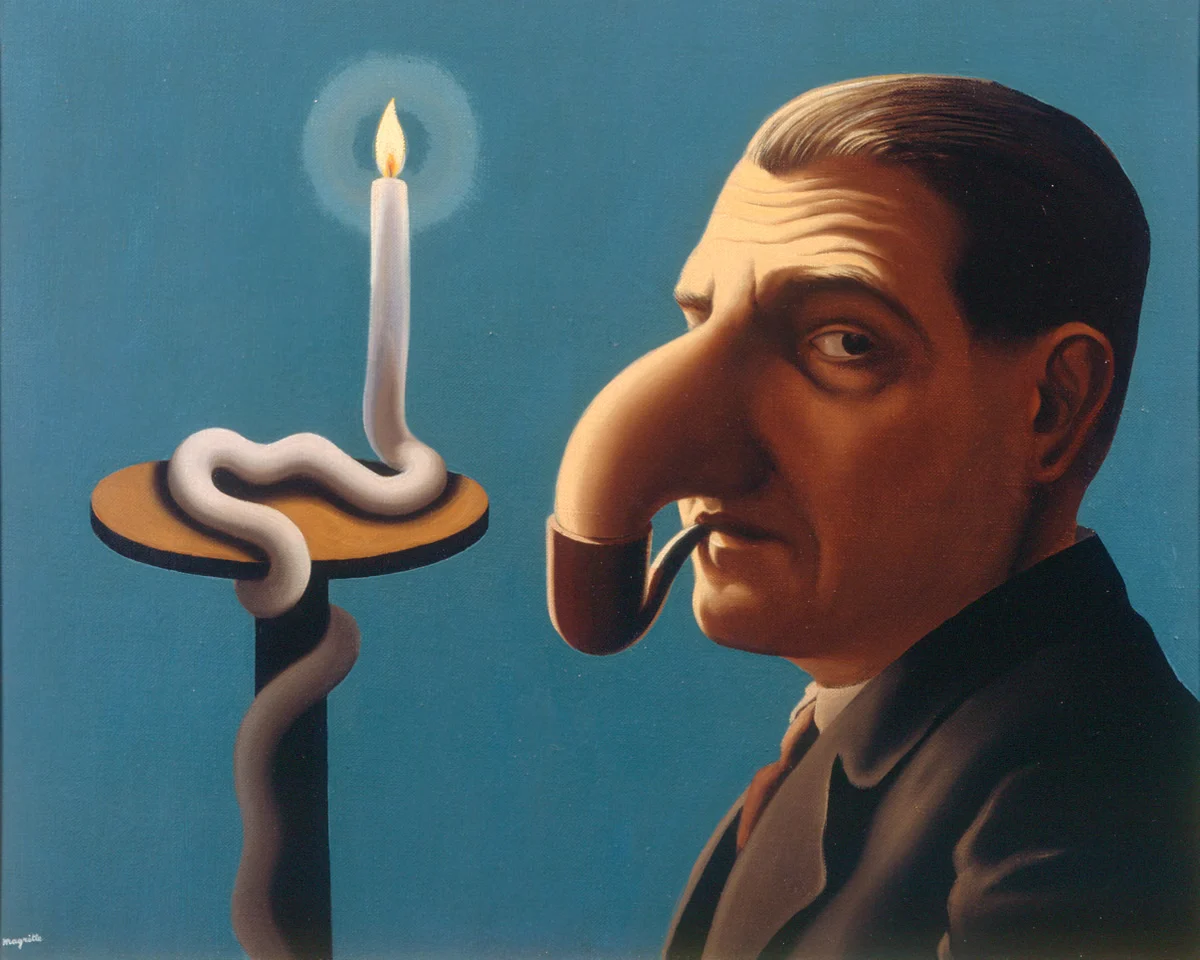
This satirical streak is highly visible in his 1936 self-portrait, The Philosopher’s Lamp. The piece features a nose morphing into a pipe bowl, accompanied by a candle snaking around a table leg. It is an absurd, meta-Freudian composition that mocks the tendency to over-analyze symbols. Magritte appears to be poking fun at the psychoanalytic community’s obsession with uncovering hidden sexual meanings in everything, suggesting such interpretations are often forced and overly logical.
The exhibition also features The Interpretation of Dreams (1935), a masterpiece on loan from artist Jasper Johns. The work, originally titled La Clef des Songes, presents four distinct objects against a neutral backdrop. A horse’s head is labeled “the door,” a clock face is called “the wind,” and a white jug is identified as “the bird.” Yet, in a final subversion, a suitcase is correctly labeled “the valise.” This specific detail disrupts the dream-like confusion, forcing the viewer to confront the unsettling possibility that some realities are impossible to decode, leaving the observer caught between recognition and uncertainty.
Magritte’s work often delved into intense nightmares, such as The Pleasure, where a girl consumes a bird, or The Listening Room, which depicts a massive green apple filling a room to the point of structural distortion. Despite these profound explorations, the gallery’s attempt to bridge Magritte’s genius with modern contemporaries feels uneven. Works by Jeff Koons, Sarah Lucas, and Isabelle Albuquerque appear one-dimensional when placed alongside the Belgian artist’s complex, conceptual puzzles.
Even Magritte’s own output could be startlingly varied. The exhibition includes pieces from his “Vache” (cow) period, during which he deliberately produced crude, cartoonish works—such as a three-legged figure in a feathered headdress—specifically to irritate his family and critics. It serves as a testament to an artist who was intelligent enough to disregard the sanctity of art altogether, proving he could master the precision of Jan van Eyck one day and adopt the style of a clumsy amateur the next. The report also notes that the revolutionary art movement that took from the psychoanalytic writings of Sigmund Freud the insight that nothing is innocent and no image is simply what it seems, magritte made it in 1931 at the height of surrealism. The report also notes that either way, this 1935 painting suggests that dreams and reality are equally bizarre and neither can be explained by the oedipal complex. The report also notes that it’s much harder to get a handle on him than such supposedly difficult modern greats as Cézanne or Picasso. The report also notes that after all, cubism is a perfectly rational attempt to capture the complexity of reality. The report also notes that he confronts you with wilful mysteries. The report also notes that unexpected treasures that give your wonder at Magritte little twists in new and perverse directions, this show sets choice examples of his magic against modern art and is full of quirky. The report also notes that a painting of puffy white clouds held me across the gallery and still floats ineffably in my mind.






Comments