
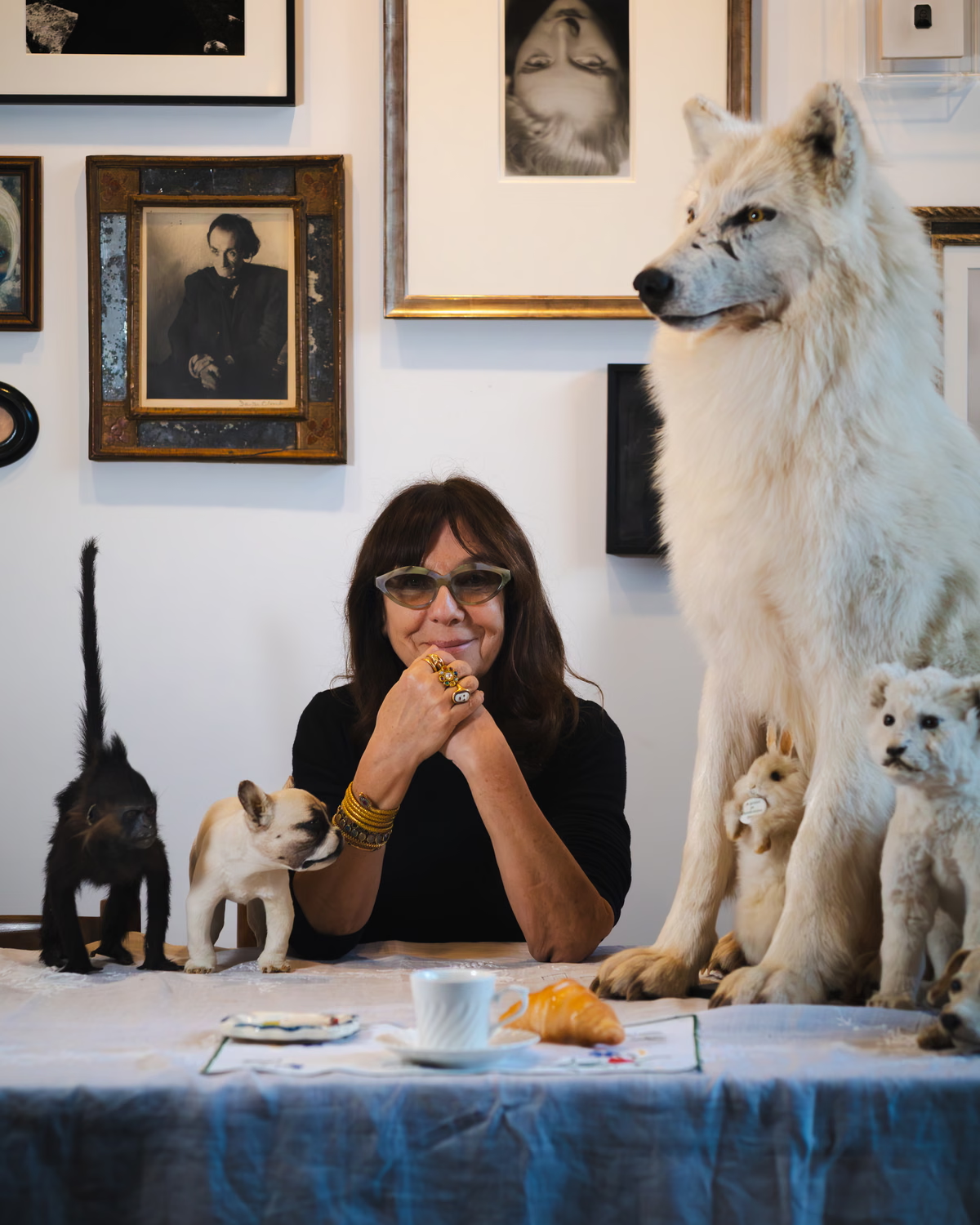
Sophie Calle, France’s preeminent conceptual artist, has spent nearly five decades exploring the thin line between the intimate and the intrusive. From her early days in the 1980s, when she began documenting the lives of strangers, to her current standing as a global creative force, Calle has built a career on the intersection of reality and performance. Now aged 72, she prepares to open her first significant UK exhibition in nearly twenty years at Turner Contemporary in Margate. The show, titled Something Missing?, offers a retrospective of her work spanning from 1986 to 2024, delving into her lifelong preoccupation with absence, death, and the fragments of identity.
Reflecting on her creative roots, Calle explains that her entry into the art world was unconventional. She was 26 and adrift when she realized that creating art might be the key to connecting with her father, a doctor and collector of conceptual works. Unable to paint, she turned to photography and writing. Her early practice was driven by aimlessness; she began following strangers simply to fill her days. In one infamous 1980 project, she stalked a man she had met at a party, trailing him from Paris to Venice and photographing his movements without his knowledge. She admits that today her motivations have shifted. While she once found the process of tailing strangers to be both restful and active, she no longer possesses the energy for such prolonged, clandestine surveillance.
Calle’s work often feels like a mirror held up to the human condition, reflecting themes that are both morbid and playful. She has invited strangers to sleep in her bed, posed as a hotel maid to inspect the lives of guests, and contacted individuals from a found address book to piece together a portrait of a stranger’s existence. At the core of her practice is a need to create distance during difficult times. When her mother was dying in 2006, Calle filmed the event, a choice she describes as a mechanism to avoid being emotionally overwhelmed by the tragedy. Similarly, she has tackled the subject of death by commissioning her own headstone and editing her own obituary, driven by a desire to address the inevitable as she ages.
The upcoming Margate exhibition includes a series of unfinished projects, a collection she curated in 2023 to grant them a form of existence. She notes that some ideas are discarded because they are too costly or simply fail to manifest, while others are abandoned due to their ethical implications. “Sometimes I think an idea is too cruel and not worth that cruelty,” she says, though she acknowledges a willingness to push boundaries if the artistic result is compelling. This tension between cruelty and creation was present in her 1986 series, The Blind, which featured portraits of people born without sight and their descriptions of beauty. After receiving permission from one participant, she felt emboldened to pursue the project. Years later, she continued this exploration of vision with Voir la Mer, a film capturing the emotional reactions of Istanbul residents seeing the sea for the first time.
Life in the public eye has not shielded her from personal contradictions. Despite her fame, she continues to live in the same Paris apartment she has occupied for half a century, surrounded by the remnants of her projects. She maintains a long-term relationship, though she is notoriously skeptical of the structure of domestic coupling. To preserve her independence, she and her partner have a signed agreement: should she ever base an art project on him, he is entitled to leave. She laughs at the prospect, calling it an “easy out” for her own autonomy.
Her relationship with other artists, particularly Pablo Picasso, has evolved over time. She previously declined to exhibit at the Picasso Museum in Paris, fearing his legacy would overshadow her own. It was only during the pandemic, when she saw his works obscured and protected from the elements, that the prospect felt manageable. This shift in perspective led her to take over four floors of the museum in 2023, where she installed her own personal belongings alongside his hidden treasures. “I was afraid of being crushed by Picasso, but I wasn’t afraid of his absence – that gave me a new direction,” she notes.
Calle remains largely unfazed by the label of provocateur. Whether the audience finds her work inventive or invasive matters little to her at this stage of her life. She is aware that her interview style can be challenging, often parrying questions about her psychological state with a dry, matter-of-fact deflection. When pushed on why she avoids traditional therapy, she clarifies that she is not there to engage in that kind of exchange. As she looks toward the future, her focus remains on the present. She no longer fears running out of ideas, asserting that even if her creative output were to cease, she would simply focus on enjoying her life. The report also notes that then, 10 minutes in, she tells me she is obsessed with absence. The report also notes that she is talking to me from the same Paris apartment she has been living in for almost 50 years. The report also notes that she was 26 and “very lost”. The report also notes that i ’ve read enough interviews with Sophie Calle to know that the conversation ahead could be tricky. The report also notes that who is friendly and seemingly open, all smiles, which is why I’m so surprised by the woman before me. The report also notes that and behind them I picture her eyes twinkling, she’s wearing big tinted glasses. The report also notes that and, alongside pictures and books, there are boxes that I imagine are filled with the innermost thoughts and feelings of her subjects, hanging from the ceiling is a disco ball. The report also notes that hitch-hiking around the world with no money or sense of purpose, he wasn’t happy with how she’d been spending her time.

Comments