
Following her first professional role in the 1980s, Andrea Modica utilized her savings to travel to Italy, beginning a 40-year practice of documenting the country through an instinctive, agenda-free approach to photography. This lifelong connection to her ancestral home is the subject of her new book and exhibition, “Andrea Modica: Italian Story,” which is currently on display at the Alice Austen House in Staten Island, New York, through February 20.
A significant portion of this body of work, captured using a large-format 8×10 camera, focuses on a horse hospital situated outside Bologna. Modica explained that the substantial 8×10 inch negatives necessitated a deliberate pace, preventing the possibility of capturing fast-action shots like galloping horses. Instead, she concentrated on the quiet, atmospheric recovery boxes filled with shredded paper and soft lighting, as well as the specialized tools used in equine surgery and breeding.
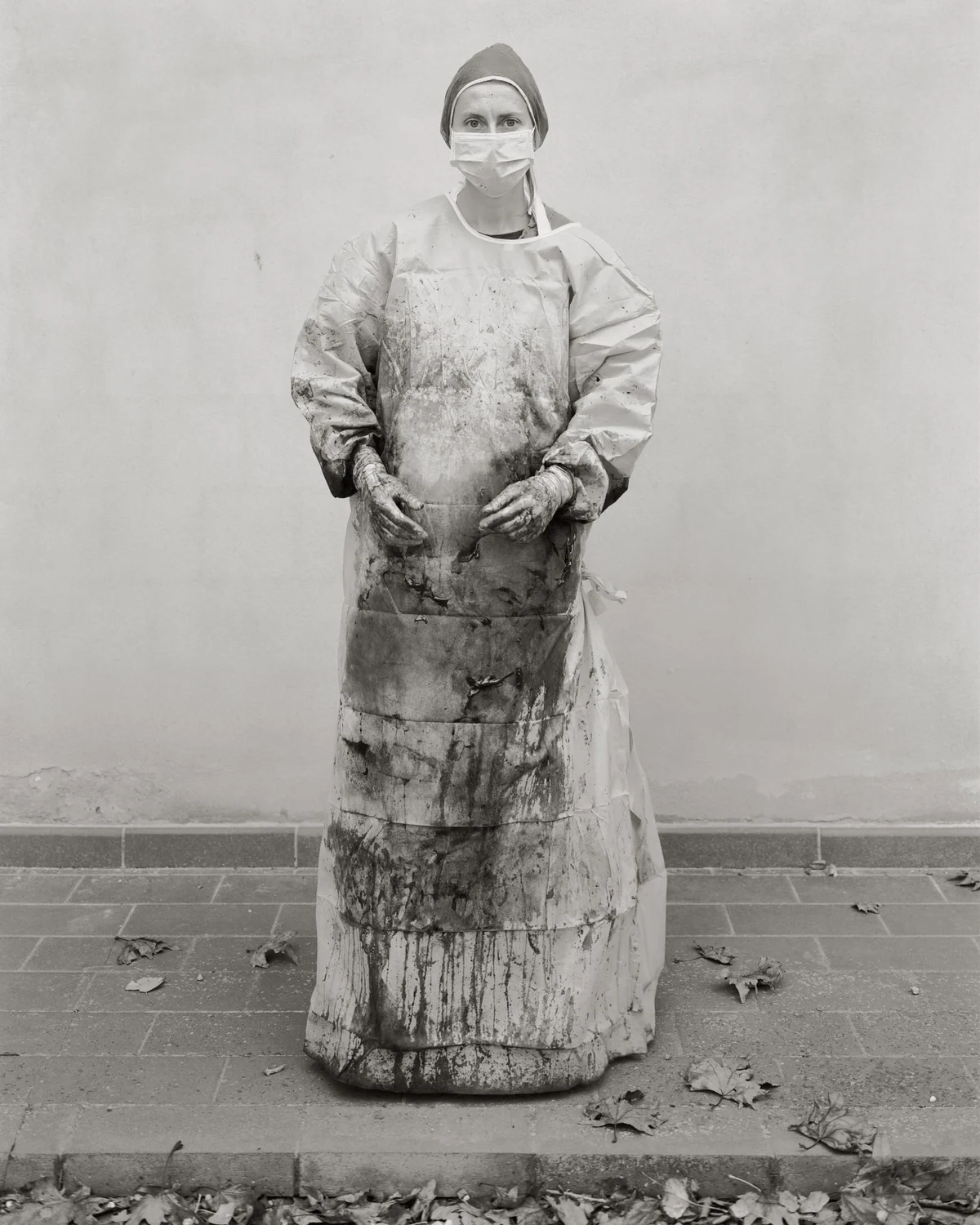
Among the many images captured at the facility is a particularly striking portrait of a female surgeon. Modica recalls that the veterinarian had just completed an emergency procedure on a horse suffering from a gastrointestinal obstruction. The surgical setting was visceral, with the floor covered in blood and intestinal matter, offering a stark contrast to the tidy, keyhole procedures Modica had documented elsewhere. When the surgeon emerged from the operation, Modica felt compelled to capture her image, noting, “You’d have to be out of your mind not to want to photograph this incredible woman.”
The pair relocated to the shade outdoors, where the lighting allowed for clearer detail. Modica noted that the subject’s posture and the way her feet were obscured created the impression of a column, while the positioning of her hands evoked the aesthetic of medieval wooden statues of saints. “I only realised afterwards that she looks like a medieval statue, a madonna,” Modica said. She emphasized that while the composition was unconscious, the photograph balances elegance with the raw horror of the scene.
Modica maintains a philosophy that viewers should be left to interpret the images themselves, noting that photography is intrinsically tied to the facts of the scene. “The way the blood drips down from each one of the folds, each one becomes its own little painting,” she stated. For the artist, the image represents a powerful conflict, capturing both the strength of the woman and the harrowing reality of the emergency intervention.
Reflecting on her career, Modica, born in Manhattan in 1960, remains focused on the present moment rather than past milestones. She emphasizes that the most profound work arises when a photographer disregards their audience, a sentiment she views as particularly vital in the era of immediate social media documentation. “There’s something lost in the joy of the process of shooting if one thinks about the product,” she concluded. The report also notes that a fter my first job in the 80s, I had a little money and set off for Italy with my camera and a backpack. The report also notes that where my family is from, and so began 40 years of travelling back and forth – at times to teach photography, or for a relationship, and always to make photographs with no real agenda, i had grown up hearing about Italy. The report also notes that it takes 8×10 inch negatives – a lot bigger than the tiny negatives from 35mm cameras, to give you a sense of the size of the camera. The report also notes that i made a large body of work there and this first appeared in a book called Theatrum Equorum, Latin for Horse Theatre, all caught on an old-style large-format 8×10 camera. The report also notes that in my work everybody knows they’re being photographed. The report also notes that and in a sense posing, but hopefully not appearing to be posing, which is where my skill comes in, they are reacting to me and the camera. The report also notes that with the horses in recovery, I had a few minutes before they came to.

Comments