
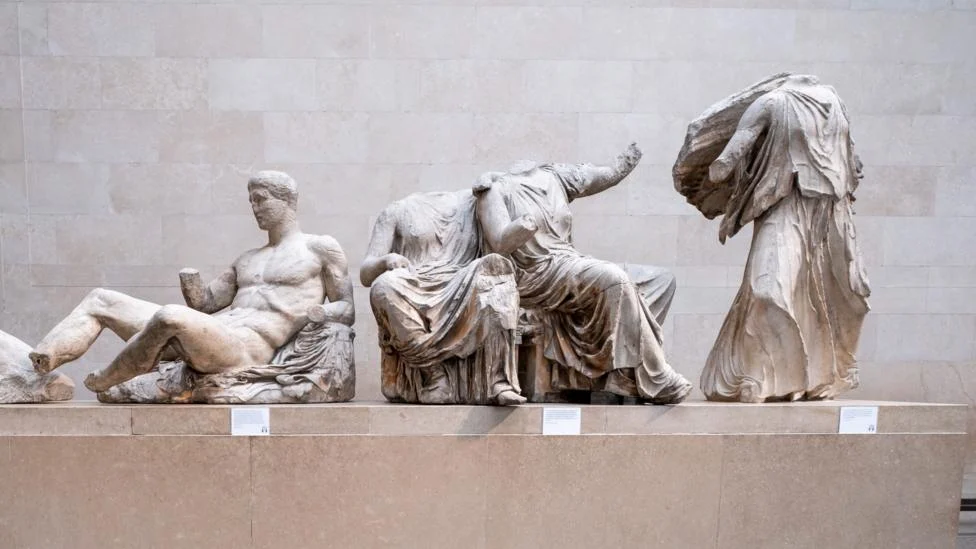
Greek Prime Minister Kyriakos Mitsotakis has urged Andy Burnham to summon the political will needed to send the Parthenon sculptures back to Greece. Writing in the Guardian, Mitsotakis argued that returning the classical treasures—widely known in the UK as the Elgin Marbles—would demand courage and send a powerful signal.
The ancient pieces have remained inside the British Museum since the nineteenth century, though Athens has long challenged the lawfulness of their extraction. Mitsotakis dismissed suggestions that the recent loan of the Bayeux Tapestry from France could serve as a blueprint for resolving the dispute, stating that Greece would reject any compromise requiring it to acknowledge British ownership or borrow fragments of its own heritage.
The Greek leader called on Burnham to stand by remarks he made in 2023, prior to returning to government, when he insisted the sculptures ought to be sent home without conditions. Back then, Burnham had advocated for legislative changes, though he noted last month that the matter ultimately rests with the British Museum under current legal frameworks.
Discussions between Athens and the British Museum have stalled over Greek demands for a permanent homecoming. While the museum’s director, Nicholas Cullinan, recently pointed to the Bayeux Tapestry arrangement as a source of optimism, Mitsotakis maintained that the situations are entirely different.
The marble sculptures were carved between 447BC and 432BC to adorn the Temple of Athena on the Acropolis. In the early nineteenth century, British ambassador Lord Elgin removed several pieces with permission from the Ottoman Empire, which controlled Athens at the time. A parliamentary select committee subsequently declared the removal lawful in 1816, allowing the collection to enter the British Museum through an act of Parliament.
Although former museum chair George Osborne expressed a desire for a cooperative arrangement in 2023 following centuries of friction, the institution maintains that existing laws bar the permanent removal of its artifacts. Meanwhile, UK officials have indicated no plans to amend the British Museum Act to facilitate a transfer.
The diplomatic pressure surrounding the collection has intensified recently. Last month, the Greek health minister suggested that US President Donald Trump should intervene to press British authorities into returning the Parthenon treasures, underscoring Athens’ ongoing determination to reclaim the disputed antiquities. The report also notes that but the two have so far failed to reach an agreement, with Greek authorities seeking their permanent return, mitsotakis and his government have previously held talks with the British Museum about the sculptures. The report also notes that and claiming this was an adequate way to understand it,” he wrote on Thursday, external, nobody would seriously contemplate cutting what survives of the tapestry in two and displaying half in London and half in Bayeux. The report also notes that this would be a “decisive step”, Mitsotakis said, that would “reunite the sculptures and transform a historic dispute into a unique act of cultural friendship”. The report also notes that back in 2023, several years before he returned to government and became prime minister, Burnham said the sculptures should be returned to Greece with “no strings attached”.



Comments