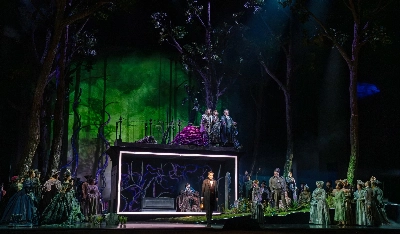
A new opera based on George Saunders’ Booker Prize-winning novel “Lincoln in the Bardo” is making its way to the stage. While the setting is a graveyard filled with deceased characters and an Abraham Lincoln paralyzed by grief over his 11-year-old son’s death, the creators emphasize that the production is far from a grim evening at the theatre.
Librettist Royce Vavrek, who collaborated with composer Missy Mazzoli to adapt the book, noted that despite the story’s heavy themes, it contains significant heartbreak, joy, and effervescent humor. The narrative centers on the concept of the bardo—a Tibetan Buddhist state between death and rebirth. The spirits inhabiting Georgetown’s Oakhill Cemetery cling to their former lives, referring to their coffins as “sick-boxes.” They only move on through a dramatic explosion of fireworks, termed “matterlightblooming” by Saunders as a nod to James Joyce, once they accept their deaths. The ghosts populating Georgetown’s Oakhill Cemetery refuse to accept the circumstances – often abrupt or violent – that ended their lives.
Director Lileana Blain-Cruz, leading the world premiere at the Metropolitan Opera, highlighted how the opera honors the full spectrum of human experience, from tragic and inspiring to ridiculous. Into this realm steps Willie Lincoln, who died from typhoid fever, followed by his heartbroken father. Lincoln visits his son’s crypt late at night to cradle the boy’s body before ultimately returning to the outside world, ready to guide the country through the Civil War.
Mazzoli found addressing the death of a young child to be the most challenging aspect of writing the score. To navigate the emotional weight during the composition process, she shifted her focus to the narrative’s conclusion, where Willie realizes his spirit is liberated from physical limits. The child sings an aria celebrating his newfound freedom to fly out windows or hang from chandeliers, which helps awaken the surrounding spirits to a broader perspective. “When I’m writing, there’s a period of years where I’m alone with these characters,” she said. “I really tried to inhabit the character of this boy, but it’s hard to enter that place every day.”. According to she solved the problem by focusing on the end of the story, when Willie realises that since he is dead he is freed from earthly constraints. “He sings this incredible aria where he, ‘all is allowed me now,’” Mazzoli. “He’s found this beautiful way of looking at it, and he sort of awakens the other dead people in the cemetery to this,” she said. “I had to find this positive slant so I wouldn’t be crushed by the sadder parts of the sto. There’s something wonderful about encountering the fullness of life in all these characters.”. For Mazzoli, the biggest challenge in composing the score was the fact that it deals with the death of a child.
Opening on Oct. 19 under the baton of Met music director Yannick Nezet-Seguin, the opera will run for nine performances. Baritone Peter Mattei plays Abraham Lincoln, while the production features gender-swapped casting with counter-tenor Anthony Roth Costanzo as Miss Elise Traynor and soprano Christine Goerke as the Reverend.
Goerke, a prominent dramatic soprano known for Wagner and Richard Strauss roles, expressed her excitement over having a character custom-written for her. Vocally, the role spans her complete range, including a two-octave plunge from high C. Dramatically, the Reverend understands his own death but fights his destiny due to a terrifying vision of damnation, ultimately performing a heroic act of sacrifice that offers potential redemption.