
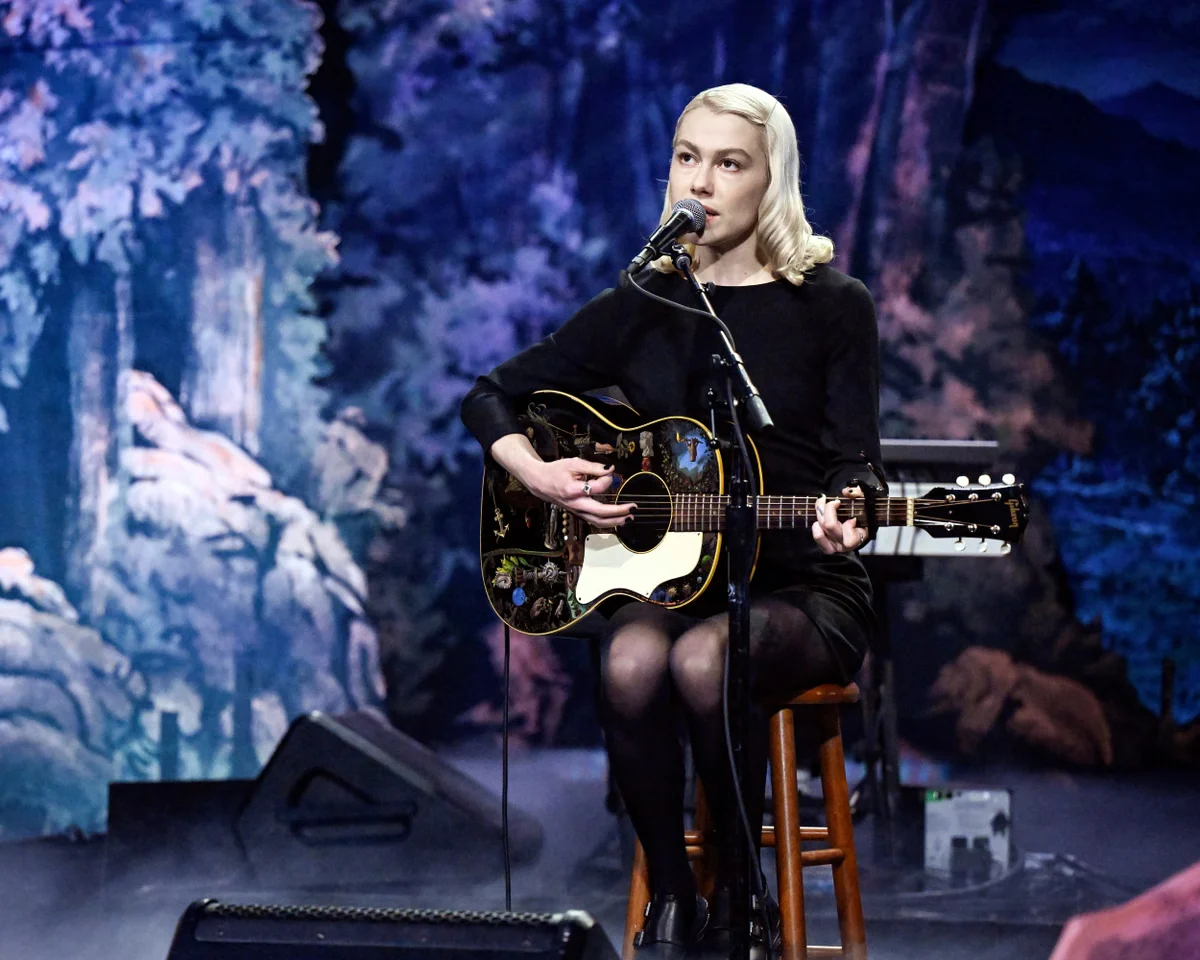
This week, indie star Phoebe Bridgers releases her long-awaited third album, Lost Weekend, six years since her pandemic-era breakthrough. Alongside a slew of glittering reviews, including five stars from, the release marks her first solo charting single in the UK. Yet, the Californian musician’s influence runs far deeper than reviews or record sales. Just how did a RuneScape-referencing, Halloween-costumed Berklee drop-out become the most influential songwriter of the 2020s?
Bridgers’ idiosyncratic writing has shaped the sound of the decade. Her second album Punisher, released in June 2020 (and recorded many months before), spookily anticipated that strange, lonely year: in her eerie double-tracked vocals (a nod to Bridgers’ musical hero, Elliott Smith), Bridgers sang of empty shopping malls and conspiracy theories over lush, unsettling music made from watery electric guitar, Mellotron, strings, screams and birdsong. Today, her mix of dry wit and pathos is traceable in the lyrics of pop’s new chart toppers, such as Olivia Rodrigo and Gracie Abrams, while heavyweights including Paul McCartney, Taylor Swift and SZA have clamoured for collaborations. “She is the reference now,” Swift told in 2022.
“She’s the voice of a really particular moment,” says author Carmen Maria Machado, who first met Bridgers when she attended an event for Machado’s prize-winning memoir In the Dream House. There is a kinship between Machado’s prose and Bridgers’ lyrics—both are candid, haunted, and unafraid to get gruesome—which resulted in Machado publishing a short story to accompany Punisher. “Phoebe’s never looking directly on, rather looking askance,” says Machado. “Her music is so precise and weird and beautiful; it’s a prayer or an ode to this place that we’re living in, while also watching it fall apart.”
Reviews for Lost Weekend have highlighted the album’s deeply personal subject matter, including the death of Bridgers’ father and the end of her engagement to actor Paul Mescal, alongside her enduringly surreal sense of humour. For Naomi McPherson, a member of synth-pop three-piece Muna, it is this mixture of matter-of-fact and magical that makes Bridgers so distinct. “It’s infuriating and inspiring how good she is,” McPherson says, pointing to a forthcoming Lost Weekend song with a line about turning down the stereo volume to better parallel park: “To be able to put that in a song in a way that isn’t stupid, but is actually brilliant and somehow deeply touching, is an enormous feat.”
Muna signed to Bridgers’ record label Saddest Factory in 2021, joining a cohort of imaginative, predominantly queer musicians united under Bridgers’ mentality of “getting cool stuff out to people as fast as possible”. Singer-songwriter Claud, the label’s first signee, emphasises the value of Bridgers’ support: “I knew I could trust her opinions and instincts for my project, because I love everything she does with hers.” The label’s influence reflects Bridgers’ determination to change the music industry, much like her supergroup, Boygenius, formed with Lucy Dacus and Julien Baker. Together the trio played their biggest stages to date and clinched three Grammy awards, while Bridgers took the award ceremony as an opportunity to condemn former Recording Academy boss Neil Portnow, who had been accused of sexual assault, for his disparaging comments about female artists.
Bridgers’ plain-talking has won her a passionate fanbase, many of whom sport matching ghost tattoos—a reference to her 2017 debut Stranger in the Alps. Her concerts are intense, as seen when she played at the Loud, a 500-capacity venue in Huntington, West Virginia. Fan Baleigh Epperly, an environmental advocate and DJ, “freaked out” at the visit. “We never get shit,” she laughs, noting it meant everything that Bridgers visited the overlooked places. The tiny shows were capped at $50 and were mobile-phone free. “It was the talk of the town, literally,” Epperly marvels, predicting the performance will have a lasting impact on young musicians who may have internalised damaging stereotypes about Appalachia: “If Phoebe is good enough for West Virginia, then you’re good enough.”
Comments