
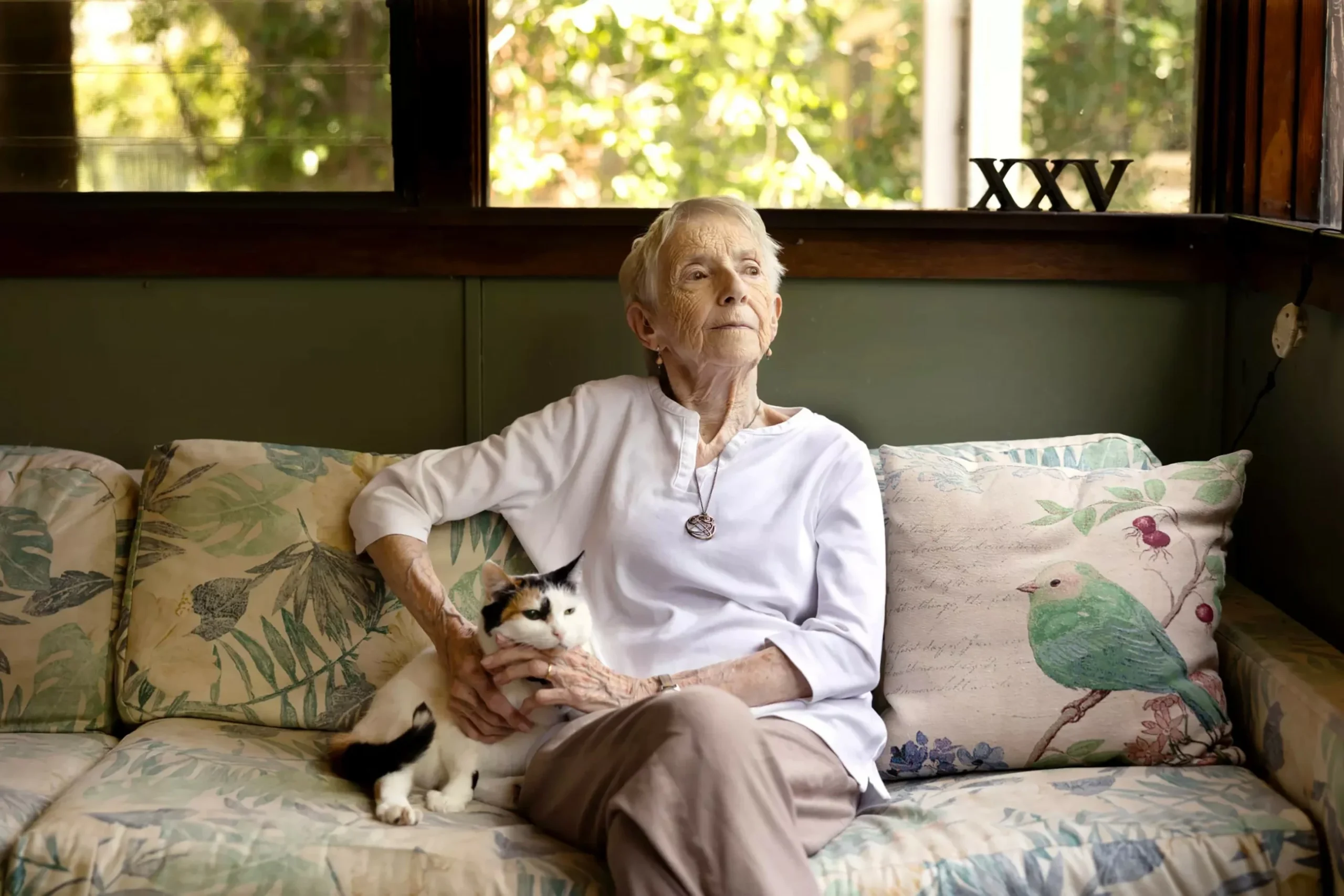
In 1953, French journalist J.C. Vérots reviewed a performance of “Les Sylphides” by the Marquis de Cuevas ballet company. While the production featured renowned post-war dancers such as Serge Golovine, Rosella Hightower, and Jacqueline Moreau, Vérots was captivated by a rising talent named Helga Monson de Kansky. He wrote, “We were surprised to find ourselves preferring Helga Monson. Remember her name. It will soon be a famous one.” Although she did not achieve the global fame Vérots predicted, Monson de Kansky’s dedication to the art form has endured for over seven decades.
Now 99 years old and a resident of Sierra Madre, Monson de Kansky continues to teach ballet at the Pasadena Dance Theatre. Despite recent health challenges, including a bout of pneumonia that led to hospitalization, her enthusiasm remains undimmed. She describes her lifelong journey with dance as a central pillar of her existence, noting that she has no intention of retiring as long as she remains mobile.
Her introduction to the arts began during her childhood in Independence, Kansas. As her family moved frequently during the Great Depression, her parents consistently enrolled her in local dance schools. A pivotal moment in her youth occurred when her father drove the family to Topeka to witness a German modern dance company perform “The Green Table.” She recalled the experience during a recent interview at her home of 60 years, stating, “That was the first professional performance I ever saw of ballet or anything. I was just mesmerized. Between the music, the lighting and the dancing, jumping up and down from the table, it was a wonderful performance.”
Following high school graduation, she moved to New York City to train under former Bolshoi Ballet prima ballerina Elizabeth Anderson-Ivantzova. After three years of rigorous study, her father encouraged her to pursue professional work. She successfully auditioned for Colonel Wassily de Basil’s Ballet Russe while the company was touring the United States. Within seven days of being accepted, she secured a passport and traveled to England to perform at the Royal Opera House in Covent Garden, where the demanding schedule left little room for personal reflection.
Monson de Kansky later spent nine years touring with the Marquis de Cuevas ballet company, performing across Europe, North Africa, and South America. Her career highlights included dancing for Prince Rainier III of Monaco and studying under esteemed mentors like Olga Preobrajenska, Bronislava Nijinska, and Vera Volkova. She performed numerous roles, including the prelude to “Les Sylphides” and queen Myrtha in “Giselle,” which she described as a particularly difficult challenge.
During her time with the company, she met her husband, Igor, a painter and sculptor who was performing as an organ grinder in the ballet “Petrouchka.” The couple married in 1954 and eventually had a daughter, Svetlana. Balancing motherhood with a professional career proved difficult, as she noted that roles were often quickly filled by others during her absences. She briefly returned to the Marquis de Cuevas company before moving to the Netherlands to serve as a principal ballerina for Het Netherlands Ballet, then led by Sonia Gaskell.
While she cherished her time in the Netherlands, the separation from her daughter became unsustainable. “Svetlana bounced back and forth from my mother-in-law and from my cousin,” she explained. “I had to leave about 10 months later. I left to go back to Paris because I just couldn’t be away from my family.” In Paris, she focused on teaching, providing lessons to members of the French aristocracy within a duchess’s palace, before eventually relocating to California with her family.
Today, her home serves as a testament to her life, filled with her husband’s artwork and the classical music recordings she prepares for her students. She has developed a deep appreciation for her natural surroundings, noting that her perspective on the world has broadened over time. For Monson de Kansky, the dance studio remains a second home, a place where she continues to foster joy and connection through the art of ballet. The report also notes that but more than 70 years later, Monson de Kansky hasn’t lost her love of dance. The report also notes that the walls are lined with paintings done by her husband, Igor — a painter and sculptor whom The Times profiled in 1991. The report also notes that to the birds,” Monson de Kansky said, while those same birds chirped in the background, i’m more attuned to — especially since they’re tearing it up — to our surroundings. The report also notes that she started a family and had to balance her responsibilities as a performer and ballet instructor with those of motherhood, ultimately returning to the U.S, just a few years later. The report also notes that and recently battled a bout of pneumonia that hospitalised her, she’s more frail than she once was. The report also notes that classical music CDs and cassette tapes that Monson de Kansky records for ballet class clutter her shelves. The report also notes that he also built the wooden kitchen cabinets. The report also notes that gravel driveway, surrounded by nature, which Monson de Kansky says is the most important thing she’s learned to appreciate, the house is tucked down a long.






Comments