The United Kingdom will have a “voice in the room” but no vote on European Union food policies as part of a proposed “Brexit reset” aimed at reducing trade red tape, EU relations minister Hamish Falconer has told.
Prime Minister Andy Burnham hopes to finalize the deal at a bilateral summit on Friday, but political critics warn that the closer alignment will leave Britain as a “rule taker” rather than a rule maker.
Consultative Influence and Consumer Pricing
Falconer defended the negotiation strategy, explaining that the UK would be involved in a consultative process to help shape regulations, which could ultimately lower grocery costs for domestic consumers.
- The reset agreement requires no upfront payments from the British government.
- It is expected to include an “exit clause” allowing the EU to protect itself if a future UK administration decides to reverse the alignment.
- The UK will gain input during policy formation despite relinquishing formal voting rights on European food standards.
Addressing potential political shifts, Falconer acknowledged it was “reasonable” to consider what might happen if a future Conservative or Reform UK government sought to dismantle the arrangement. The amount of uncertainty – you have to have it in the right pen colour, if it’s not black, it might be refused,” Falconer said, the amount of paperwork you would need to do.
“The EU is worried about that and you can see why,” Falconer stated, adding that observers would have to “wait and see the detail” regarding specific technical mechanisms.
He conceded that any international agreement involves compromises, but insisted the government is committed to ensuring British competitive advantages “aren’t lost under the deal.”
Dismantling Costly Border Red Tape
It is understood that the inclusion of an exit clause stems from EU concerns regarding the financial burden of rebuilding border inspection facilities if the UK pulls out later. Under the new deal, existing border check infrastructure would be dismantled.
Speaking from a Marks & Spencer food court in central London, Falconer highlighted how administrative hurdles currently hamper British business operations across the Channel.
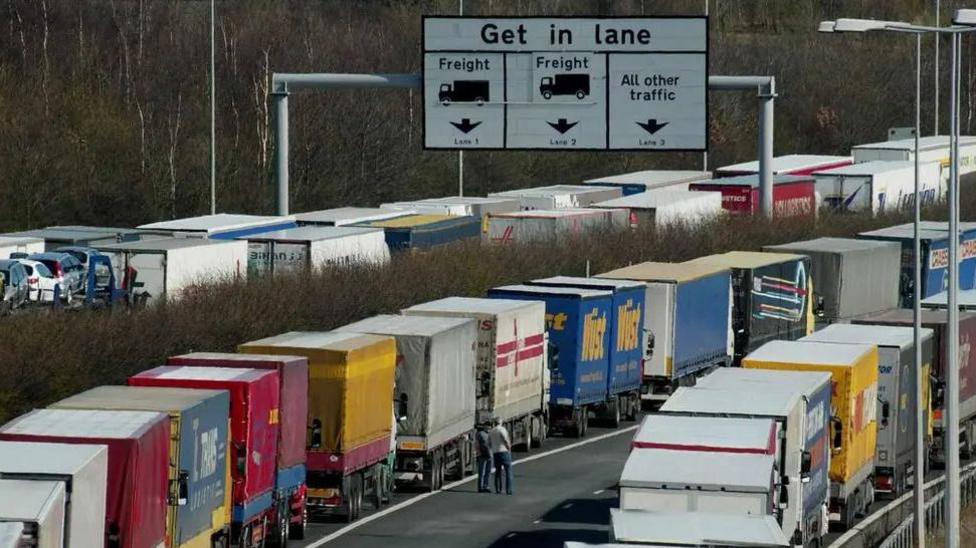
- Supermarket supply chains face extensive paperwork, including export health and phytosanitary certificates, mandatory veterinary visits, and complex border forms.
- Some M&S delivery trucks require upwards of 300 pages of documentation to clear European customs.
- Consignments are sometimes turned back at the border for minor clerical errors, such as using the wrong ink color or imprecise Latin names for cooked meats.
- Producers exporting items like Kentish Cox apples face mandatory day-long delays before entering the single market.
Falconer noted that cumbersome rules have forced some suppliers to stop exporting to Europe entirely, making items like traditional Lincolnshire sausages almost impossible to sell abroad. Some British sausages have faced barriers to being exported to the EU.
“This will mean less cost for supermarkets, and I hope that less cost then turns into cheaper produce on the shelves,” Falconer said.
Broader Economic and Political Impacts
Beyond agricultural regulations, the proposed reset is expected to eliminate friction on goods moving between Great Britain and Northern Ireland, while doing away with specialized “Not for EU” product labels.
Officials calculate that the food protocol alone will generate an additional £5bn for the economy, while the wider summit deal is projected to boost total UK GDP by 0.4%. The whole deal to be signed on Friday is calculated to add 0.4% to UK GDP.
The broader bilateral agreement encompasses several key policy areas
- Aligning British and European emissions trading markets.
- Establishing a reciprocal youth mobility framework.
- Tearing up redundant physical border checks for food imports and exports.
However, the political opposition remains firmly against the plan. In September, the Conservative Party warned that the reset would leave British consumers and firms “dangerously exposed, with no input on how regulations are made or power to reject them.” Both the Conservatives and Reform UK have vowed to cancel the treaty if elected to power.
Agricultural Sectors Weigh Risks and Benefits
Tom Bradshaw, president of the National Farmers’ Union (NFU), welcomed the prospective reduction in bureaucratic inspections, noting that UK food export volumes to the EU have fallen by more than a third since 2019.
However, Bradshaw described the moment as one of both “opportunity and risk,” explaining that agricultural producers are closely monitoring what carve-outs and transitional rules will be put in place.
He urged a pragmatic approach, highlighting gene-edited crops and pesticide approvals as key areas requiring compromise.
- UK researchers are currently developing gene-edited crops, such as tomatoes engineered with elevated vitamin D levels.
- While the EU historically maintained strict rules on precision breeding, it began relaxing regulations earlier this year.
- British farmers hope domestic innovations will not be restricted by aligning with European frameworks.
Addressing Misinformation Over Food Regulations
Falconer also dismissed concerns regarding specific food product bans resulting from European regulatory alignment, noting that post-Brexit Britain has already maintained close ties to European food safety norms.
“The truth is, almost every business in this country that wants to export food or drink will be aligning with EU rules because it’s our biggest market,” he noted.
He specifically sought to clarify rumors regarding popular snack ingredients that had raised public concern.
“I want to take this opportunity to absolutely stamp down on misinformation about smoky bacon crisps,” Falconer said, reassuring consumers that major brands like Walkers and Frazzles have already adjusted their recipes to comply with updated safety standards.