
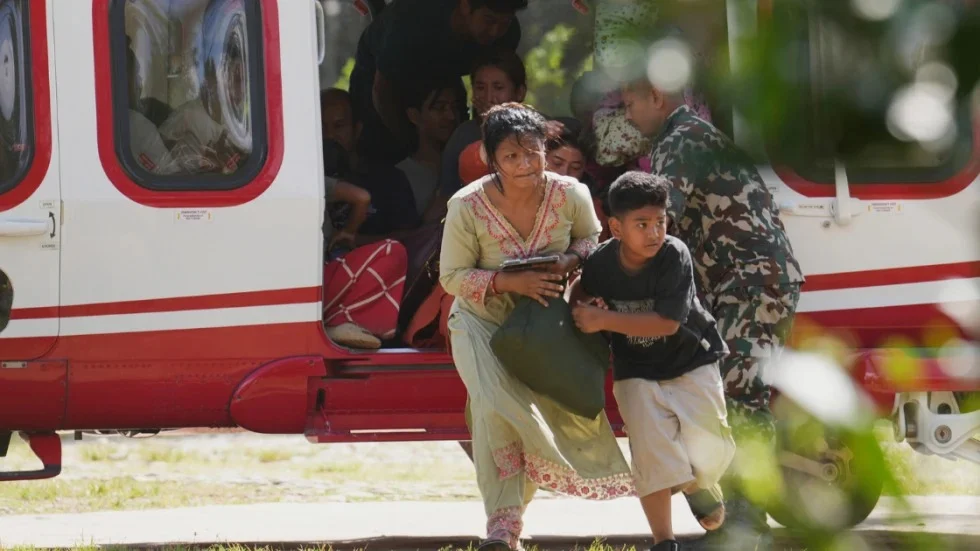
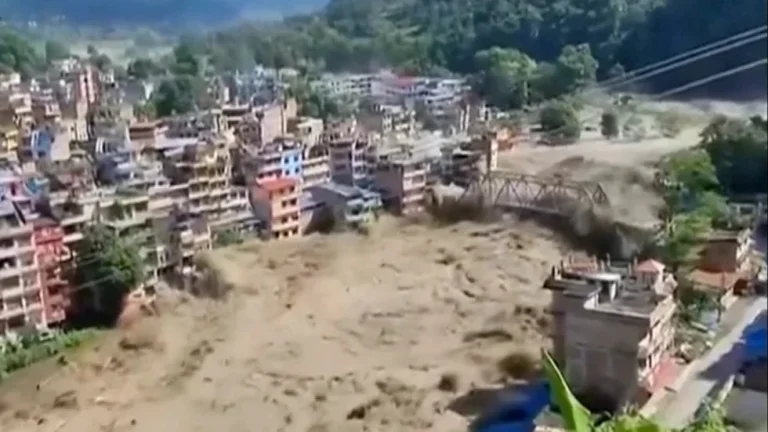
Humanitarian aid began reaching survivors in Nepal on Friday, following devastating flash floods that swept through the mountainous border region shared with China. As the scale of the disaster continues to unfold, thousands of people remain displaced, seeking refuge in makeshift military relief centers.
The U.N. agency for children has issued a stark warning, noting that at least 17,000 children are in urgent need of humanitarian assistance. The flooding has caused significant damage to educational infrastructure, with 18 schools destroyed and another 20 sustaining damage. Meanwhile, the International Red Cross estimates that at least 93,000 people have been affected by the disaster and are in “great need.”
Official figures from Nepal’s National Disaster Risk Reduction and Management Authority indicate the situation is worsening, with the number of missing persons doubling to just under 2,000. To address the crisis, 14,829 security personnel have been mobilized for search and rescue operations. These efforts include the deployment of drones to navigate and search areas that are otherwise too dangerous for ground teams to access.
In Nuwakot, one of the areas nearest to Kathmandu, the landscape has been transformed by thick mud and sediment after entire villages were wiped out. Survivors have congregated at roadside tea shops, while others are being processed at the Maithali Barrack, a military training facility repurposed as a shelter. The site has become a hub for relief efforts, with helicopters frequently transporting supplies and evacuees. Outside the facility, families gather along the perimeter, hoping to spot loved ones arriving on incoming flights.
Medical teams at the barracks are treating a diverse group of survivors, including local residents, foreign tourists, and Chinese workers rescued from the flood zone. An army medic noted that while most receive basic care, those with severe conditions—such as a pregnant woman who went into labor at the camp—are airlifted to nearby hospitals. The center also serves as a site of mourning, where recovered bodies are held behind tarps until they can be identified.
For many, the disaster struck with little warning. Chanda Lal Chitrakar, 62, recalled that he initially ignored government flood alerts, having survived previous seasonal flooding. However, within 45 minutes of the initial warning, he witnessed a massive surge of water from the hills that rose above the tallest trees. He managed to escape to a high hill behind a police station with only his cellphone and the clothes he was wearing. “When I reached the top, only then did I feel like I could breathe,” he said.
At a temporary distribution center in a local school, survivors received essential supplies like solar panels, clothing, and hygiene kits. Kanchi Nepali, one of the recipients, expressed the depth of the loss: “What I’ve been given today is worth more than a million. I have no food, no shelter, no utensils to cook with. Only my body survived.” The report also notes that chanda Lal Chitrakar, 62, told the AP that on the morning of the flood he paid little attention to the government flood warning messages being sent to his phone. The report also notes that he said, he saw an enormous cascade of water rushing from the hills, reaching so high he couldn’t see the top of the tallest tree near his home, after about 45 minutes. The report also notes that while the carcass of a dead buffalo lay on the ground, broken pieces of a golden temple were seen jutting out from the sand. The report also notes that waiting to see if their loved ones will arrive in the next helicopter, community members surround the barbed wire perimeter of the center. The report also notes that sitting at his riverside tea shop with friends as they watched the water rise, he’d lived through last year’s floods. The report also notes that he simply closed the doors and windows, when he received the warning messages ahead of the latest floods. The report also notes that the Associated Press’ climate and environmental coverage receives financial support from multiple private foundations. The report also notes that aP is solely responsible for all content.







Comments