
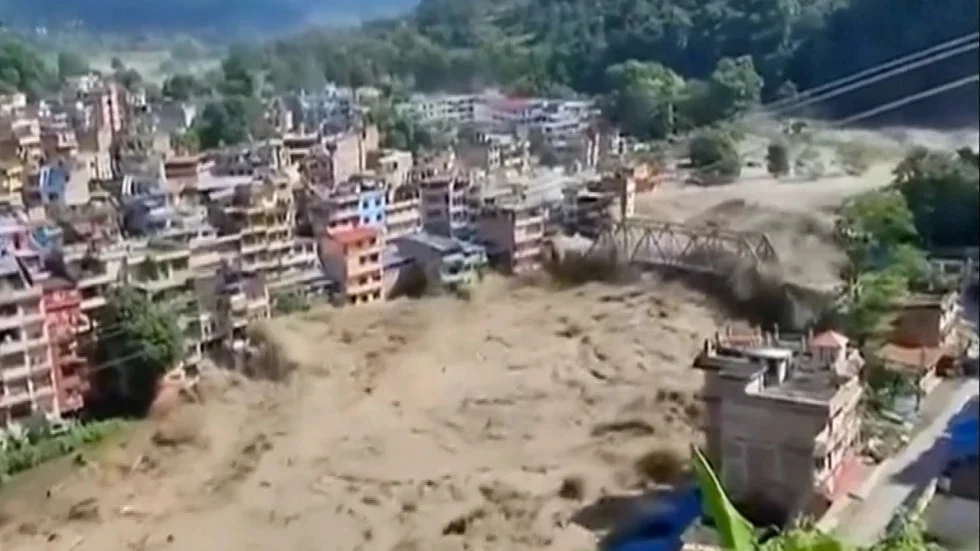
Preliminary investigations into the devastating flash flood that struck Nepal on Wednesday indicate the disaster was likely triggered when a massive section of a glacier broke off, temporarily obstructing a river. Experts believe this blockage caused water to back up before surging downstream with immense, destructive force several hours later. The U.S. Geological Survey identified a magnitude 5.2 glacier collapse, utilizing data from nearby seismic stations, long-period seismic waves, and satellite imagery to confirm the event.
The catastrophe has resulted in hundreds of deaths, with many individuals, including foreign nationals and pilgrims, still reported missing. As researchers continue to analyze ground-level and satellite data, they are piecing together the sequence of events that led to the surge. Jakob Steiner, a geoscientist at the University of Graz currently based in Bangladesh, described the scale of the collapse, noting that imagery suggests the lower portion of the glacier was severed as if cut by a massive blade. Steiner added that the impact of the ice mass falling from such a significant height likely created an effect comparable to an explosion.
Evidence suggests that a substantial volume of ice and rock plunged into the Lhende Khola, a tributary of the Bhote Koshi River. This displacement of water, combined with the collection of boulders and sediment, generated a powerful downstream flow. Researchers are currently evaluating whether the debris created a temporary dam that eventually burst, significantly magnifying the flood’s impact. In the affected region, water levels in local rivers rose by as much as 9 meters (29.5 feet) within just 30 minutes, leaving residents and visitors with virtually no time to escape.
While scientists urge caution against drawing an immediate, direct link between climate change and this specific event, they emphasize that rising global temperatures—driven by human activities like the burning of coal, oil, and gas—are increasing the frequency of such disasters. The Hindu Kush Himalaya region is warming at a rate significantly faster than many other parts of the world. Saswat Sanyal, a disaster risk reduction specialist at the International Centre for Integrated Mountain Development in Kathmandu, noted that while they must remain cautious, the region is clearly undergoing rapid transformation due to melting glaciers and shifting environmental conditions.
The impact on the region has been severe, with hundreds of homes destroyed and critical infrastructure, including roads, bridges, buildings, and hydropower dams, suffering extensive damage. Steiner pointed out that the affected valley contained roughly 10% of Nepal’s power production capacity. The area has a documented history of mountain hazards, including a 2025 glacial lake flood, a 2024 ice and rock avalanche, and the devastating avalanches that occurred during the 2015 earthquake.
The Hindu Kush Himalaya holds the largest volume of ice and snow outside the polar regions, with over 63,000 glaciers supporting the livelihoods, food, and water security of billions of people. However, approximately 78% of the glacier area situated between 4,500 and 6,000 meters above sea level is highly vulnerable to warming. Research indicates that ice-loss rates in these mountains have doubled since 2000. As glaciers retreat, previously insulated rock faces become exposed to warmer temperatures and cycles of freezing and thawing, while thawing permafrost further destabilizes slopes, increasing the likelihood of cascading hazards like debris flows.
Looking ahead, experts warn that these disasters may represent a new normal. United Nations reports highlight that between 2000 and 2019, glaciers lost 267 gigatons of ice annually. Even if global warming is limited to 1.5 degrees Celsius, projections suggest a loss of up to 50% of all glaciers outside of Greenland and Antarctica by 2100. Current global policies put the planet on a trajectory toward 2.8 degrees Celsius of warming by the end of the century.
Steiner expressed frustration over the slow pace of government action, noting that despite previous warnings, coordination among stakeholders remains insufficient. He emphasized that some regions of Nepal have reached a point of extreme risk where living is no longer viable. Moving forward, scientists stress that stronger early warning systems, improved monitoring of thousands of glaciers, and faster cross-border information sharing are essential to mitigate future risks in an increasingly unstable mountain landscape. The report also notes that “If you look at the imagery it’s like someone cut with a huge knife through the whole lower part and it fell off.”. The report also notes that resulting in the chaos that followed, steiner said a mass of glacial ice dropping from a great height could have felt like a bomb exploding. The report also notes that “We have to be cautious and not draw a connection yet. The report also notes that sudden rise in water levels gave no chance to escape. The report also notes that more than 63,000 glaciers in the area feed at least 10 major Asian river systems and support the food, water, energy and livelihood security of billions of people. The report also notes that “What happened yesterday is unfortunately the new normal. The report also notes that it’s going to get worse from here onwards,” Steiner said.









Comments