
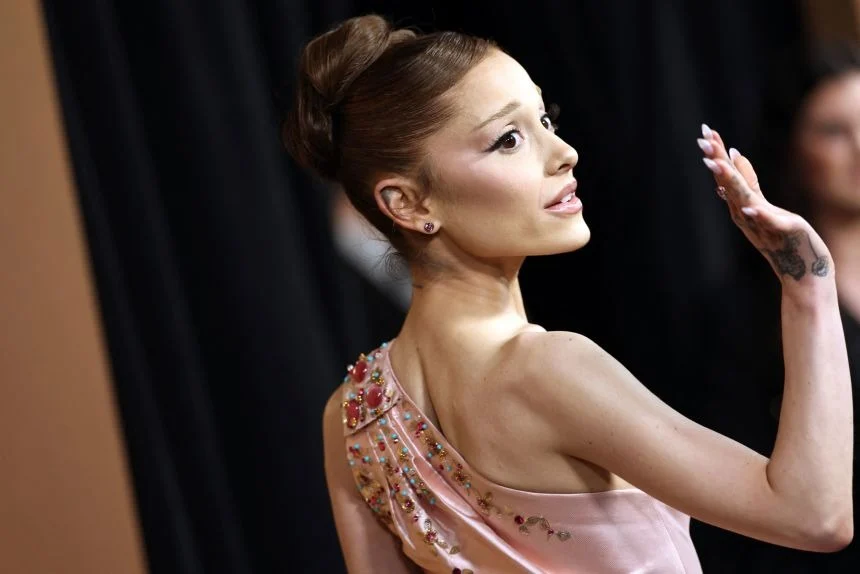
Ariana Grande announced on Sunday that she will be taking a step back from visibility, confirming plans to suspend future public appearances once her current summer tour concludes. The announcement, provided by her representative in an exclusive statement to People magazine, comes shortly after the release of her music video for the single “Petal.” The video, which features the 33-year-old singer in a frame that drew significant attention from fans and critics, has reignited long-standing public discourse regarding her weight and health—a topic that has followed the performer since she was a teenager.
On Monday, while in Chicago, Grande addressed the announcement, clarifying that her decision to retreat from public life had been planned for some time. Her representative declined to provide further details. Beyond the conclusion of her tour, which the statement noted would end “healthily and happily,” Grande has canceled her participation in the upcoming West End revival of Stephen Sondheim’s “Sunday in the Park with George.” It remains unclear whether she will participate in the promotional tour for the film “Focker-in-Law,” co-starring Ben Stiller, which is scheduled for a November release. The statement emphasized that she is turning away from “endless, ongoing public scrutiny.”
The speculation surrounding Grande highlights a broader, often contentious debate about the public’s role in monitoring the bodies of celebrities. This tension is underscored by historical precedents, such as the death of Karen Carpenter 43 years ago. Carpenter, who was 32 at the time of her passing, died from heart failure linked to anorexia and bulimia. Writing for the New York Times in 2010, James Gavin noted that by the mid-’70s, it became “painfully clear” that Carpenter was suffering, as audiences watched her “wither away before their eyes.” In a 2022 CBS interview, her brother and bandmate, Richard Carpenter, reflected on her struggle, stating, “I don’t think her illness was handled properly.”
Public scrutiny can also lead to misplaced assumptions, as seen in 2020 when actor Chadwick Boseman faced intense online speculation regarding his weight. Critics focused on his appearance in an Instagram video, unaware that the Black Panther star had been privately undergoing treatment for colon cancer since 2016. Following his death at age 43, many observers condemned the earlier body-shaming directed at him. At the time, health coach Kelly Coffey remarked to Business Insider that the criticism demonstrated how superficially people judge others based solely on online imagery.
Grande has previously attempted to set boundaries regarding her body image. In 2013, at age 19, she addressed rumors on Tumblr, explaining that her weight loss was the result of healthier lifestyle choices rather than an eating disorder. A decade later, she posted a video on TikTok urging the public to be “gentler and less comfortable commenting on people’s bodies, no matter what.” Despite these requests, her appearance remained a subject of intense debate, particularly in 2025 during the promotional tour for “Wicked: For Good,” when she and co-star Cynthia Erivo were subjected to widespread commentary about their thinness.
Parent coach Oona Hanson, who specializes in eating disorders, noted in a previous interview that such images can be triggering for families. “Regardless of what the actual medical or health status is of these actresses, which we don’t know, the ultra-thin images, I think, are very painful and can be triggering to someone who has, let’s say, seen their child become emaciated from an eating disorder,” Hanson stated. The recent release of the “Petal” video and the ongoing Eternal Sunshine Tour, which concludes in London on September 1, have further fueled these concerns.
Recovery advocate Charli Howard criticized the imagery in the “Petal” video on Instagram, writing, “WHAT YOU SEE HERE IS NOT NORMAL” and arguing that it is vital to discuss the potential damage such content can cause to young viewers. Actress Jameela Jamil also weighed in, suggesting that the singer’s team was “irresponsible” for allowing such an image to be glamorized. However, Jamil’s use of the word “possibly” acknowledged a fundamental reality: no one outside of Grande’s personal circle has access to the truth regarding her health, leaving the public to navigate the space between private reality and visible image. The report also notes that who developed an addiction to Quaaludes under the strain of stardom, said he had made peace with his past except when it comes to his sister’s death, richard Carpenter. The report also notes that but then it’s only been six years since the press and public got caught up in a frenzy of gossip and guesswork about Chadwick Boseman’s appearance in an April 2020 Instagram video for Jackie Robinson Day — focusing not o. The report also notes that in 2013, when she was 19, Grande wrote on Tumblr that while she didn’t “usually like to address rumors,” she “felt like since some of you are worrying about me that I should take the time to write you all a little note t. The report also notes that the pop star had just released the music video for her latest single, “Petal,” which showed her always petite frame ridged with shadows of the bones of her chest. The report also notes that fans, critics and consumers of celebrity news responded with a chorus of dismay or alarm. The report also notes that and with arguments about whether it’s right or wrong to speculate, the space between those two premises is filled with speculation. The report also notes that but then it’s only been six years since the press and public got caught up in a frenzy of gossip and guesswork about Chadwick Boseman’s appearance in an April 2020 Instagram video for Jackie Robinson Day — focusing not on the charitable initiative the Black Panther star was announcing, but on how suddenly skinny he looked. The report also notes that people on mass media and social media alike then condemned what they viewed as the body shaming of the beloved star.


Comments