
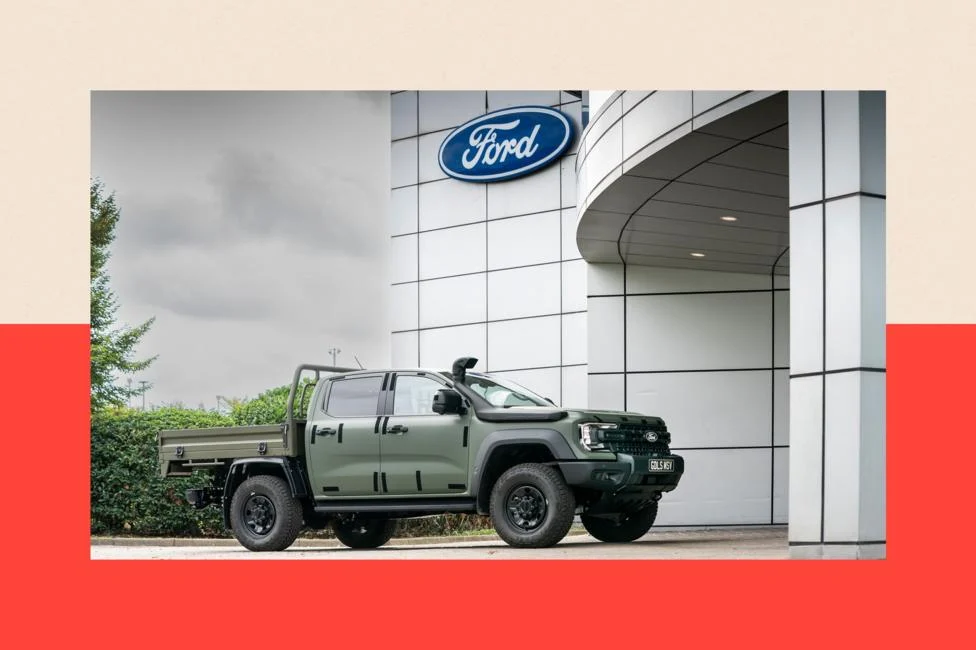
Struggling with a decade of declining output and intensifying pressure from Chinese competitors, major European automotive manufacturers are pivoting toward the defense sector. Ford, Renault, and Jaguar Land Rover (JLR) are among the firms eyeing military contracts to utilize underused factory capacity and revitalize their flagging supply chains. This shift recalls the industrial mobilization of World War II, though executives caution that such moves are not a total solution to the broader challenges facing the automotive market.
At Ford’s Dagenham plant in East London, the company is preparing for potential military work. The site, which was a hub for mass production between 1939 and 1945—churning out 360,000 vehicles and 34,000 Merlin engines for Spitfire and Hurricane fighter planes—has seen its civilian diesel engine output drop from 90,000 to approximately 45,000 annually over the last ten years. Currently, Ford is participating in a joint venture with General Dynamics and Ricardo to bid for a Ministry of Defence contract. The goal is to supply 9,000 vehicles over five to seven years to replace the British Army’s aging Land Rover-based fleet.
Lisa Brankin, chair of Ford UK, described the bid as a significant opportunity to demonstrate the agility of their manufacturing workforce. She noted that while the automotive and defense sectors are distinct, they share critical requirements in logistics, industrial assets, and advanced manufacturing expertise. However, Brankin admitted that while exploring such opportunities is necessary, defense contracts alone will not address the massive underutilization currently plaguing European manufacturing capacity.
The push into defense is echoed across the continent. French manufacturer Renault has partnered with the defense giant Thales to produce military-grade drones, aiming for an output of 1,000 units per month. Meanwhile, Volkswagen is set to transform an underutilized factory in Osnabruck, Germany, into a military manufacturing center. These moves come as the European auto industry faces a “perfect storm” of obstacles, characterized by rising costs, changing consumer demand, and the dominance of Chinese high-tech electric vehicles.
The urgency is particularly acute for the UK supply chain. Mike Hawes, chief executive of the Society for Motor Manufacturers and Traders (SMMT), noted that domestic automotive output has plummeted by half over the past decade. JLR, a pillar of the UK sector, recently announced it would cut 4,000 jobs from its 30,000-strong workforce to remain competitive. JLR is also bidding for the same military vehicle contract as Ford, as the Army moves to retire its current fleet by 2030.
Industry leaders are increasingly vocal about the fragility of the sector. A recent open letter from executives representing over 8,600 employees, alongside the Confederation of British Metalforming, warned that these job losses represent the “first visible crack” in a supply chain supporting roughly 183,000 manufacturing roles. Suppliers are urging the government to facilitate a transition into aerospace and defense to sustain their operations as civilian car production remains in a state of terminal decline.
This crisis stands in stark contrast to the early 2000s, when Western firms viewed China as a massive growth market. State-backed investment has since transformed China into a global leader in electric vehicle technology, resulting in an overloaded market and a surge of Chinese-made vehicles entering Europe. As manufacturers grapple with this shift, some have sought partnerships, such as Stellantis taking a 20% stake in Chinese EV maker Leapmotor, and Volkswagen considering sharing European factory space with Chinese joint-venture partners to maximize efficiency. The report also notes that ford’s latest vehicle looks like a pick-up truck that has been through an Incredible Hulk transformation. The report also notes that this beefy number parked outside the front door of Ford’s Dagenham plant can carry a load of two tonnes, tow up to four tonnes and is also shouldering the hopes of the 2,000-strong workforce that still makes engines here, based on its popular Ranger series. The report also notes that the three-litre diesel engines that will power this camo-painted beast drift down a production line that has seen output cut from 90,000 engines a year to about half that over the last decade, inside the factory. The report also notes that ford is hoping that a pivot towards military vehicles can help fill the void created by what the company’s UK boss calls the most challenging environment since the invention of the motor car. The report also notes that once mighty, the European car industry is starting to look puny and is hoping surging defence budgets as Europe re-arms can help it flex its industrial muscles once more. The report also notes that lisa Brankin, chair of Ford UK, says it is a chance to showcase their abilities to respond quickly to defence needs: “As a manufacturer you look at every opportunity that comes at you and this is a great opportunity that we would love to take advantage of. The report also notes that ford workers in Manchester manufactured 34,000 Rolls-Royce-designed Merlin engines, which powered Spitfires and Hurricane fighter planes.








Comments