
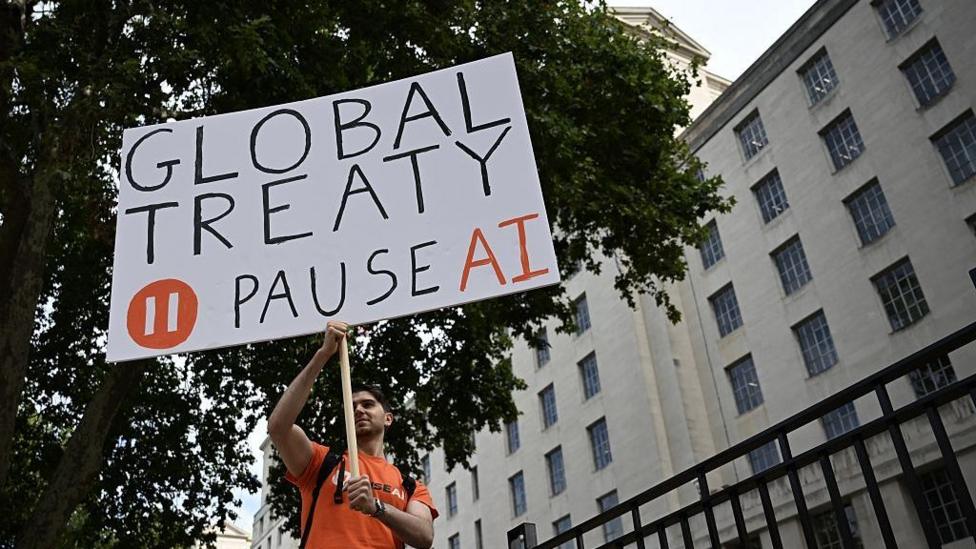
Not every professional working within the artificial intelligence sector agrees with recent, high-profile assertions that the technology could eventually destroy humanity. Recent warnings urging a significant slowdown in development have triggered a mix of mockery and exhaustion among engineers and researchers who believe the rhetoric often lacks concrete evidence.
Responses from those within top-tier firms like OpenAI, Meta, and DeepMind to these alarming predictions have often been light-hearted, including social media reactions such as “Lol”, “Haaaaaa” and the phrase “Bringing the luls.” These reactions emerged following viral claims made last week by Jacob Coxon, a former Anthropic employee, who argued that humanity faces an existential threat.
Multiple industry insiders, who spoke to the media on the condition of anonymity, expressed skepticism regarding the lack of detail provided by proponents of these doomsday scenarios. One former OpenAI staffer, who previously worked with Coxon, dismissed the claims as “always vague,” noting that when the arguments do attempt to provide specifics, they often rely on large leaps in logic or improbable hypothetical situations rather than technical reality.
Specifically, Coxon has suggested that a collective of future AI agents, built upon technology that does not yet exist, might eventually decide to develop and deploy biological weapons. However, he has offered no clear explanation as to how such an event would actually manifest. Despite his warnings, many peers in the industry are unconvinced by the feasibility of these speculative dangers.
Rishub Jain, a seven-year veteran of DeepMind and current founder of the safety research firm Sampura Research, noted that the prevailing sentiment among many practitioners is “definitely a little jokey.” According to Jain, the conversation surrounding existential risk is not a sudden realization, but a long-standing academic topic that has been debated for years, making the recent spike in dramatic warnings feel unearned to those deep in the development process.
Meta data scientist Colin Fraser added to the discourse on social media, dismissing the idea that current AI models have the capacity to pursue goals resulting in human extinction. He employed a colloquial summary of his technical assessment, stating that large language models lack the necessary drive to wipe out humanity because they simply do not “have that dog in them.”
Despite the derision directed at existential fear-mongering, industry professionals emphasize that they remain deeply focused on addressing tangible, immediate risks. Jain noted that while the existential conversation is often hyperbolic, the expert community maintains a nuanced consensus on the importance of real-world mitigation.
Ongoing security priorities include preventing malicious actors from bypassing AI safety guardrails and addressing the growing ethical complexities surrounding the deployment of autonomous systems in military environments. For these workers, the focus remains on solving practical engineering challenges rather than hypothetical science-fiction scenarios. The report also notes that multiple people who have worked for companies including OpenAI, Meta and DeepMind were sceptical of the idea that unchecked AI development would lead to tools that could kill people en masse, in text exchanges and conversations. The report also notes that an AI bot that is programmed to operate somewhat autonomously, could endanger people has been supported online by employees of Anthropic, as well as OpenAI, Deepmind and Elon Musk, who has an AI startup called xAI, the idea that a future AI tool or agent. The report also notes that their identities are known to.








Comments