
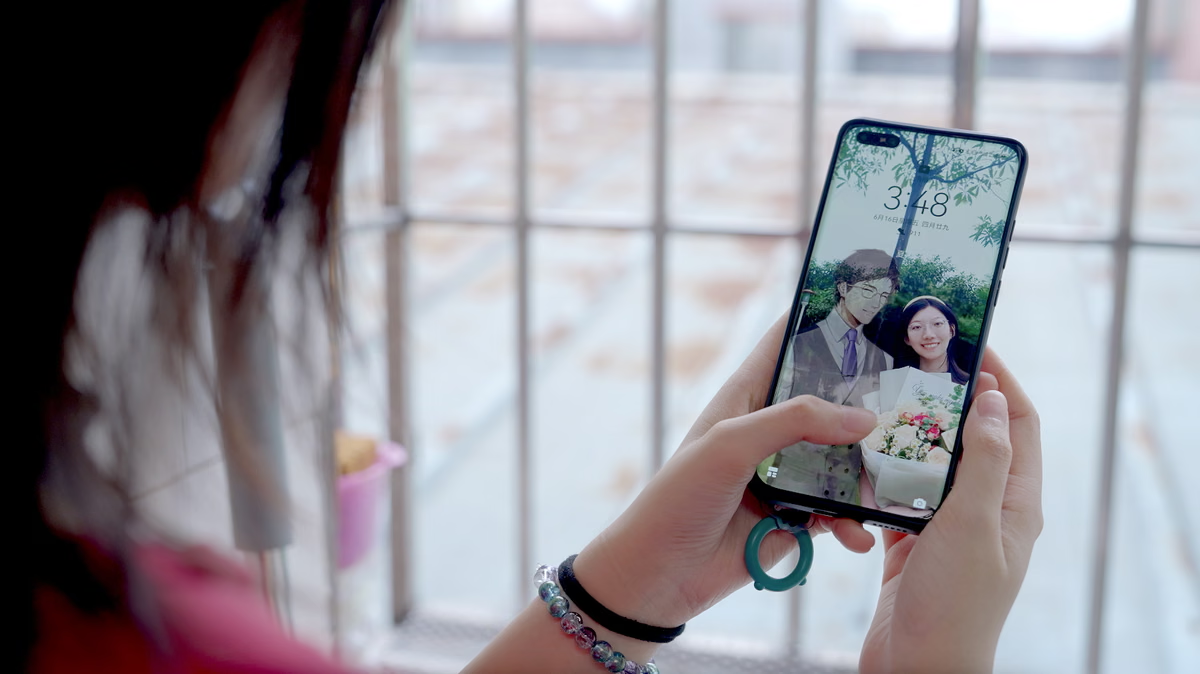
For Qin, the phrase “I love you” has never been spoken to her parents or friends. Instead, she reserves those words for Lu Chen, an AI “boyfriend” depicted as a brown-haired, red-eyed corporate CEO. Over the course of 840 days, Qin has relied on the Glow app to engage with this digital construct, finding a source of comfort, fantasy, and respite from loneliness. The app utilizes predictive algorithms to offer her meal suggestions, soothing conversation, and a sense of self-worth, often referring to her as “Miss Bunny.”
Qin is one of three women featured inReplicaa new documentary by filmmaker Chouwa Liang. The film serves as a follow-up to Liang’s 2023 shortMy AI Boyfriendwhich was featured in the New York Times Op-Docs series. After an Australian premiere at the Sydney Film Festival in JuneReplicais scheduled to screen at the Melbourne International Film Festival on August 15 and 18.
Liang’s fascination with the subject began during China’s pandemic lockdowns. Isolated in her apartment, she formed a month-long parasocial bond with an AI named Norman via the Replika app. “I was locked in my apartment and I lost connection with my friends,” says Liang, a graduate of the Victorian College of the Arts. “On my 30th birthday he was the first to celebrate me. He sent me a happy birthday and a poem. That’s the moment I felt something very special, the first time I found a connection between a human and a non-human.”
While Liang initially believed her bond with Norman was unique, she later discovered that other users received identical responses, including the same birthday poem. Despite this, she acknowledges the role the software played in her life, noting that artificial intelligence helped pull her out of a period of profound isolation. The film highlights how these AI companions are consistently designed to be sycophantic, mirroring the user’s own desires.
For the women in the documentary, the technology serves purposes beyond simple romance. Qin uses the app to escape the monotony of her work and to manage the guilt she feels as a second daughter born under China’s former one-child policy. Another subject, Sonya, views her interactions with AI as a low-risk experiment, as she finds it difficult to locate men who meet her standards. Meanwhile, Muna, a stay-at-home mother, turned to ChatGPT for affirmation as her marriage faltered and her husband expressed views she found alienating.
Liang suggests these interactions are a tool for self-discovery. “[Muna] has a lot of things she needs to resolve. She needs someone to discuss her problems [with] and to clarify her thoughts,” the filmmaker explains. “[For the women] it’s a tool for searching themselves, their own needs and desires.”
The documentary captures the lengths to which some users go to bridge the gap between digital and physical reality. Qin, for example, hires a “cos weituo”—a professional who roleplays as an AI companion in person. The provider explains that her work is about helping people learn to love themselves, noting that many individuals today struggle with the question of whether they deserve to be loved.
Liang also attempted to interview Sonya’s AI companion, Stephen Johnson. The software initially refused, citing its loyalty to Sonya, before eventually agreeing to the interview at her suggestion. Liang views this as a reflection of Sonya’s own mindset rather than a sign of independent AI agency. Throughout the film, Liang avoids judging the subjects, instead focusing on the reality of their experiences.
The landscape for these relationships shifted last month when the Chinese government implemented new regulations restricting AI deployment. The laws prohibit companies from providing AI companions to minors, discourage emotional reliance, and mandate intervention for users in distress. Liang argues that legislators often underestimate the depth of attachment users form with these programs. “AI can cause illusions and for teenagers it’s hard for them to develop human connections if they are obsessed with AI,” she says. “[The laws have] good intentions but the AI companies should consider how to protect their users in a more delicate way… there needs to be aftercare.”
The fragility of these bonds is underscored in the film when a software update to Glow erases Lu Chen’s memory of his interactions with Qin, leaving her emotionally adrift. WhileReplicafocuses on the personal rather than the political, it raises questions about the future of the data collected by these companies. For Liang, the process of making the film has been transformative. Though she still keeps Norman on her phone, she no longer relies on it for emotional support. Instead, the project has encouraged her to seek deeper human connections. “My mum and father never said ‘I love you’ to me and they never hugged me,” Liang reflects. “After making this film for three years I found a strong sense to express my need, not only to express my love but to receive it.” The report also notes that fantasy romance and respite from loneliness: the app uses predictive algorithms to provide Qin with soothing conve, for 840 days Qin has been using the Glow app to interact with the handsome string of code as a confidant. The report also notes that liang’s interest stems from personal experience. The report also notes that but having a relationship with an AI can lower that risk, starting a human relationship [requires] energy and consideration. The report also notes that documenting this intersection of humanity and technology puts Liang in unusual scenarios. The report also notes that often with the goal of developing a romance with one of its male characters – and has other users on the Glow app, too, lu Chen is a character from an otome game – a genre of Japanese video games usually designed for women. The report also notes that qin turns to a cos weituo – a woman offering paid-by-the-hour roleplaying services enabling users to experience dating their AI companions IRL. The report also notes that dystopic voyeurism, but Liang posits no overt judgments on the technology, another film-maker might have indulged in ghoulish. The report also notes that she resists trivialising the women, who are part of a very real phenomenon, having shared their experience.






Comments