
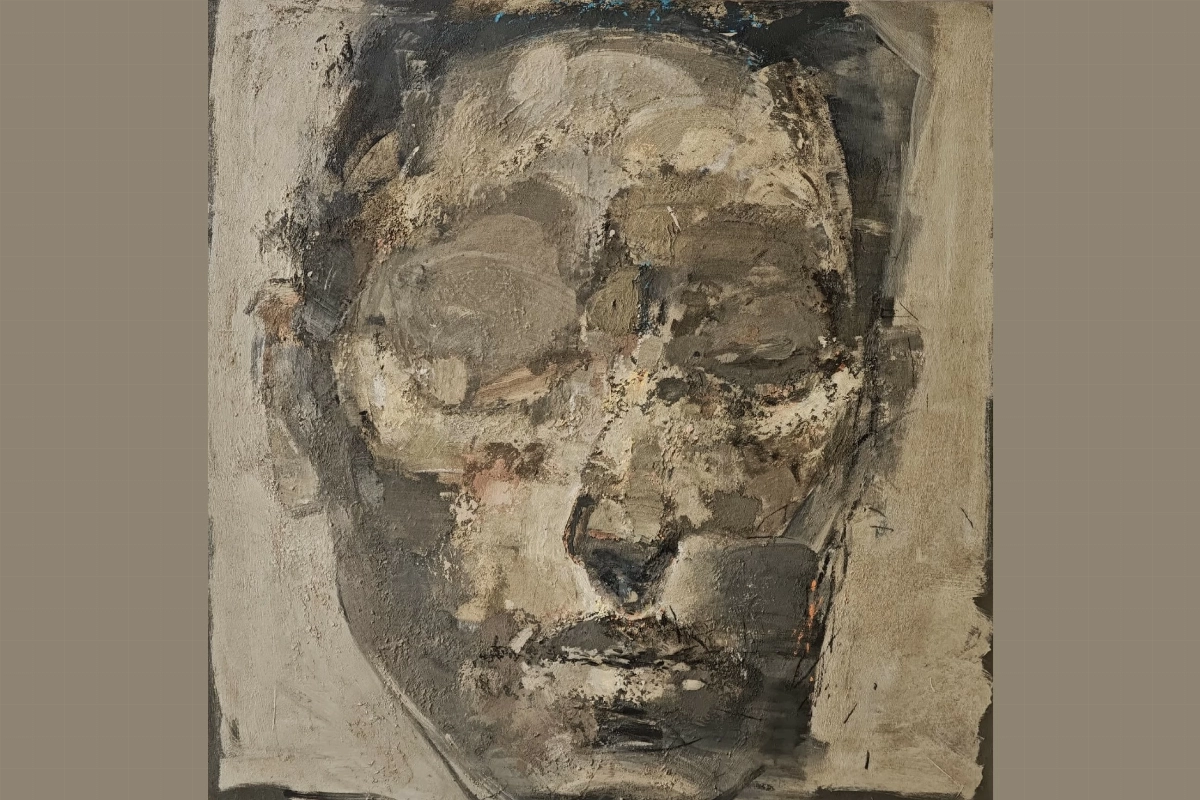
Firetti Contemporary has unveiled The Living Archive, a comprehensive solo exhibition by Syrian artist Ahmad Tallaa, scheduled to run from September 21 through November 11. This showcase represents the most extensive collection of Tallaa’s work to date, featuring a diverse array of large-scale portraits, sculptures, artist books, works on paper, and an intricate tile installation. Curator Celine Azem notes that the exhibition explores a specific type of knowledge that defies verbal expression, stating, “There is a particular kind of knowledge that cannot be spoken, only carried.” According to Azem, the work focuses on the residue of survival rather than a simple record of historical events, highlighting how human experience manifests in physical gestures and the lines etched into a person’s features over time.
The exhibition challenges traditional notions of the archive, presenting it not as a static collection but as a dynamic, evolving entity. Tallaa investigates how time alters human traces and how these marks are carried forward. The artist books, constructed from raw canvas, recycled materials, and pigment, serve as the conceptual bedrock of his practice. These objects, displayed on plinths, function as a hybrid between diaries and experimental records, inviting viewers to engage with a process of constant revision where forms emerge organically from the material rather than following a predetermined plan.
Tallaa’s portraits move away from conventional representation, as he does not aim to capture a specific individual’s likeness or psychology. Instead, he views the face as “a trace of human experiences, a document, and a witness to a specific time.” These works are built from a dense, sculptural mixture of acrylic, glue, pigments, chalk powder, and sand gathered in the UAE. By incorporating local sand into his process, Tallaa bridges his current environment in the Emirates with the memories of his upbringing in Syria, physically binding his past and present within the texture of the art.
The artist characterizes his subjects as witnesses rather than victims or survivors. This perspective is further explored through a tile installation composed of recycled wood panels. By layering charcoal, sand, and pigments, Tallaa creates faded, near-erased faces that suggest transformation rather than disappearance. This theme of resilience is echoed in his sculptures, where fissured, eroded heads are often depicted in sleeping positions. These figures exist in a state of transition—hovering between silence, rest, and the instability born from the artist’s experiences living under the shadow of conflict in wartime Damascus.
Tallaa’s creative process is deeply physical, involving the fabrication of his own tools and a studio practice defined by inquiry. His compositions are shaped by the resistance of his materials and the passage of time, resulting in surfaces that appear to be in a perpetual state of emergence or dissolution. This approach reflects the lasting imprint of displacement and the sensory textures of his early life in Damascus, where the visual language of rubble and ruin informs his aesthetic of presence and erasure.
Reflecting on the exhibition, writer Veronica Azzari observes that for Tallaa, an archive is a living organism that continues to shape the present. “Every experience leaves a mark, every wound reshapes matter, every passing moment rewrites identity,” she notes. Born in Damascus in 1994, Tallaa is a graduate of the Faculty of Fine Arts in Damascus. His professional recognition includes receiving the Spring Annual Exhibition Award for Best Artwork from the Syrian Ministry of Culture in both 2017 and 2019. The artist is currently based in Sharjah, UAE.
Tallaa describes the face as “neither a victim nor a survivor”, but as a witness.
It is seen in the way a person holds their shoulders, in the lines that deepen around the eyes, in the gestures that return long after the circumstances that shaped them have passed.
Tallaa asks: what does time leave behind, and what happens to those traces as they are carried forward?
Rather than treating the archive as a fixed repository of the past, he approaches it as something living – altered by time and continually transformed through the bodies and materials that carry it.
A single mark may occupy a page; elsewhere, paint sits beside a scratched line or unfinished form.
Alongside, smaller studies on paper appear too.
They retain the message, at different speeds and scales.
Faces appear as though excavated rather than painted; features surface and dissolve, while forms unite only to fragment again.
The sand carries a particular geographical significance.
His figures bear evidence of pressure without being reduced to suffering; their fissures and eroded features register what they have passed through, but preventing that history to define them entirely.
Individually, the panels appear as fragments; together, they form a field of presences on the edge of clarity.
With each repetition the face changes, suggesting that deterioration need not mean disappearance, but transformation.
Sleep resists a single interpretation; it can hover between withdrawal, profound rest, silence and transience.
Balanced atop scored cylinders and rough stone forms, the heads occupy a similar threshold: between formation and collapse, emergence and dissolution.
He does not have the mind map of a completed piece of work.
Tallaa suggests that the archive is not what we preserve on a shelf, but what we continue to carry within ourselves…





Comments