
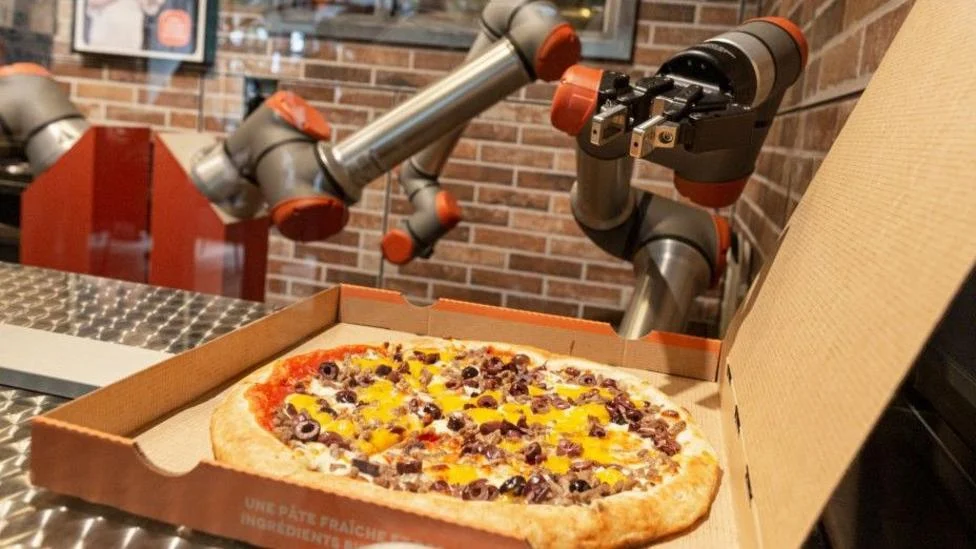
The promise of fully automated pizza production has hit a series of significant roadblocks, leaving many to question if the technology is truly ready for the mainstream market. A string of business collapses has soured confidence in the sector, with several once-promising ventures shuttering their operations entirely.
For Lee Kindell, founder and chief executive of Moto Pizza in Seattle, the reality of robotic integration proved costly. His restaurant previously utilized a pair of robots to assemble pizzas, but the machines were rendered “basically useless” in May when their supplier, Picnic, abruptly ceased operations. The sudden shutdown left Kindell with $160,000 (£118,000) worth of cabinet-like equipment and no technical support. Reflecting on the experience, Kindell expressed deep hesitation about future partnerships, noting that the failures have made him wary of relying on external providers.
The landscape of pizza robotics is littered with similar cautionary tales. Companies such as Zume, Pazzi, and the vending machine purveyor Basil Street have all come and gone, struggling to move beyond the experimental phase. Sara Senatore, a senior restaurants analyst at Bank of America, notes that the industry has yet to see the success stories that many initially anticipated. She points out that food preparation bots often struggle with precision, occasionally dropping ingredients in the wrong locations, whereas human workers remain highly efficient at the craft.
Despite these setbacks, some entrepreneurs remain undeterred. Kindell is currently developing his own proprietary pizza-making robot, inspired by the mechanics of 3D printers. While he admits to having no formal background in robotics, he believes that the data gathered from failed ventures has paved the way for future breakthroughs. He aims to have a functional, fully autonomous version of his machine ready by the summer of 2027.
Proponents argue that automation does not necessarily signal the end of human employment in the sector. During his time using Picnic robots at T-Mobile Park, home of the Seattle Mariners, Kindell observed that while the number of staff required to assemble pizzas dropped from ten to two, the remaining employees were redeployed to customer-facing roles. This shift allowed for faster service and more personal interaction with stadium guests.
Efficiency remains a primary driver for the industry. Last year, the Canadian firm Appetronix installed a 24/7 robotic unit at the John Glenn Columbus International Airport for the Donatos chain. CEO Nipun Sharma says his team is now focused on increasing production speed, exploring methods like “shower head” sauce dispensers that could cut application time from 9.5 seconds to just 1.5 seconds. They are even investigating the use of lasers and ultrasound to slice pizzas more rapidly than traditional blades.
However, the push for automation faces a cultural divide. Traditionalists like Paul Giannone, owner of Paulie Gee’s, maintain that the human element is non-negotiable. Giannone has long vowed never to use robots, emphasizing that his restaurants prioritize personal customer service. Senatore agrees, warning that removing humans from the process is a risky proposition that could strip a restaurant of its “human touch” and leave customers stranded if a machine malfunctions.
Even as some companies fail, their intellectual property continues to fuel innovation. Miso Robotics, the California-based firm behind the French fry-cooking bot “Flippy,” recently acquired more than 300 patents formerly owned by Zume. Rich Hull, chief executive of Miso Robotics, believes the original vision for robotic pizza was brilliant but simply arrived too early for a market that was not yet ready. He views the acquisition as a learning opportunity to expand his company’s capabilities.
Ultimately, the debate over whether a machine can replicate the quality of a hand-crafted pie continues. While some, like Sharma, argue that chains require the consistency that only robots can provide, others remain skeptical of the technology’s long-term viability. For Kindell, the question is no longer if a fully autonomous pizza robot will succeed, but rather who will be the first to perfect it. The report also notes that robot pizza makers have struggled to make money. The report also notes that the sauce and cheese modules â even the pepperoni-sprinkler. The report also notes that i don’t know if I want to do a partnership again because of the failures,” he says. The report also notes that it’s proved harder than many expected, although so-called fast food might seem an easy target for automation. The report also notes that plus, bringing robots into pizza restaurants could take away entry-level jobs in the hospitality sector. The report also notes that her employer has financial interests in multiple high street pizza chains including Papa Johns and Domino’s. The report also notes that let’s say, a type of kiosk, put in your order, and it makes a fresh pizza,” he tells, i want to be able to walk up to. The report also notes that he declines to share details but the contraption will make square pan-style pies and that the machine is inspired by the way 3D printers work.






Comments