
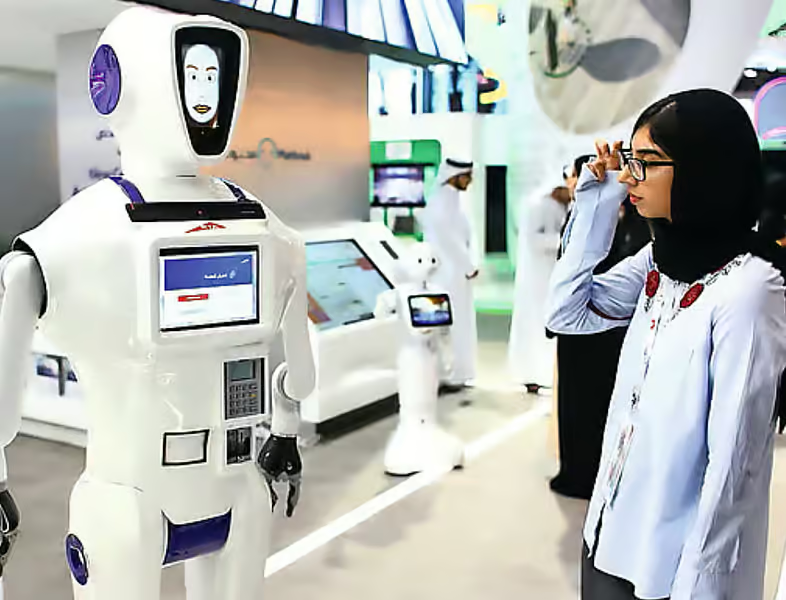
The professional landscape is undergoing a rapid transformation driven by the integration of artificial intelligence and the emergence of new sectors within the green economy. According to the World Economic Forum’s Future of Jobs Report 2025, nearly 40 percent of core professional skills are projected to shift by 2030. Rather than viewing this technological disruption with apprehension, the younger generation in the UAE is actively leveraging these changes to pivot, adapt, and define their career trajectories.
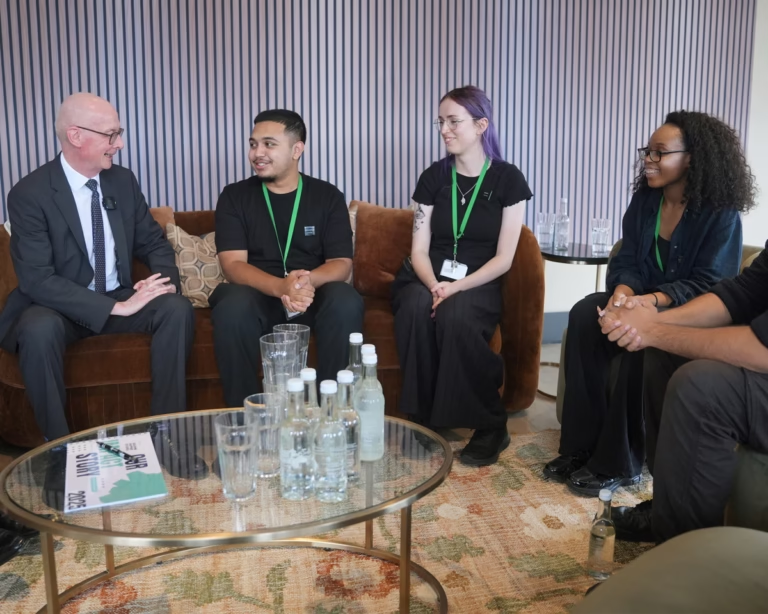
Razan Bashiti, CEO of the non-profit organization Injaz UAE, has observed this shift firsthand over her two-decade career. She emphasizes that the most valuable assets for a 2026 graduate, whether from high school or university, are judgement, adaptability, and the capacity to navigate complex problems that lack a pre-defined playbook. Through Injaz programs, students are encouraged to take on leadership roles such as CEO or CFO, pitching their own business ventures to real-world investors. Several student teams have already successfully secured funding through platforms like Shark Tank Dubai.
Bashiti notes that the current generation’s willingness to treat setbacks as learning opportunities is a significant strength. She frequently observes students receiving critical feedback on their projects, only to refine their ideas overnight and return with improved solutions. This resilience, she argues, is a vital trait in an era of constant change.
While some fear that AI might diminish the importance of communication, Omar Chihane, Global General Manager of TOEFL at ETS, argues that the opposite is true. Although AI can perform instantaneous translations, he maintains that meaningful human connection remains dependent on critical thinking, clear communication, and the ability to build trust. Consequently, English proficiency remains a cornerstone of international business, research, and collaboration.
Chihane highlights that modern employers in the UAE are seeking more than mere technical or grammatical competence. They prioritize graduates who can actively listen, collaborate across diverse cultures, simplify complex concepts, and articulate ideas with confidence. This sentiment is echoed by Hayder Almazraqchi, Careers Advice and Guidance Manager at the University of Birmingham Dubai, who stresses that universities must go beyond traditional instruction. He notes that while a degree provides a starting point, it is adaptability that ensures long-term professional relevance. His institution embeds employability into its curriculum by fostering digital fluency and collaborative problem-solving skills that transcend specific job titles.
The responsibility for this evolution is shared by the private sector as well. Muhammad Abdulrahman, Vice President of Empowerment Services at Maximus Gulf, asserts that investing in continuous learning is no longer optional but essential for both individual and community growth. He emphasizes that a career path does not just impact one person, but serves to stabilize families and fuel broader economic development.
Similarly, Amel Chadli, President of the Gulf Cluster at Schneider Electric, points to the surging demand for expertise in automation, electrification, and digital energy across the Gulf region. As the United Nations marks World Youth Skills Day under the theme ‘Skills for a Shared Future,’ it is evident that the next generation in the UAE is not merely waiting for the future to arrive, but is actively leading the transition through proactive skill development and a commitment to lifelong learning. The report also notes that two tankers on fire after hitting mines in Strait of Hormuz: IRGC. The report also notes that fire at Kuwait residential complex under control after Iran drone attack. The report also notes that bahrain, Kuwait, Jordan deal with attacks after US launches new strikes on Iran. The report also notes that iran security chief says US to face new war strategy after strikes. The report also notes that renewed campaign won’t last long, trump says prepared to strike Iran again. The report also notes that stay up to date with the latest news. The report also notes that what she has observed gives her reason for optimism.







Comments