
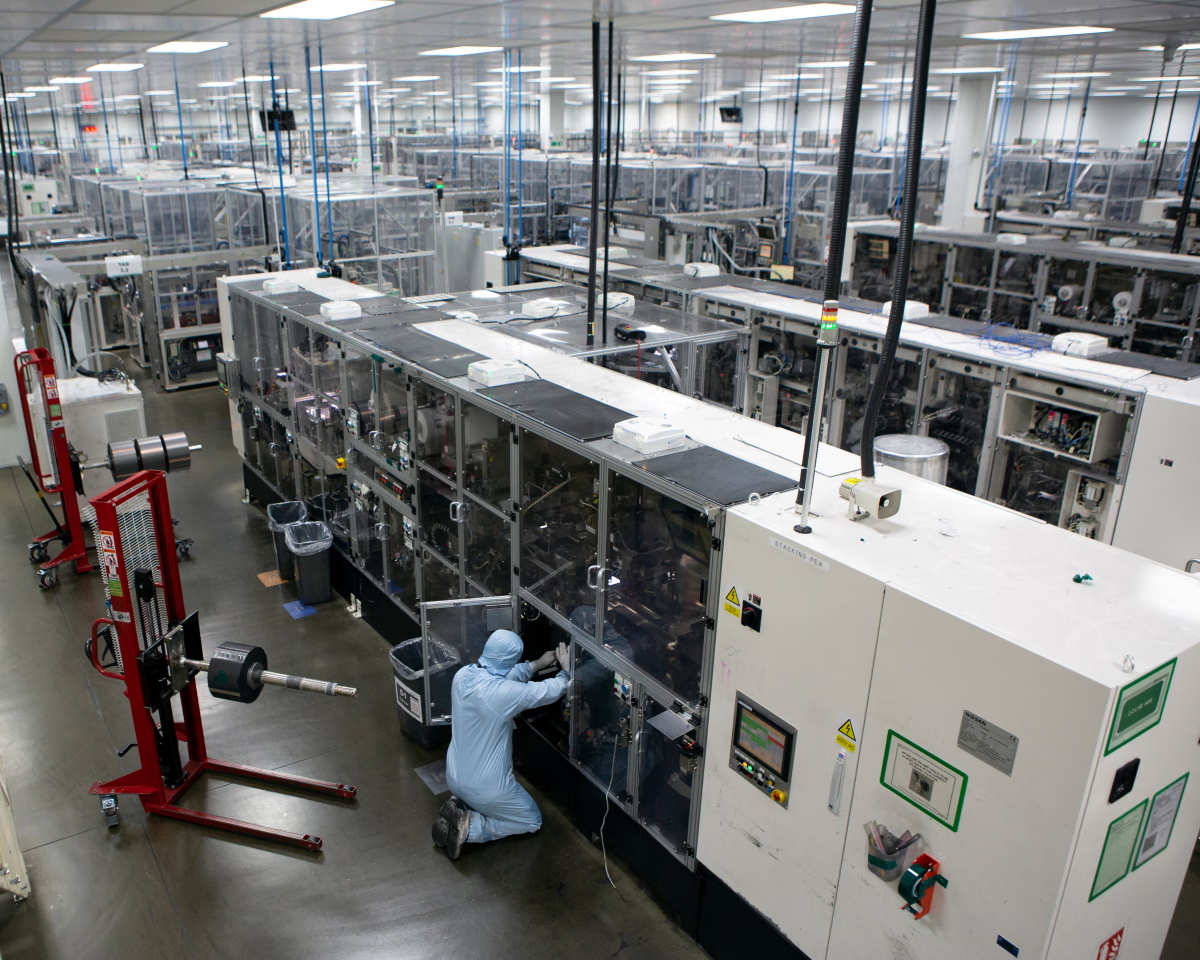
The UK’s largest gigafactory has shelved plans to expand production in Sunderland due to stalled negotiations regarding a supply deal for electric car batteries with Jaguar Land Rover (JLR). Chinese-owned AESC, which currently produces batteries for Nissan at its facility adjacent to the Japanese carmaker’s Sunderland plant, has been forced to delay its ramp-up schedule. According to individuals with knowledge of the situation, this decision stems from lower-than-expected demand from Nissan and the failure to finalize a supply agreement with JLR.
These delays serve as a significant indicator of the cooling transition from internal combustion engines to electric vehicles. The Labour government recently signaled that it might further reduce the UK’s electric car sales targets, a move that could potentially undermine the domestic electric vehicle supply chain. Battery manufacturers across the UK and Europe have endured a difficult period as carmakers retreat from previously ambitious electrification goals. Several major European battery projects have faced bankruptcy, while others have been forced to scale back operations in an industry currently dominated by Chinese giants such as CATL and BYD.
JLR’s sister company, Agratas, is currently constructing its own gigafactory in Somerset, England, though that facility is not scheduled to start production until 2027. Reports from June indicated that Agratas has encountered construction difficulties that could further delay its operational timeline. While JLR, Britain’s largest automotive employer, was close to a supply deal with AESC last year to secure cells until the Agratas factory becomes operational, it is understood that JLR has since reached agreements with other battery suppliers.
The failure to secure JLR as a customer has had a direct impact on AESC’s operations. Although the Sunderland gigafactory currently has two manufacturing lines in operation, the company has held off on installing a third line intended for JLR production. One source familiar with the situation stated that talks stalled because the carmaker was unwilling to make formal financial commitments, while another suggested that disputes over the cost and timing of battery supply remained unresolved.
AESC maintains long-term plans for two additional lines to supply Nissan, but the carmaker has slowed its shift toward electric vehicles while undergoing a restructuring process that includes factory closures and significant layoffs. Some people who spoke to expressed specific concerns regarding the scale of demand for Nissan in the next few years. Nissan has already halted production of its own vehicles on one of its two Sunderland assembly lines to prepare for manufacturing cars for China’s Chery. While Chery could theoretically source batteries from AESC, a deal has not yet been finalized.
The uncertainty surrounding these projects reflects a broader shift in the electric vehicle industry. Carmaker commitments to rapid electrification have been scaled back as demand failed to materialize at the expected pace, and political shifts—notably in the US under Donald Trump—have created a more challenging environment for the sector. This cooling demand, combined with high interest rates, has proven terminal for several European battery makers, including the high-profile collapses of Sweden’s Northvolt and the UK’s Britishvolt.
The complexity of these facilities was highlighted by an Agratas executive at an industry conference in June. Karthik Selvan, the Agratas chief procurement officer, noted that 1,000 shipping containers are required to transport the equipment for a single assembly line, which features half a kilometre of machinery from end to end. He added that the Agratas gigafactory in Somerset will eventually house 500km of pipes and 600km of wiring.
Maintaining these facilities requires extreme precision, as much of the plant must operate as a clean room to prevent cell contamination. Robots must be capable of cutting and sealing cells to an accuracy of approximately two microns; for context, a human hair is typically about 40 or 50 microns thick. The slower-than-expected ramp-up has also cast doubt on plans to build a “microgrid” to include power generation beside the factory for both AESC and Nissan.
Despite these setbacks, AESC is now aiming for an annual output of 15.8GWh, enough to supply approximately 300,000 electric cars. Its French factory is reportedly performing well, bolstered by strong demand for the Renault 5. A person familiar with the situation indicated that AESC remains confident in long-term battery demand, including potential applications for storing energy from intermittent solar and wind power. Last year, the company secured a £1bn refinancing package, including funding from the UK government, to support the Sunderland gigafactory, though recent statements suggest previous output goals were more aspirational than firm targets. The report also notes that producing batteries for the carmaker’s pioneering Leaf electric car with 1.8 gigawatt hours (GWh) of total capacity each year, the business that became AESC was first started within Nissan. The report also notes that in 2021, amid the coronavirus pandemic boom in spending on green technologies, AESC said it was targeting a huge 38GWh of annual capacity. The report also notes that making the energy-intensive factories more competitive against European or Chinese peers who pay less for electricity, the microgrid would have offered cheaper energy. The report also notes that andy Burnham moves to cut new EV sales targets.







Comments