
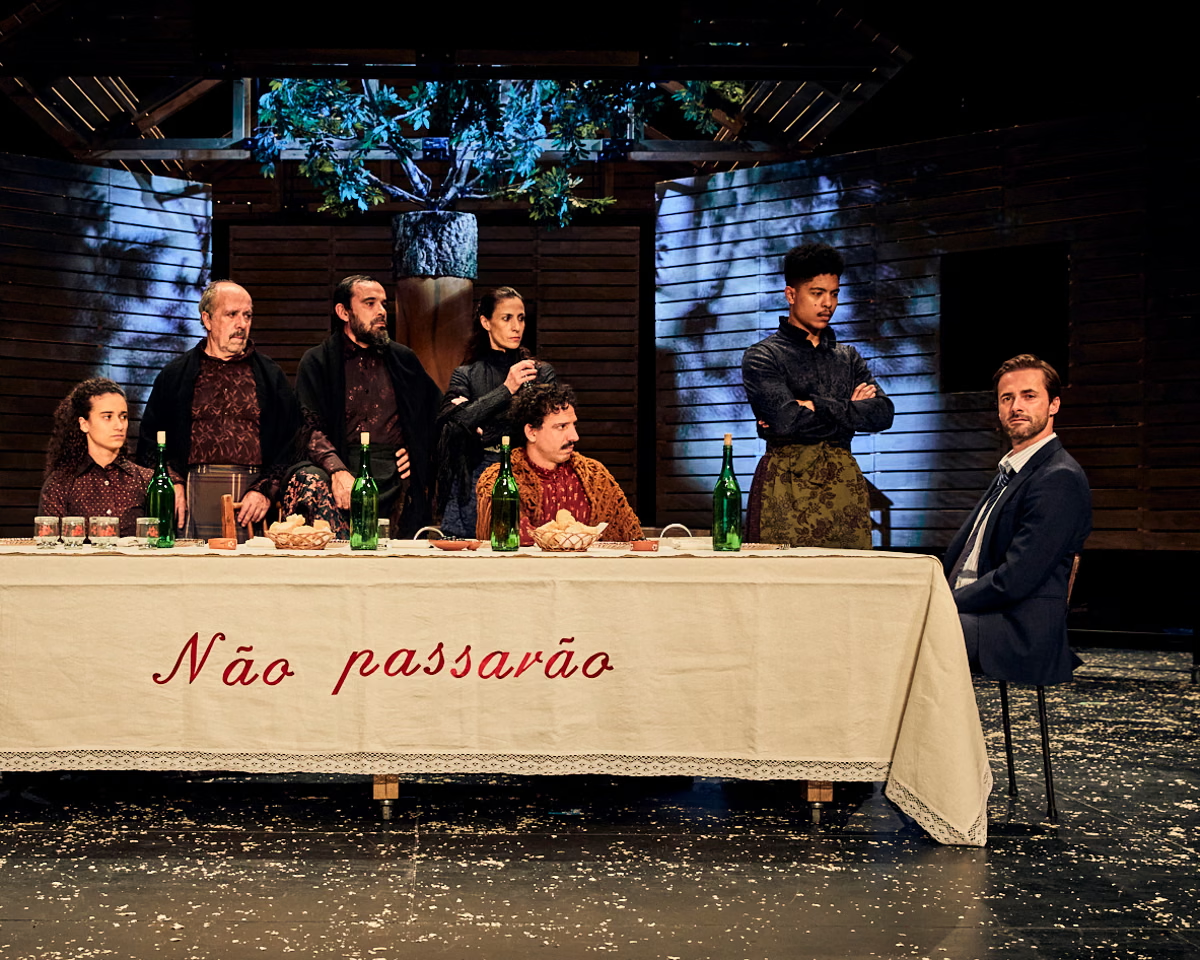
When the play Catarina and the Beauty of Killing Fascists reaches London’s National Theatre next month, it will carry a reputation for inciting intense, sometimes chaotic, audience reactions. From Norway to Rome, the production has frequently triggered walkouts, jeers, and even attempts to storm the stage. In February, a performance at the Schauspielhaus in Bochum, Germany, made international headlines when an audience member threw an orange at the actor portraying a far-right politician, leading to a disruption that felt to some like a 19th-century reaction to a provocative new art form.
Portuguese playwright Tiago Rodrigues, however, views these outbursts as a predictable element of the work. “I was not surprised by the reaction,” he says. “I was surprised by the fact that it was so surprising for so many people.” He characterizes the audience response as “very intense” but notes that it is “typical” for the production. Across roughly 200 performances, he estimates that only a handful have concluded with the audience listening to the final monologue in silence.
The play centers on a macabre, multi-generational family tradition: every year, relatives gather in the southern Portuguese countryside to feast on wild boar and asparagus before killing a kidnapped fascist. This ritual serves as a form of vengeance for the 1954 death of Catarina Eufémia, a harvester killed by the police force of the Salazar regime. Since its premiere in Guimarães in September 2020, the play has consistently prompted spectators to intervene. In Portugal, audiences have drowned out the fascist character’s lines by chanting the 1974 Carnation Revolution anthem, Grândola, Vila Morena. In Italy, crowds sang the resistance song Bella Ciao, while in Austria, viewers stood up and walked out.
The play functions as a reflection on the “paradox of tolerance” defined by philosopher Karl Popper: must a tolerant society be intolerant of those who advocate for intolerance? The narrative is split into two distinct parts that challenge the viewer’s moral stance. For the first two hours, the audience follows the family’s internal debate, particularly through the character of Sara, a young woman tasked with her first killing who finds herself paralyzed by doubt. She questions whether the act of killing itself mirrors the authoritarianism they claim to oppose, asking, “Death, where you don’t think, don’t argue, where you can’t change your mind, is that not the greatest dictatorship of all?”
Rodrigues, who has served as the artistic director of the D’Avignon theatre festival since 2022, admits he shares Sara’s internal conflict. While he maintains that the far right is an enemy that must be fought, he advocates for democratic methods of resistance. He notes that in his current home in the south of France, armed resistance against Nazi occupation is widely considered legitimate, yet he emphasizes that in a modern democratic context, the struggle should remain non-violent. He condemns the physical assaults against his cast members but refuses to judge spectators who shout down the fascist character, viewing their visceral reactions as a response to the play’s invitation to engage.
The play’s climax features a victory speech delivered by the freed fascist, which draws heavily from contemporary far-right rhetoric regarding the “dictatorship of minorities,” biased media, and the intolerance of the liberal left. Rodrigues wrote this monologue during rehearsals, deciding that a far-right victory was the most dystopian and thought-provoking conclusion. He began developing the work in 2019, following the election of André Ventura—the founder of the anti-immigration party Chega—as the first far-right politician to enter the Portuguese parliament since the dictatorship. “I remember when I mentioned in rehearsals that the story would be about a victory for the far right in 2028,” he recalls. “As a playwright, you are sometimes dystopian because you don’t want to be prophetic. Unfortunately, reality keeps making this piece more relevant.”
Rodrigues suggests that the audience’s outrage often stems from a sense of helplessness. After two hours of navigating a complex moral debate, the audience is suddenly confronted with a scenario where their preferred choice is removed. “Some of the same people who agreed most strongly with Sara that the left should not use violence are the loudest to scream ‘kill him’ at the end of the play,” he observes. By forcing the audience to confront these contradictions, the play continues to serve as a 21st-century equivalent of Stravinsky’s The Rite of Spring, consistently provoking reactions that blur the line between theatrical performance and real-world political protest. The report also notes that i n February, turbulent scenes inside a German theatre made headlines around the globe. The report also notes that two spectators climbed on to the stage and tried to wrestle the actor off, an orange lobbed from the auditorium narrowly missed its target; eventually. The report also notes that news of the incident travelled around the world: it seemed a bizarre throwback to a world in which people were not able to tell the difference between art and real life, like 19th-century Parisians stampeding out of a cinema after watching a train hurtle towards the camera. The report also notes that each of which annuls the answers offered by the other: an anti-fascist play that asks difficult questions of both liberal and militant anti-fascists, one answer may be that Catarina and the Beauty of Killing Fascists is essentially two plays in one. The report also notes that for the anti-fascist tradition that the family at the heart of the play represents is one that comes across as self-absorbed, self-regarding and, in its own way, reactionary, the second question carries particular weight in Rodrigues’s staging. The report also notes that “You shouldn’t ask yourself ‘Why?’ or ‘Why also me?’.



Comments