
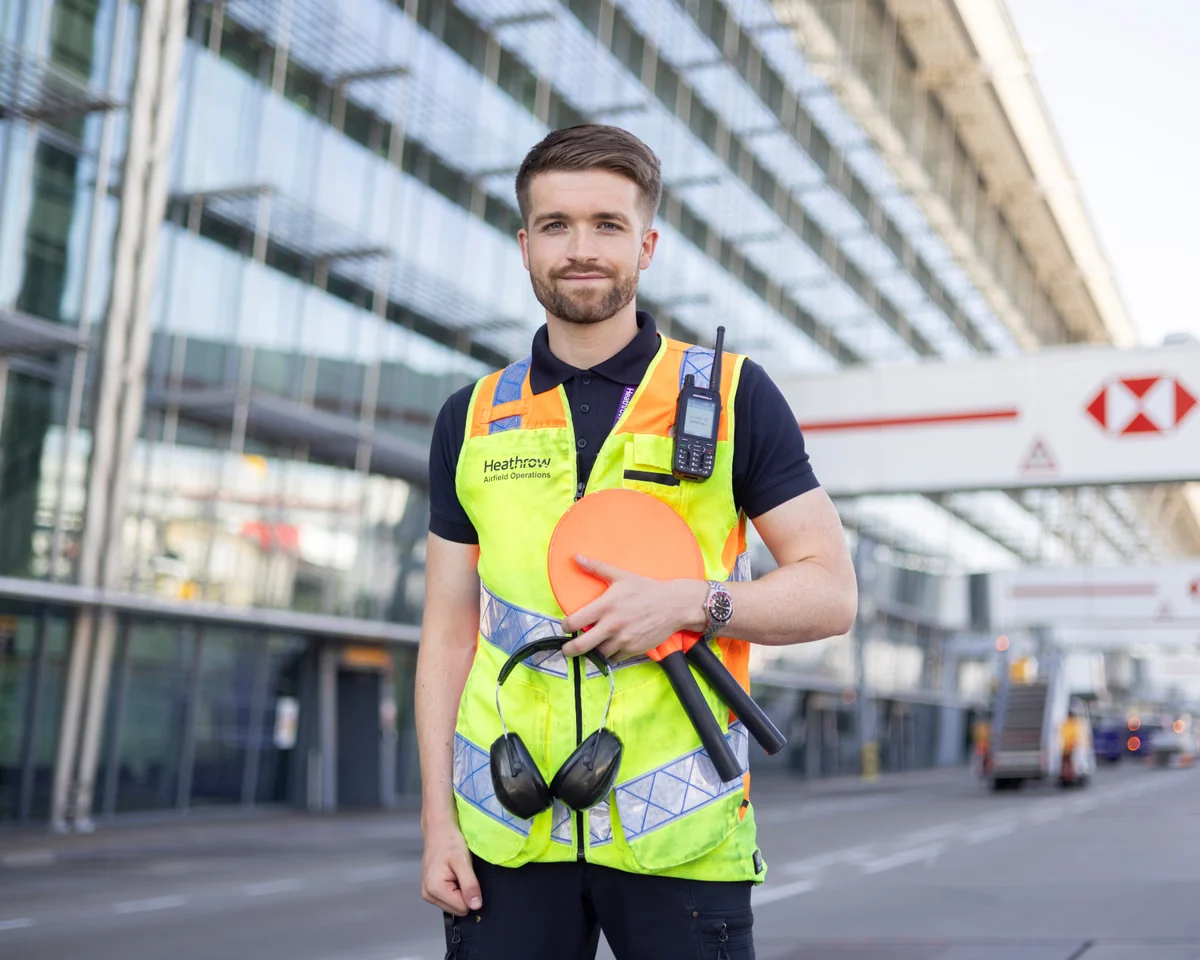
High-stakes transport operations across England rely on a dedicated workforce that rarely sees the public eye. At Heathrow Airport, airfield operations officer Jack Quantick-Thorne works directly on the taxiways, where the sheer scale of aviation is evident. He notes that a single A380 aircraft deposits as much rubber on the tarmac as an entire car’s set of tyres would over its lifespan.
While passengers might briefly notice Quantick-Thorne when he uses paddles to guide a plane into its stand, he explains that this manual marshalling is only about 5% of his actual duties. Most aircraft are now positioned using laser-guided electronic displays, but human intervention remains a vital safety backup. When handling massive aircraft like the A380, a second marshal is required near the wheel to ensure precise stopping. Beyond guiding planes, his role involves constant patrolling, monitoring refuelling procedures, and verifying that chocks are correctly placed under aircraft wheels.
Quantick-Thorne also enforces safety protocols across the airfield’s road system, where he can issue points for traffic infringements. A critical part of his job involves wildlife management to prevent bird strikes. He utilizes speakers mounted on his van to broadcast specific bird calls, such as starlings or falcons, to deter flocks from gathering near runways. His path to this role was driven by a passion for aviation; although he previously worked at the Nats air traffic control centre in Swanwick, he found the proximity to the aircraft at Heathrow to be the next best thing to being a pilot, a career path he noted is often hindered by training costs exceeding £100,000. Last year, he even managed the rare task of towing the airport’s stationary Concorde for an exhibition.
In London, Chris Thackaberry serves as a network traffic controller for Transport for London, operating out of Victoria Station House. His responsibility covers roughly 500 of the capital’s 19,000 bus stops, primarily within the heavily congested Westminster area. Thackaberry manages the fallout from roadworks, broken-down vehicles, and infrastructure issues like burst water mains. His incident response van is equipped with a mobile office, signage materials, and spill kits to manage diesel or oil leaks. He also carries “spit kits”—swabs and evidence bags—to document assaults against staff, a grim reality of the role.
The complexity of managing bus routes in central London is highlighted during peak traffic in areas like Trafalgar Square, where Thackaberry must navigate limited street furniture to post diversion signs. He notes that the density of routes often leads to competition for limited road space. Meanwhile, in the rail sector, the traditional signal box has largely been replaced by centralized control. From a windowless facility in York, signallers manage traffic along the East Coast mainline using computer interfaces. Sarah, a signaller, describes the transition from physical levers to mouse clicks as akin to a high-stakes computer game, though the consequences of every decision remain very real.
Signallers work with multiple screens displaying live track data, timetables, and traffic management information. Despite the lack of windows and the feeling of being in a “black hole,” they maintain control over trains traveling all the way into King’s Cross. Their primary focus during any incident—whether a circuit failure, a trespasser, or a medical emergency—is to secure the area before working to restore service.
In Manchester, the focus shifts to the maintenance of the Bee Network. Jamie, a public service vehicle engineer, works at a depot where shifts run from 5 a.m. to 1 a.m., with engineers often staying overnight to address breakdowns. Routine inspections are mandated by law on a monthly basis, but the team’s responsibilities extend beyond the workshop. Because engineers hold bus driving licences, they frequently deliver replacement vehicles to drivers on the road to ensure service continuity. The physical demands of the transport industry are also significant; for ground crews handling baggage, the work is highly regimented. With an average bag weighing 20kg and loads often reaching 90 bags per turn, a team can lift nearly 30 tonnes in a single day across eight shifts. The report also notes that on the taxiway just a stretch of grass away from where a line of passenger planes is coming in to land, not many people get to park their car here – bang in the middle of Heathrow airport. The report also notes that it’s close enough to see the shimmering air and smoke as nose tyres hit the tarmac. The report also notes that “People just think you’re that person with the table tennis bats,” he grimaces slightly, as requests a demonstration. The report also notes that brandishing the paddles, Quantick-Thorne beckons in a taxiing British Airways arrival, the pilot peering down from the cockpit and steering 50 tonnes of plane straight towards him. The report also notes that stopping exactly in position for the airbridge to swing in and allow passengers to disembark, the nosewheel travels bang on the guideline. The report also notes that an A380, you need a second marshal right by the wheel to check it’s stopped in the right place,” he says, when you’ve got a really big plane.


Comments