
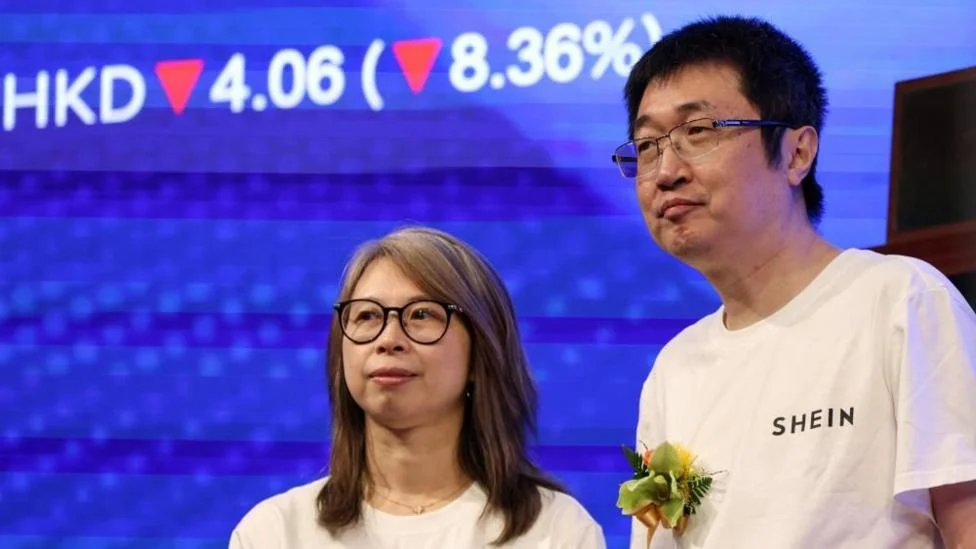
Fast-fashion retailer Shein experienced a lukewarm reception on the Hong Kong Stock Exchange this Tuesday, with shares falling by as much as 10% during early trading before recovering slightly to sit 3.5% lower at midday. The debut follows a protracted effort by the company to go public, including previously unsuccessful attempts to list in the United Kingdom and the United States amid ongoing scrutiny regarding its environmental footprint and labor practices.
At a ceremony marking the start of trading, founder Xu Yangtian and financial director Poppy Bao were joined by chief financial officer Leigh Gui. Gui emphasized the company’s business model, which leverages rapid payment options and a vast network of Chinese factories to deliver small, high-volume orders to approximately 160 global markets. “Let global consumers enjoy the sound of fashion,” Gui remarked after striking the ceremonial gong.
The company priced its shares at HK$48.56 on Monday, successfully raising 13.6 billion Hong Kong dollars ($1.7bn; £1.3bn). This valuation places the firm at $26.3bn, a significant decline from its previous peak estimate of nearly $100bn (£74bn). The current valuation reflects the mounting pressures of trade tensions and fierce industry competition.
Market analysts suggest the lackluster performance indicates investor skepticism regarding Shein’s future growth potential. Charu Chanana, chief investment strategist at Saxo, noted that the market appears unconvinced of a major “comeback” for the brand. She pointed out that Shein is currently grappling with rising operational costs and increased regulatory oversight, while capital is increasingly flowing toward technology-focused sectors.
The financial impact of the share slump may eventually reach consumers. Chanana suggested that the pressure on the company’s stock is a signal that its ultra-low pricing strategy is becoming increasingly difficult to maintain, potentially leading to price hikes for shoppers.
Despite the challenges, the firm maintains a massive reach, reporting over 273 million active customers who placed more than one billion orders in the year ending March 2026. This listing represents the largest new share sale in Hong Kong this year, serving as a critical barometer for investor appetite within the fast-fashion sector.
Industry experts remain cautious about the company’s long-term outlook. Louise Deglise-Favre, a fashion industry analyst at GlobalData, described Shein as a rare “standalone” e-commerce entity that must be judged on its own merits. She noted that investors have become more skeptical, with concerns over ethical standards and sustainability adding layers of complexity to the share sale.
The broader fast-fashion market has struggled recently, with competitors like Asos and Boohoo seeing their share prices decline under the weight of regulatory pressure and intense market rivalry. For Shein, the Hong Kong listing is now the primary test of whether it can navigate these headwinds as a public company. The report also notes that especially among younger people, due to its ability to source the very latest fashions at ultra-low prices through a vast network of factories in China, shein became hugely popular.





Comments