
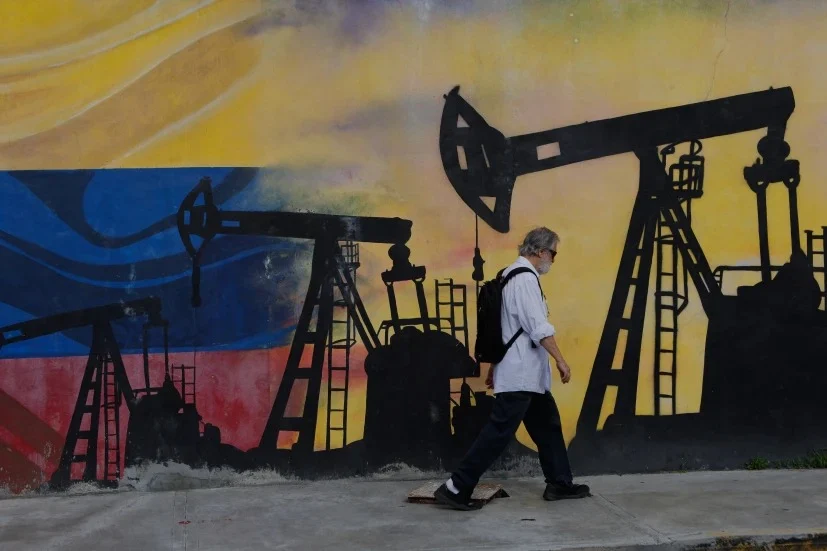
President Donald Trump has characterized a new agreement involving Venezuela as “THE BIGGEST OIL DEAL IN WORLD HISTORY,” though the White House has provided limited information beyond a social media announcement. The deal, unveiled Friday night, aims to grant the United States a stake in Venezuela’s extensive oil reserves, marking a strategic move to secure energy resources following the January capture of former President Nicolás Maduro by American forces. Maduro was subsequently transported to New York to face federal drug trafficking charges.
Delcy Rodríguez, Venezuela’s acting president, has framed the agreement as a vital component of the nation’s economic recovery and modernization efforts. In a televised address on Sunday, she emphasized that the country’s sovereignty remains intact and expressed an ambition for Venezuela to emerge as a global energy powerhouse. Previously, Rodríguez noted that the nation’s oil reserves would “cease to be an inert, cold statistic and will instead become concrete solutions,” specifically citing housing as a primary beneficiary.
The structural details of the arrangement remain opaque, as no official text has been released. According to Rodríguez, the deal involves the development of 17 oil fields with a proven potential of 65 billion barrels. The agreement reportedly aims to attract $100 billion in investment into the Venezuelan oil sector, potentially generating over $209 billion in tax revenue for Caracas. A new entity, formed by the U.S. government and an unnamed private operator in Venezuela, has been granted rights to these untapped fields for a 100-year term.
A U.S. official, speaking on the condition of anonymity, indicated that the United States is set to receive 55% of the company’s effective output, structured through a combination of ownership stakes and rights to purchase oil at cost. This output is intended to bolster U.S. strategic oil reserves and military supplies. If realized, the official noted, this company would become the second-largest corporate holder of proven reserves globally, trailing only Saudi Aramco. Trump stated the deal was negotiated by Secretary of State Marco Rubio, Defense Secretary Pete Hegseth, and Rodríguez.
While the administration claims the deal will help lower domestic gas prices—a key objective amid the ongoing Iran war and the upcoming November elections—industry experts remain skeptical about the immediate impact. Amy Myers Jaffe of New York University’s Energy, Climate Justice and Sustainability Lab noted that while the deal may have long-term potential, it will not influence retail gasoline prices for the Labor Day weekend. Current U.S. gas prices average approximately $4.08 per gallon, compared to $3.20 at this time last year.
Logistical challenges present significant hurdles, as Venezuela’s oil infrastructure has suffered from years of neglect. Kevin Book, managing director at ClearView Energy Partners, observed that while Venezuela previously produced over 2.5 million barrels per day above current levels, restoring such capacity requires massive capital and many years of development. Furthermore, the agreement lacks clarity regarding who will finance these infrastructure investments and the associated costs.
The deal has faced sharp criticism both within Venezuela and on Capitol Hill. Some Venezuelans view the arrangement as a betrayal of the long-standing national policy that resources should benefit the public rather than a corrupt elite. Douglas Borjas, a resident of Caracas, described the move as a desperate attempt by leadership to maintain power. Ricardo Hausmann, a Harvard professor and former Venezuelan planning minister, labeled the agreement a “shameful deal,” arguing that Rodríguez lacks the constitutional legitimacy to commit the country to such terms.
In the United States, political reaction has been divided. Sen. Bernie Moreno, R-Ohio, praised the agreement as a historic step that benefits both nations. Conversely, Democrats have condemned the deal, with Sen. Tim Kaine, D-Va., characterizing it as “corruption at epic scale” and accusing the administration of prioritizing oil access over the risks posed to service members. Sen. Chris Van Hollen, D-Md., echoed these concerns, alleging that Trump put military personnel at risk to secure resources for “billionaire buddies.” Despite the criticism, Rodríguez maintained that Venezuela retains full ownership of its resources and indicated that the government intends to pursue further agreements with international companies such as Chevron, Repsol, and Shell. The report also notes that “It’s going to take time — many years — to deploy that much capital and produce the kind of incremental results that history suggests possible,” Book said. The report also notes that including how soon the reserves could be drilled and who will pay to make it happen, were not immediately clear, but the answers to many questions. The report also notes that a look at what is known and unknown. The report also notes that a substantial boost in production is not expected to happen quickly.





Comments