
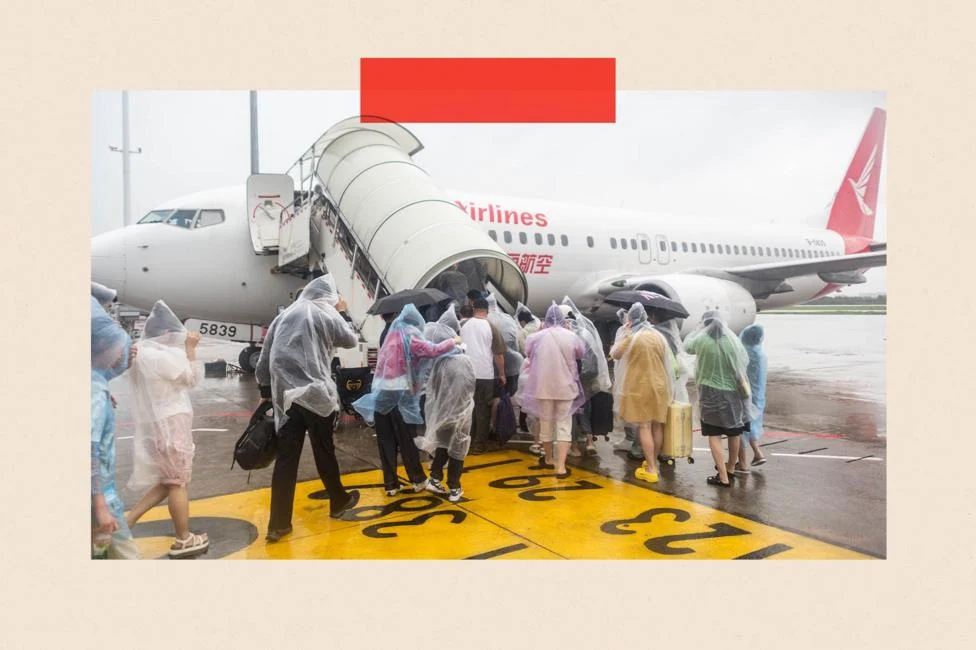
A summer heatwave in late June triggered a cascade of travel chaos across the UK, as towering thunderclouds forced air traffic controllers to scramble, rerouting planes and causing approximately 900 flights to face delays of up to 11 hours. While the immediate weather has since stabilized, industry experts are viewing the event as a stark warning of what may become a common reality as climate change accelerates.
Tim Atkinson, a former pilot and airline risk consultant, highlights that the densely packed airspace over the UK and northern Europe leaves the region uniquely vulnerable. He warns of a scenario where multiple major hubs—such as Heathrow, Gatwick, Luton, and Stansted—could be simultaneously impacted by severe storms. Such a situation would create significant consequences both in the air and on the ground, potentially escalating beyond simple delays to serious risk events, such as aircraft facing fuel shortages while waiting for clearance.
Atkinson emphasizes the unpredictability of these rapid climate shifts, noting that the industry is transitioning from weather patterns that systems can manage to situations where predictability is minimal. However, not all industry voices share this level of alarm. Andrew Charlton, manager of the Swiss-based consultancy Aviation Advocacy, acknowledges the potential for worst-case scenarios but remains confident in the industry’s ability to make sound operational decisions. He notes that while the risk exists, it is not currently among his primary concerns for the sector.
The technical requirements for flight safety remain stringent, with aircraft legally mandated to carry enough fuel to reach an alternative airport plus an additional 30 minutes of flying time. Despite these safeguards, the physics of a warming planet complicate flight management. For every degree of warming, the atmosphere holds approximately 7% more moisture, which increases the likelihood of intense rainfall and severe thunderstorms. The UK Met Office suggests that while the total number of storms may not necessarily rise, those that do occur are likely to be significantly more impactful.
Managing these storms is a tactical challenge for organizations like the National Air Traffic Services (NATS). At their control center in Swanwick, Hampshire, controllers monitor storm cells continuously to manage traffic flow. When storms shrink available airspace, controllers must restrict or reroute flights. If an airport becomes unusable due to high winds or flooding, the system must often refuse all but emergency traffic. Prof. Guy Gratton of Cranfield University notes that current onboard weather radar systems—which can scan up to 320 nautical miles ahead—are essentially tactical tools rather than strategic ones. He argues that airlines must adjust their planning to account for the reality that aircraft will increasingly need to fly further to avoid convective weather.
To mitigate these pressures, some airports are adopting new technologies to improve efficiency. NATS has successfully reduced delays by optimizing landing rates, and hubs like Heathrow and Gatwick have moved toward dynamic spacing systems that calculate arrival times based on real-time conditions rather than rigid minimum distances. Despite these improvements, the physical infrastructure of global aviation faces long-term threats. Many of the world’s airports are situated in low-lying coastal areas, with approximately 40% of the global population living within 100km of a coastline.
Research from Newcastle University indicates that 269 airports worldwide are already at risk of flooding due to rising sea levels, a figure expected to grow. Protecting these facilities could cost as much as $57bn (£42bn). LaGuardia Airport in New York serves as a prime example of this vulnerability, as it is built on reclaimed land near Flushing Bay. A major study suggests that flooding events previously expected once every 500 years could occur every 25 years, potentially reaching a five-year frequency by the middle of the century.
Beyond the runways, severe weather can paralyze the supporting infrastructure of travel, including roads, railways, and parking facilities. Even when flight paths are clear, passengers may find themselves unable to reach terminals. The aviation industry now faces the dual challenge of meeting a carbon-neutral target by 2050 while simultaneously accommodating a projected doubling of the global aircraft fleet over the next two decades. The report also notes that and with the holiday season getting under way, thousands of passengers were heading to London’s Heathrow and Gatwick airports to catch flights abroad, it was a Saturday. The report also notes that it was always going to be a very busy day. The report also notes that the timing in this case was clearly unlucky. The report also notes that he thinks, would make the disruption for passengers caused by the incident in June seem relatively minor â and could even put lives at risk, such a scenario. The report also notes that when I visit, it is a hot and humid day, there are ominous dark clouds in the sky, and heavy, thundery downpours are hitting the surrounding region.







Comments