
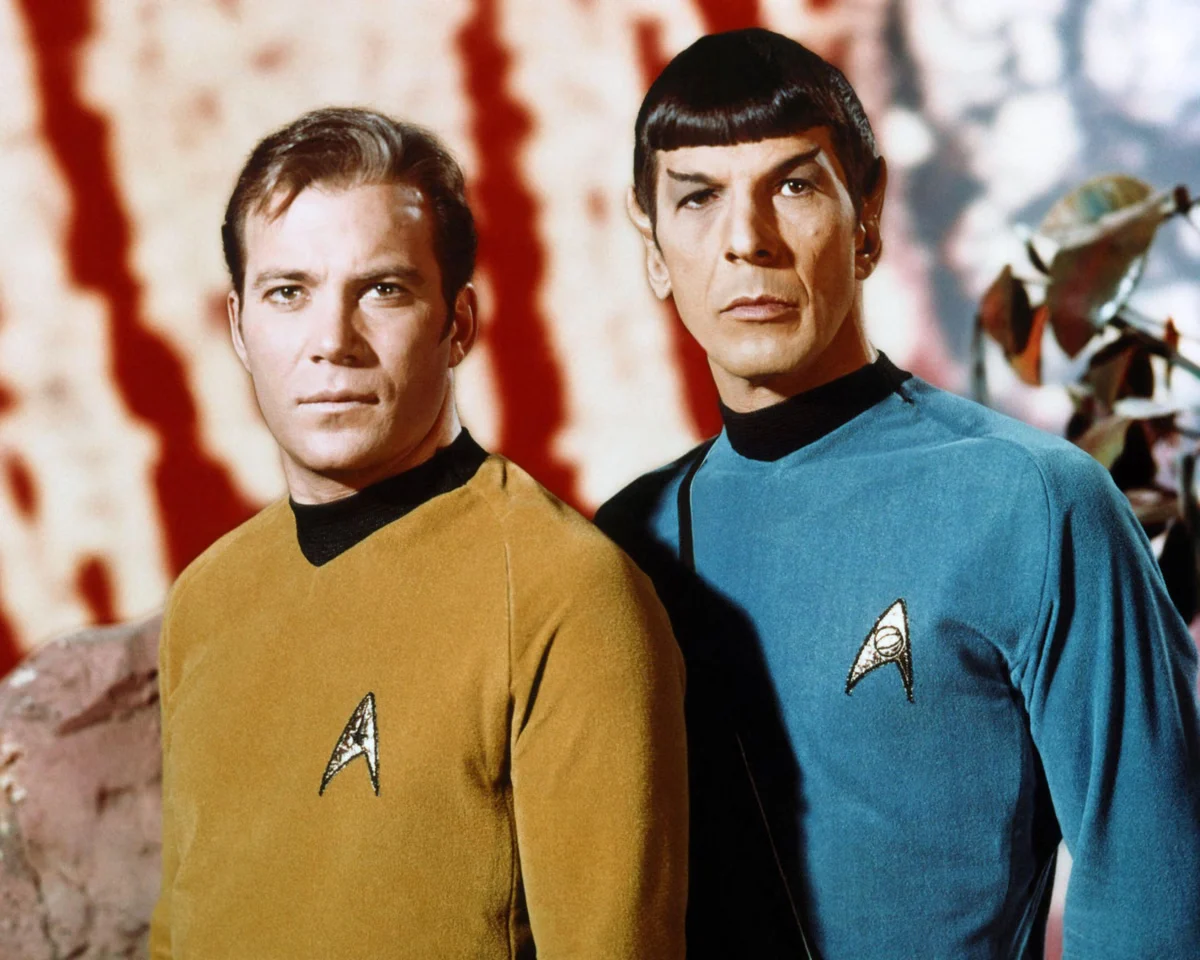
As Star Trek marks its 60th anniversary on September 8, the franchise remains a significant force in American culture, serving as both a pioneering science fiction series and a mirror for the nation’s shifting political landscape. William Shatner, who portrayed the iconic Captain James T. Kirk, reflects on the milestone with a sense of philosophical detachment. “The mystery of time,” he muses, questioning the significance of six decades in the broader context of existence.
Born from the idealism of the 1960s, the original series presented a utopian future where humanity prioritized exploration over conquest. The show’s commitment to diversity, empathy, and reason resonated deeply with viewers, including Martin Luther King Jr. and his wife, Coretta, who famously allowed their children to watch the program as a rare exception to their television rules. When Shatner was cast in 1965—replacing Jeffrey Hunter’s more somber portrayal of Captain Pike—he introduced an athletic, theatrical charisma that defined the series. Recalling the original pilot, Shatner notes, “I saw the film and I thought it was really interesting, a little ponderous. So I suggested maybe a lighter touch, and we made another pilot and it sold.”
This lighter touch did not shy away from social commentary. In the 1968 episode “Plato’s Stepchildren,” Shatner and Nichelle Nichols, who played Lt. Nyota Uhura, performed television’s first high-profile scripted interracial kiss. While Shatner remains somewhat reluctant to be labeled a civil rights activist, the moment remains a landmark in broadcast history. The show’s progressive ethos, which envisioned a United Federation of Planets that had moved past racism and nationalism, stands in stark contrast to contemporary political rhetoric that often champions isolationism and “America first” ideologies.
The franchise currently faces an uncertain future as Paramount, recently merged with Skydance Media in an $8 billion deal, navigates internal shifts. Reports suggest the company has canceled recent series amid internal debates over “woke” content. Meanwhile, the broader media landscape sees Paramount’s owners eyeing a potential $110 billion acquisition of Warner Bros. Despite this, the series continues to spark debate. Even figures like Stephen Miller, the former deputy White House chief of staff, have engaged with the show, leading Shatner to express bemusement at the idea of political aides scrutinizing science fiction for ideological purity. “I don’t know what going too far is,” Shatner says. “Who drew that line?”
The philosophical divide surrounding the show is perhaps best captured by billionaire investor Peter Thiel, who once remarked that while he prefers the “capitalist” nature of Star Wars, he views Star Trek as the “communist” show. Shatner, who famously traveled to space at age 90, dismisses such rigid categorizations with wry amusement, noting that Thiel’s success suggests a high level of intelligence regardless of his opinions on fictional starships.
Experts like Mark Altman, co-author of “The Fifty-Year Mission” and director of the new documentary “The 60-Year Mission,” emphasize that the show’s creators were deeply influenced by their own experiences. Gene Roddenberry, a decorated World War II bomber pilot, and his writing partner Gene Coon, a former Marine, were shaped by the trauma of war. “Their approach to Star Trek was they had lost a lot of friends and had seen the horrors of war,” Altman explains. This perspective informed episodes like “Arena,” where Kirk refuses to execute a monstrous Gorn, choosing mercy over vengeance.
The evolution of the franchise has mirrored the changing American zeitgeist. Altman notes that the original series was heavily influenced by the Kennedy era, with Kirk serving as a “New Frontier” archetype. In contrast, later iterations like “The Next Generation” reflected the consensus-building style of the George H.W. Bush administration, while “Deep Space Nine” was shaped by the social climate following the Los Angeles riots. As Robert Picardo observes, the post-9/11 era has seen much of science fiction turn toward the apocalyptic, making Star Trek’s enduring hopefulness feel increasingly distinct.
Today, the franchise continues to evolve, with the latest series, “Starfleet Academy,” featuring Oscar-winner Holly Hunter in a leading role. Whether through its exploration of the “final frontier” or its commitment to a meritocratic vision of the future, Star Trek remains a complex, often debated, but undeniably vital piece of television history that continues to challenge audiences to imagine a better world. The report also notes that isn’t it, 60 years, in terms of what time is, it really is meaningless. The report also notes that on the other hand, Dolly Parton just died. The report also notes that it brings up the whole concept of the passage of time and what that means. The report also notes that in an episode called The City on the Edge of Forever, Shatner’s Kirk travelled back in time and fell in love with a pacifist (Joan Collins) only to discover that she must die to prevent Nazi Germany winning the second world war. The report also notes that such ethical quandaries help explain why Star Trek will celebrate its 60th anniversary on 8 September not just as a force in US culture but a mirror held up to the country’s politics. The report also notes that big government and big tech were liberators from scarcity and inequality. The report also notes that the Enterprise is encountering some cosmic turbulence, but six decades on. The report also notes that culture wars and the retreat of liberal democracy, along with anxiety over artificial intelligence and climate catastrophe, donald Trump’s America is convulsed by polarisation.





Comments