
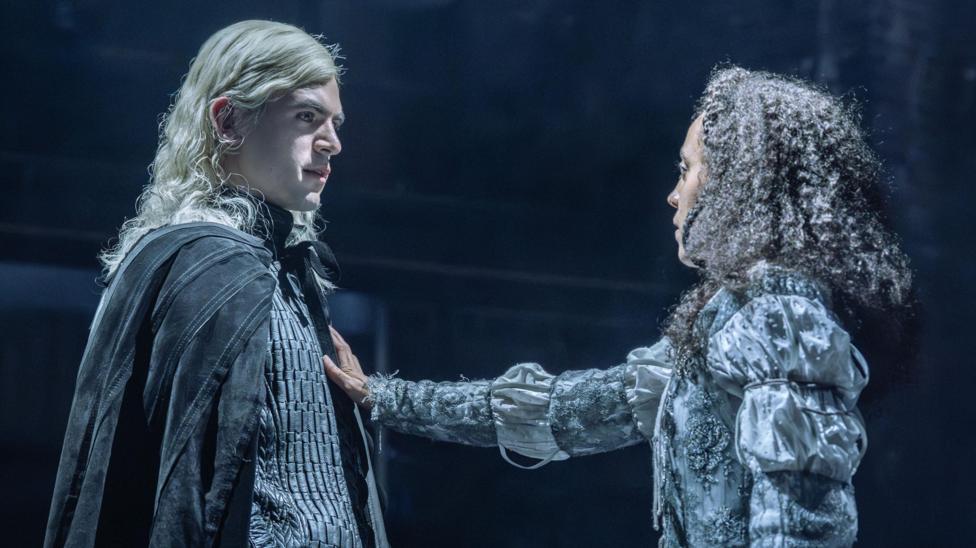
The Royal Shakespeare Company (RSC) has officially launched the first stage spin-off of the Game of Thrones franchise, with critics offering a divided verdict on the ambitious new production. Titled Game of Thrones: The Mad King, the prequel is set shortly before the events of George RR Martin’s original novels and the subsequent television series. It held its opening weekend at the RSC’s home in Stratford-upon-Avon, with the author himself in attendance.
The production is a massive undertaking, spanning three hours and 45 minutes with a cast of 36 performers. It has been seven years in development, aiming to capture the scale of a Shakespearean history play. The narrative centers on the era of Aerys II Targaryen, portrayed by Michael Shaeffer, and features younger iterations of iconic characters such as Ned Stark, Jaime Lannister, Robert Baratheon, Lyanna Stark, and Prince Rhaegar Targaryen.
Critical reception has been varied, reflecting the challenge of adapting such a massive franchise. The Telegraph awarded four stars to the “spellbinding spectacle,” while the Guardian’s four-star review praised its “spectacular stagecraft and plenty of modern resonance.” Conversely, The Times was more lukewarm, awarding three stars and noting that the play “lacks pace, sex and gore.”
The Shakespeare connection is intentional, as Martin’s novels were heavily inspired by Shakespeare’s history plays, particularly those depicting the 15th-century Wars of the Roses. Tamara Harvey, the RSC’s co-artistic director, noted that the themes of power, love, succession, and dynastic struggle are deeply shared between the two worlds. Director Cooke echoed this, highlighting the focus on intergenerational conflict and the nature of power.
In his review for the Guardian, Mark Lawson addressed the controversy surrounding the production. “Purists will object that, rather than staging Shakespeare-adjacent populist spin-offs, the RSC should be offering its house dramatist’s royal dramas plain,” he wrote. However, he acknowledged the counter-argument, noting that hitching onto a cultural juggernaut may bring in new sources of income and audiences for the institution.
Lawson also observed that audiences will respond differently depending on their familiarity with the source material. He suggested that his four-star rating attempted to bridge that gap, noting, “This feels like a five-star production for most devoted throners but a three-star for those who haven’t seen the TV series.”
Regarding the play’s standalone quality, Lawson wrote, “As a stand-alone piece of theatre, The Mad King scrapes through.” He added, “But as an extension of the Game of Thrones world, it scores well, shifting the narrative to the stage with suitably theatrical thrust.”
The Telegraph’s Dominic Cavendish offered a more critical perspective on the pacing and tone. “At almost four hours, it’s a long evening, sometimes too dense with detail, and it lacks the grit and gore (not to mention the nudity) of the TV series,” he wrote. Despite these reservations, he noted that it capably serves both newcomers and devotees, speaking in a timely fashion to our age of unruly leaders.
Metro’s critic Dave Freak also bestowed four stars on the production. Meanwhile, The Times’ critic Clive Davis expressed greater reservations, writing that while the play gives hardcore fans a chance to hunt for “Easter eggs,” the script by Duncan Macmillan is “sorely lacking in poetry” and events “plod forward.”
The playwright and creative team faced significant pressure to satisfy a demanding fan base. The director said that the challenge was writing something that works for both those who know the world intimately and complete newcomers. “It’s taken a long time, but I think we’ve got there,” he said.
George RR Martin remained heavily involved throughout the process, stationing a representative in rehearsals at all times and traveling to Stratford-upon-Avon for the opening night. The director noted that Martin has been “very supportive” during the creation of the play, which the RSC hopes will replicate the commercial success of other major stage spin-offs like Harry Potter and the Cursed Child.
Ultimately, the production stands as a testament to the enduring influence of Martin’s world. Whether it succeeds as a permanent fixture in the RSC repertoire remains to be seen, but it has certainly succeeded in sparking a conversation about the intersection of high-fantasy pop culture and classic theatrical tradition.
The Game of Thrones origin story is epic in both ambition and execution â it has taken seven years to reach the stage, clocks in at three hours 45 minutes, and features a 36-strong cast.
Others were more enthusiastic, and Whatsonstage’s Sarah Crompton’s five-star review, external said the play is “a triumph; a soaring, surging spectacle and a latter-day history play, both serious and popular”.
She added: “It is a remarkable achievement, wonderfully directed by [Dominic] Cooke and superbly acted by every member of the 35-strong ensemble.
Events plod forward, one after the other, and although Michael Shaeffer is a thoroughly compelling presence as the cruel and chronically unstable monarch Aerys, other performances seem nuance-free.
Davis concluded: “It goes without saying that there are more than enough GoT devotees to keep the box office ticking over for the rest of eternity, but only the most dedicated of them will have the energy for this marathon.”
Elizabeth Ayodele as Princess Elia Martell and Tanisha Spring as Ashara Dayne
The result is a brilliant exhibition of how theatre can create magic.”
The Independent’s Alice Saville, external, awarding four stars, said the “stellar stage show has all the thrillingly staged battles, gory deaths and, yes, dragons that the most bloodthirsty fan could hope for”.
“But there’s also a surprising amount of heart â of the warm, still-beating kind â as it lingers on the faces of its fallen,” she said.
The play begins more than a decade before the events in the first book and TV series, opening with the tourney at Harrenhal, a great jousting tournament where the houses of the Seven Kingdoms gathered and where key events in the Game of Thrones legend took place.
“Making something that is going to knock the socks off of everybody has been a real challenge.
We’ve worked very closely with him.
And George, I think, picked up quite quickly that we were very serious about honouring what he’d done.”
Asked about future plans for the play, Harvey replied: “We’re hoping as many people as possible get to see it, and that starts here in Stratford.




Comments