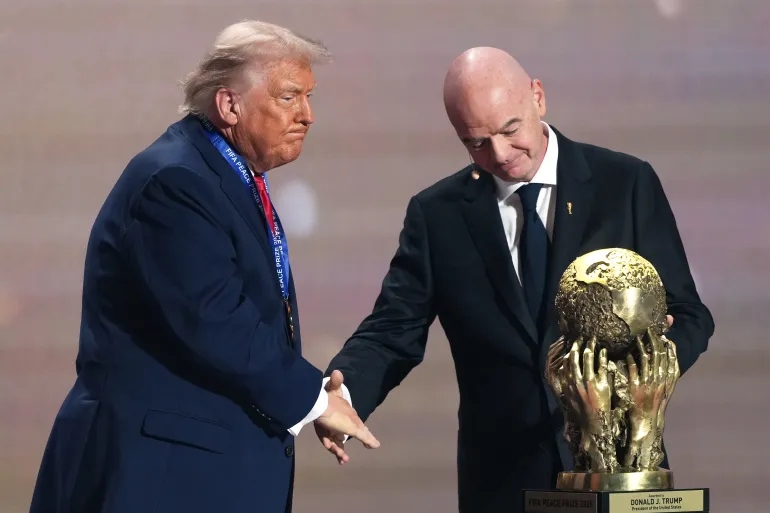
Six months after the World Cup, the future of the FIFA Peace Prize appears uncertain. The governing body is currently weighing whether to abolish the award, a move that would solidify United States President Donald Trump as the program’s first and only recipient. This reconsideration comes less than a year after FIFA President Gianni Infantino presented the accolade to Trump during a high-profile ceremony at Washington, DC’s Kennedy Center. Several members of the FIFA Council are questioning its merit and have demanded changes, including scrapping the award, less than a year after FIFA President Gianni Infantino extolled Trump in the US capital while presenting the award at the World Cup 2026 draw. The US leader had been heavily favoured to win the inaugural prize after failing to win the Nobel Peace Prize despite an aggressive campaign involving endorsements from other world leaders. Trump thanked FIFA and called the award “one of the great honours of my life”.
The “FIFA Peace Prize – Football Unites the World” was established on November 5 with the stated goal of rewarding individuals who take exceptional and extraordinary action toward global peace. However, following the glitzy debut event, members of the FIFA Council have begun questioning the merit of the award, leading to formal demands for its discontinuation or significant reform. The criticism of the award isn’t limited to football associations. The Asian Football Confederation and CONCACAF, which runs the sport in North and Central America and the Caribbean, that plan was ultimately abandoned in the face of widespread criticism with a rebellion led by the European governing body UEFA.
The controversy is compounded by broader scrutiny surrounding Infantino’s leadership, including his controversial $4.2bn plan to sell a 20 per cent commercial stake in the World Cup, which has sparked calls for his resignation. Infantino has headed FIFA since 2016 and is running for re-election in March despite calls for him to stand down in the wake of the $4.2bn plan to sell a 20 per cent commercial stake in the World Cup. Such as the World Cup, to private investors, infantino has been under fire since his announcement in late July that he wanted to open FIFA’s premium competitions.
Critics note that Trump’s recognition last year was particularly divisive, occurring less than 24 hours after his administration launched a lethal air strike in the Caribbean.
Furthermore, the political landscape shifted significantly two months later when the US and Israel initiated a war on Iran, leading to the assassination of Supreme Leader Ali Khamenei and strikes on Iranian nuclear sites. The US-Israel war on Iran has gone on for months with Trump saying this week that he will not attack Iran again before the November 3 midterm elections in the US.
During a recent FIFA Council meeting in Zurich, several member nations formally requested that the award be scrapped, while others argued that such prizes should never be bestowed upon politicians. Consequently, FIFA has tasked its 22-member Football Social Responsibility Committee with reviewing the prize’s history and purpose. A recommendation is expected ahead of the next council meeting scheduled for December 16 in Doha, Qatar. And why might it be scrapped, so what was the prize about. According to “The purpose is to raise these issues formally with the appropriate bodies, to have them examined, relevant evidence obtained and accountability for the conclusions reached,” the NFF, In a statement.
Debbie Hewitt, a FIFA vice president and leader of the English Football Association, confirmed that the committee is evaluating how the prize was conceived, whether the selection process was appropriate, and if the institution should abandon the initiative entirely. FIFA, when prompted, referred to Infantino’s commitment to allow the committee to analyze the prize and propose a final decision for the council.
The prize has faced significant external and internal opposition since its inception. In October, the Norwegian Football Association (NFF) made parallel filings with FIFA committees regarding the award, among other grievances. NFF President Lise Klaveness has been a vocal opponent, arguing in April that FIFA has no mandate for such awards and should leave peace advocacy to independent institutions like the Nobel Committee. We think we have a Nobel institute that does that job independently already,” Klaveness said.
Human rights group FairSquare has also filed a complaint with the FIFA Ethics Committee, alleging that Infantino compromised his duty of impartiality by aligning himself so closely with Trump. These concerns are echoed by players and observers who feel the sport is losing its way. Australia midfielder Jackson Irvine recently told media that the award makes a “mockery” of FIFA’s own human rights charter, warning that the organization is becoming increasingly disconnected from its grassroots foundation. “As an organisation, you would have to say decisions like the one that we saw awarding this peace prize makes a mockery of what they’re trying to do with the human rights charter and trying to use football as a global driving force for good and positive change in the world,” Irvine told the Reuters news agency in an interview. “Decisions like that feel like they just set us back in the perceived market of what football currently is, especially at the top level, where it’s becoming so disconnected from society and the grassroots of what the game actually is and means in our communities and in the world.”.
Craig Mokhiber, a former United Nations official, described the decision to honor Trump as a “truly shameful development.
He asserted that the award served to distract from Trump’s domestic and international record, including his support for Israel’s actions in Gaza, which Mokhiber characterized as a genocidal war.
While Infantino has consistently refused to take action regarding Israel—maintaining that football cannot solve geopolitical conflicts—critics argue that his efforts to curry favor with the US administration have severely damaged the federation’s global credibility.