
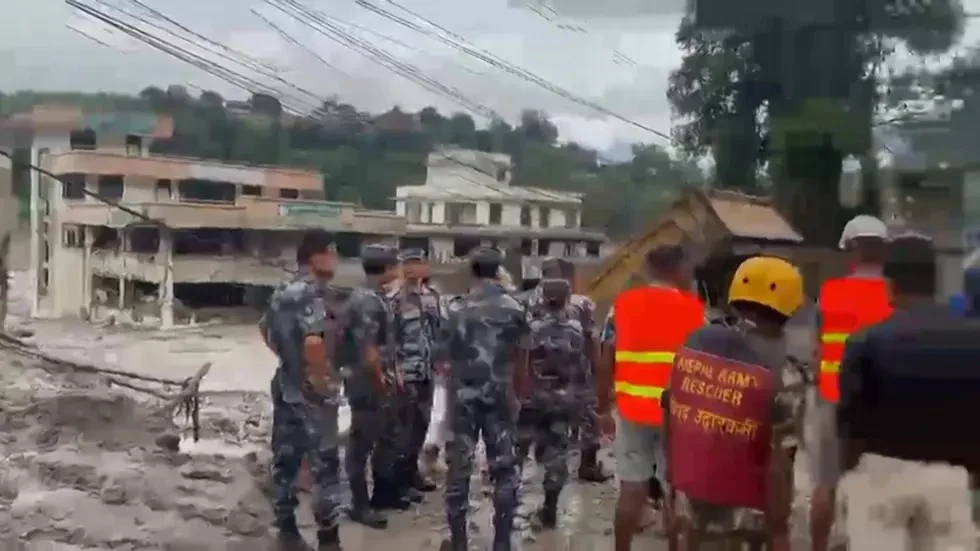
A catastrophic glacial collapse has triggered massive flash floods across the border region of Nepal and Tibet, resulting in a dire humanitarian emergency. Official figures indicate that at least 162 people have died in Nepal, while authorities in Tibet report three fatalities and 558 individuals currently missing. Among those unaccounted for in Tibet, state broadcaster CCTV confirmed that 260 are foreign nationals, and two local villagers have been successfully rescued.
The scale of the disaster has prompted international concern as countries work to locate their citizens. Nepal’s tourism board reported that 403 people were initially listed as missing, including 341 foreigners. This group includes 133 Indian pilgrims traveling to Mount Kailash, along with 47 Americans, 34 Australians, 33 British citizens, and 24 Canadians. Australia’s Foreign Minister Penny Wong confirmed that 34 Australians participating in hiking and pilgrimage tours are among the missing, noting that Canberra is coordinating with the United Nations, the Red Cross, and Nepalese authorities to assist in the response. Additionally, Malaysia’s Foreign Ministry stated that 55 of its citizens in Kathmandu are currently unreachable due to severe infrastructure damage.
The disaster unfolded when an ice-rock avalanche from a glacier on the Nepali side blocked the Lhende Khola river, a tributary of the Bhotekoshi. The subsequent release of trapped water created a surge of extreme speed and magnitude. Hydrological observations recorded water levels on the Trishuli River rising by 9 meters (27 feet) in just 30 minutes. Saswata Sanyal, a disaster risk reduction specialist, noted that this is the second time the Lhende Khola has flooded in 14 months, highlighting the growing instability of the Himalayan ice system.
Residents described the terrifying speed of the event. Shoyam Rajbhandari, a local in Dhunge bazaar, recounted that the flood overwhelmed the market area in just half an hour, leaving people no time to evacuate as they prepared for their workday. Drone footage from the area reveals a landscape transformed by the torrent, with roads obliterated, vehicles buried under debris, and buildings in the Nuwakot district coated in thick layers of mud.
While the U.S. Geological Survey initially detected seismic activity in the region, they later clarified that the event was not an earthquake but a glacial collapse. Data from seismic stations and satellite imagery confirmed that the massive debris flow was caused by the sudden failure of the glacier. This incident follows a similar disaster in August of last year, when a glacial lake overflowed due to high temperatures, killing nine people and destroying critical infrastructure, including a key bridge connecting Nepal and China.
Climate experts at the International Centre for Integrated Mountain Development in Kathmandu warn that the Hindu Kush Himalaya region is facing an accelerating crisis. Research indicates that ice loss rates across the range have doubled since 2000, driven by human-caused climate change. As monsoons intensify and glaciers melt at record speeds, the steep valleys and dense communities throughout the Himalayas remain increasingly vulnerable to such extreme weather events, making the implementation of early warning systems a critical priority for the region. The report also notes that uDIN DHUNGA, Nepal (AP) — China’s Xinhua News Agency said Thursday that mudslides in Tibet caused by a glacial collapse have left three people dead and 558 missing, while police in Nepal reported at least 162 were killed after massive flash floods in a border area of Nepal and China swept through communities a day earlier. The report also notes that infrastructure and water supplies across one of the world’s most densely populated regions, the Lhende Khola river system has now flooded twice in just 14 months and the increasingly unstable Himalayan ice system threatens communities. The report also notes that images showed what appeared to be the second floors of buildings in Nepal’s hard-hit Nuwakot district slathered in mud after the torrent rushed by. The report also notes that vehicles were buried and some stunned survivors were caked in mud, debris hung from tree branches and wires. The report also notes that the floods halted travel in some areas. The report also notes that there was little time for anyone to flee. The report also notes that people were preparing to go to office then,” resident Shoyam Rajbhandari said. The report also notes that “How many people are missing or dead, we don’t know.”.








Comments