
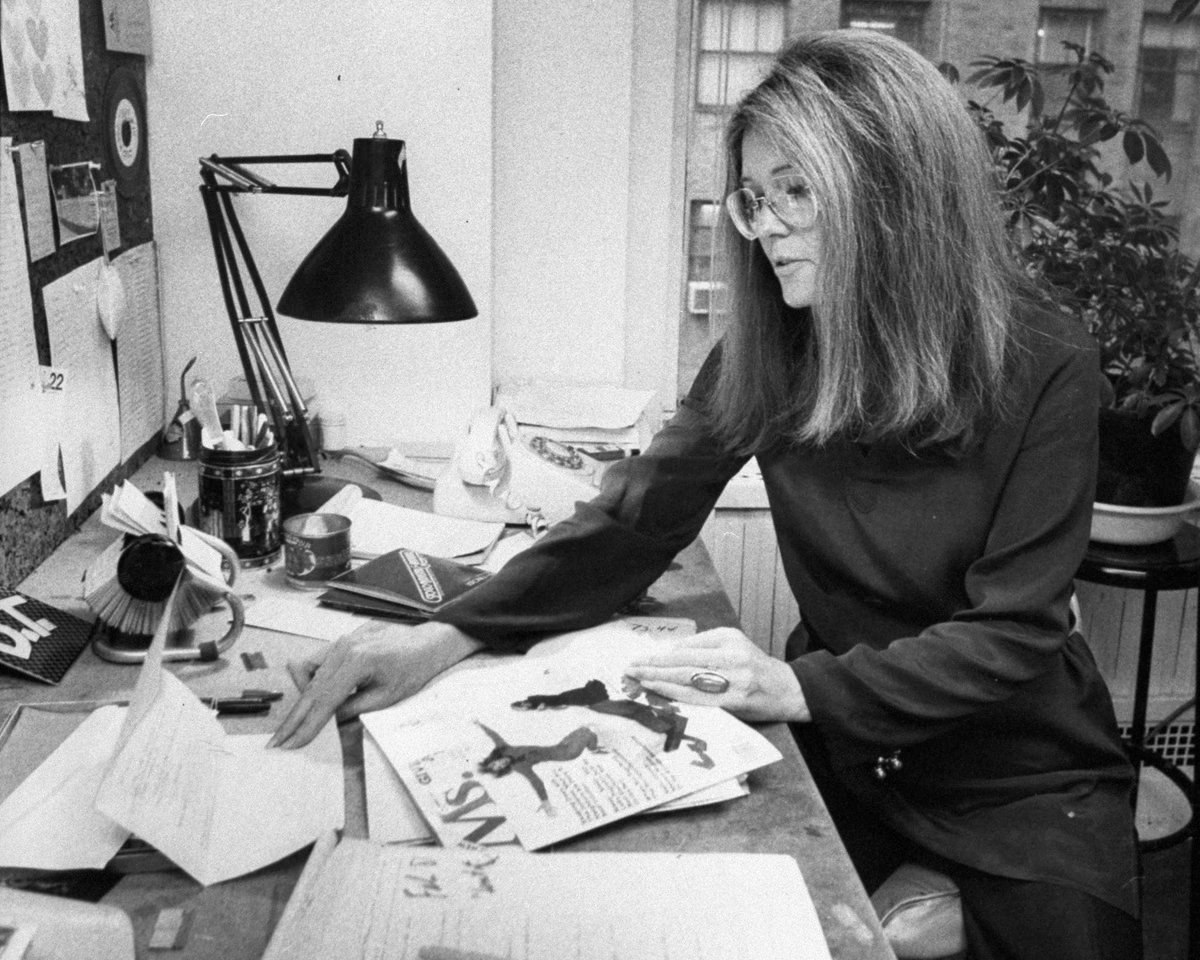
Gloria Steinem was scheduled to headline a women’s luncheon in New York later this month, with additional appearances slated for October. These engagements were intended to highlight the core message of her latest memoirAn Unexpected Life. Following her passing this Wednesday, the book—set for release in the coming weeks—now stands as a posthumous testament to the 92-year-old activist’s enduring philosophy: to simply keep moving forward.
The opening chapters of the memoir carry a profound weight in light of her death. When Steinem reflects on a journey that proved both longer and happier “than I ever imagined,” it serves as a poignant reminder of the gratitude owed to her by generations of women. The book acts as a thematic successor to her 2015 workMy Life on the Roadinviting readers to revisit her formative years in Toledo, Ohio. These early experiences—marked by poverty and family instability—were instrumental in shaping the woman who would eventually define second-wave feminism by balancing a fierce, uncompromising stance with a sense of inner serenity.
Steinem’s childhood was unconventional, defined by her father’s career as a traveling salesman and her own role as a caregiver for her mother, who struggled with severe mental health issues. She recounts the shame of growing up in a household where her mother was often referred to as the neighborhood’s “Crazy Lady.” Yet, these hardships provided a foundation for her resilience. “I learned I could survive almost anything,” she writes, noting that the experience taught her that “we are all one human family, and we are responsible for one another.”
Free from the societal pressures of marriage and motherhood that constrained many of her peers, Steinem pursued a path as a freelance journalist. A two-year period living in India proved transformative, deeply influencing her worldview. Upon returning to the United States, she launched a career in campaigning journalism, a trajectory that led to her co-foundingMs.magazine in 1971 and rising to the forefront of the women’s movement. Despite her public success, she admits to the personal costs of her chosen path, noting, “Though I managed to support myself, I didn’t save money until I was past fifty.” She describes a lingering fear of ending up destitute, which she jokingly managed by telling herself, “I’ll organize the other bag ladies.”
Steinem eventually achieved financial stability, largely through the purchase of a 19th-century brownstone on Manhattan’s Upper East Side—the very home where she passed away. However, she candidly mentions in the book that she was still managing mortgage payments well into her 80s. Throughout her life, she remained a magnetic figure, often hosting “talking circles” for diverse groups of women. She remained critical of the “patriarchal nuclear family,” describing it as a relatively modern construct of roughly 150 years, rooted primarily in industrialization and capitalism.
The memoir also provides a stark look at the gender inequality Steinem fought to dismantle. She highlights that in the 1960s, Columbia Law School maintained a 5% quota for women, while American women earned only 59 cents for every dollar earned by men. While that figure has risen to 82 cents today, she notes that at the current rate of progress, it will take 50 years to reach overall parity and 75 years for African American women to achieve parity with their male counterparts. Reflecting on her own life, she realized later that she had spent too much time doing what was expected of her rather than what she loved.
Her personal life remained a subject of public interest, particularly her principled opposition to marriage. She eventually married David Bale, her “great love,” at the age of 66, and remained with him until his death three years later. The book features brief, admiring sketches of figures like James Baldwin and Annie Leibovitz, though she reserves sharp criticism for Andy Warhol, writing, “It seems a low point of the art world that Andy Warhol’s is considered valuable.” Ultimately, the memoir captures a woman who, at 92, maintained a clear sense of purpose. As she writes with a characteristic smile, “Now even my jeans are much older than many people I work with.” The report also notes that right until the end, Steinem was stewarding large groups of women – famous and otherwise – at “talking circles” in her house and putting herself at the centre of a conversation she had in some ways begun. The report also notes that she wrote to her Smith College classmates in an alumni newsletter: “I’m quite broke, not at all who I thought I would be – and consciously happy.”, some years after graduating. The report also notes that illustrating the central theme of An Unexpected Life, her new memoir, which, when it’s published a few weeks from now, will stand as posthumous testament to the 92-year-old icon: just keep going, g loria Steinem was due to speak at a women’s lunch in New York at the end of this month and at more events in October. The report also notes that the activist’s memoir of a decade ago, and as the tributes pour in, the book offers us an opportunity to go back over Steinem’s hardscrabble origins in Toledo, Ohio, and the roots of her activism, an Unexpected Life is a follow-up of sorts to My Life on the Road. The report also notes that one is reminded of Steinem’s original power and the improbability and iconoclasm of her journey, in which a childhood governed by poverty and dysfunction turned into a lifelong mission to resist the narrow templates laid out for her, reading the first half of the book. The report also notes that touring the country with a dance pavilion that saw Steinem spend long stretches of her childhood with him on the road, which, she writes, conditioned her to enjoy a similarly unconventional existence in adulthood, steinem’s rackety father was a travelling salesman of sorts. The report also notes that the young Steinem was a carer for her increasingly mentally unwell mother, who was frequently to be found wandering the town in her nightdress, and Steinem writes movingly about what it is to grow up ashamed of your house and your family, when she was at home.









Comments