

Cricket world champions India faced intense criticism after securing a narrow two-run victory against minnows Japan in a rain-curtailed Twenty20 encounter at the Sano International Cricket Ground on Tuesday.
Set a modest target of 33 runs in a match reduced to five overs per side, Japan finished their innings at 30-3. In standard T20 fixtures, each innings spans 20 overs.
India captain Shreyas Iyer won the toss, but his team stumbled early when Charlie Hara-Hinze dismissed opening batter Abhishek Sharma in the first over. Hara-Hinze struck again with the second delivery of his next over to remove Ishan Kishan, boosting home hopes. Iyer responded with 16 runs off 12 deliveries, pushing India’s total to 32-4.
Japan pursued the target cautiously on a sluggish pitch. Axar Patel opened the bowling for India and removed Lachlan Yamamoto-Lake on his fourth delivery. Although Washington Sundar claimed another wicket and conceded six runs in the second over, Japan kept fighting. India continued deploying spin, giving up 17 runs across the next two overs while dismissing Japanese captain Kendel Kadowaki-Fleming for 12 runs.
With seven wickets intact, Japan needed eight runs from the final over bowled by Patel. Following a dot ball and a single, Patel delivered a wide. Another wide was called on the subsequent delivery as Alexander Shirai-Patmore attempted a reverse-sweep outside his scoring arc, leaving Japan requiring six runs from four balls.
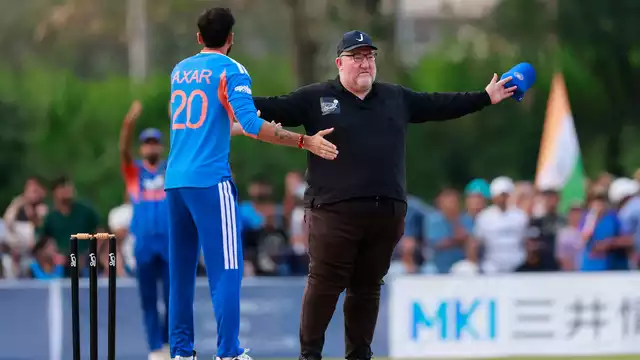
The match then descended into controversy when Iyer and Patel furiously protested the decision to the umpires. Following a brief consultation, the officials revoked the wide call without offering an explanation, denying the hosts an extra run and an additional delivery.
Japan managed only three singles off the final three balls, falling just two runs short. Had the wide decision stood, the associate nation would have come within touching distance of what would have been one of the biggest upsets in international cricket history.
The incident sparked widespread backlash among commentators and experts. Ben Gardner, a cricket writer at Wisden magazine, labeled the decision disgraceful, writing on X that India bullied the umpires into overturning the call during the closing moments of the game. Critics noted that the on-field umpires—Chris Brown of New Zealand and Chris Thurgate of Japan—reversed the call without relying on DRS replays or explaining the ruling to viewers.
Under Marylebone Cricket Club Law 22.3, an umpire can revoke a wide ball if the striker makes contact with the ball before it reaches a fielder, a condition that did not apply in this instance.
Following the match, Iyer acknowledged the difficulty of the pitch and praised the Japanese team’s performance and attitude, stating they are on the right track. Kadowaki-Fleming expressed immense pride in his squad, describing the close encounter against a full ICC member as a momentous milestone.
The historic fixture materialized following diplomatic efforts, corporate sponsorship, and more than a year of groundwork by the Japan Cricket Association alongside the Board of Control for Cricket in India, aided by Japanese government involvement. Japan currently ranks 41st in the ICC T20 men’s standings, supported by a player base of 7,300 registered athletes across 16 cricket grounds. The report also notes that however, the match took a controversial turn in the final over as the hosts inched closer to the target. The report also notes that bowled by off-spinner Washington Sundar, japan needed 31 runs off the remaining four overs but lost another wicket while scoring six runs in the second. The report also notes that why are India being accused of bullying. The report also notes that when umpires’ decisions are reviewed – either through a Decision Review System (DRS) call by the players or an umpire review when the on-field officials are unsure about a call – the ball in question is usually replayed on the screen and the TV umpire’s review is audible on broadcast and inside the stadium. The report also notes that players quarrelling with umpires publicly has also been frowned upon in the sport, traditionally. The report also notes that but the Indian captain and bowler showed no such restraint. The report also notes that subsequently, the umpire overturned his decision without seeing any evidence that suggested he had been wrong in calling a wide. The report also notes that others, like social media user Abu Zaid Sarooji, were even more blunt.

Comments