
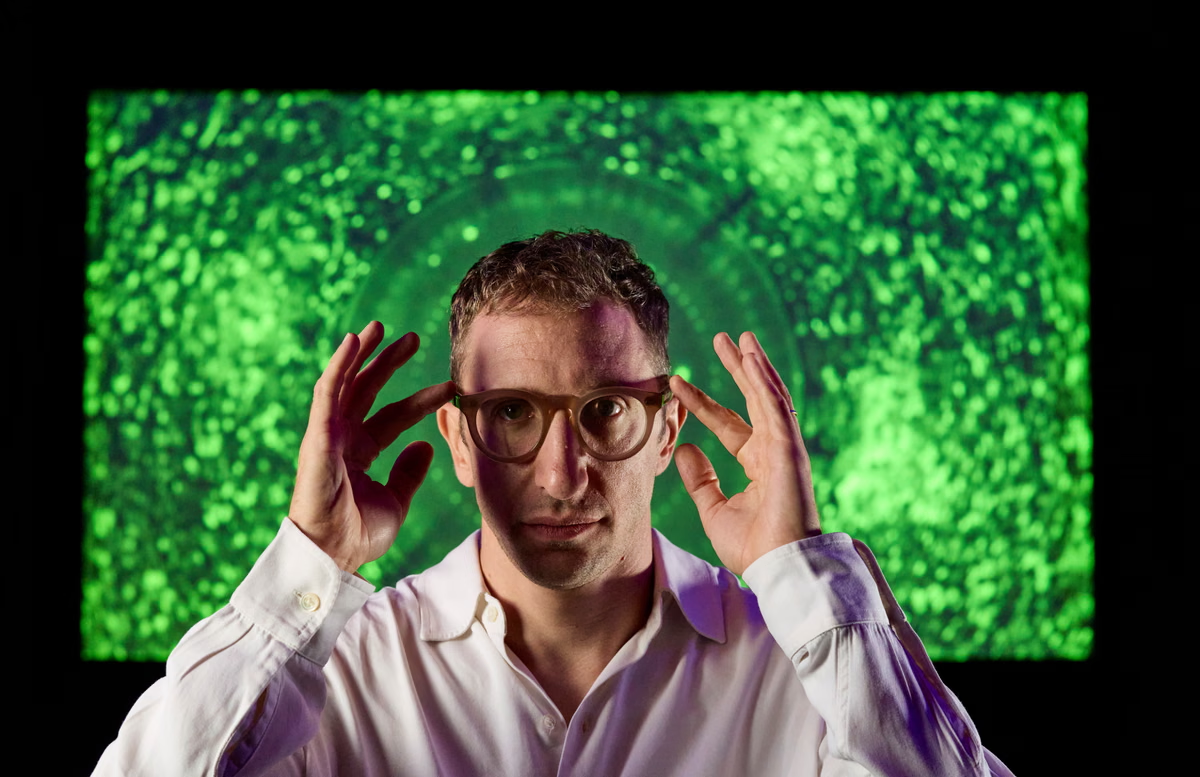
Lebanese-British artist Lawrence Abu Hamdan maintains a unique dual identity. A 2019 joint winner of the Turner Prize, he is currently showcasing work at the Venice Biennale, while simultaneously serving as the director of Earshot, an NGO he founded in 2023 to investigate human rights abuses through forensic sound analysis.
Abu Hamdan’s transition into this field began in 2016 through a collaboration with the research agency Forensic Architecture for Amnesty International. He interviewed survivors of Syria’s Sednaya prison, where prisoners were held in total darkness and subjected to enforced silence, facing severe punishment for making any sound. This experience proved foundational, as Abu Hamdan realized that his artistic practice and his investigative work were inextricably linked, with his art serving as an aesthetic and emotional expression of his research.
Operating out of a south London studio complex, Abu Hamdan describes his role as a “private ear,” a play on the classic film noir detective. His team, which includes investigators like Renate Lurdesa Baumane, uses open-source data, “earwitness” testimonies, and recorded audio to build sonic reconstructions of events. These projects often result in formal reports and multiscreen installations that bridge the gap between hard-nosed evidence and sensory experience.
One notable investigation involved a silent vigil held in March 2025 in Serbia, following a deadly railway station accident the previous year. During the demonstration, which drew up to 300,000 people, participants observed 15 minutes of silence—one minute for each victim. Earshot was brought in to analyze claims regarding the use of a sonic weapon during the event. By systematically eliminating sounds like fireworks or drones that authorities suggested caused the panic, the team reconstructed the scene to understand how the state attempted to undermine the silence of the protesters.
Abu Hamdan notes that the team’s work is often urgent, requiring them to balance immediate investigative needs with more reflective, long-term projects. Their current workload includes a collaboration with New York Times journalists to examine killings by the US Immigration and Customs Enforcement (ICE) agency. Another significant project involved a year-long investigation into killings in Gaza, where the team utilized a recording recovered from a phone found in a mass grave alongside 15 bodies. Despite the extreme destruction of the urban environment, the team was able to map the trajectory of shots by analyzing the acoustic properties of the rubble.
Beyond high-stakes forensic work, Earshot also engages in community-based advocacy. For instance, they worked with local residents to demonstrate the noise pollution levels expected from planned wind turbines, creating a walk-through simulation that contrasted the sounds of daily life with the noise of the blades. Abu Hamdan emphasizes that this active engagement is a vital alternative to the despair of passive digital consumption, which he describes as “ambiently scrolling.”
The public can engage with these projects through several upcoming events. The multiscreen work “450XL: The Story of a Fugitive Sound” remains on display at the Complesso dell’Ospedaletto in Venice until November 22. Additionally, the exhibition “Zifzafa” is at the Common Guild in Glasgow until October 17, with a live performance at the Leith Theatre on August 29. Finally, “Lawrence Abu Hamdan: Repercussions” will be presented at the Barbican in London from September 23 to 26, featuring workshops on gathering sound evidence and film screenings. The report also notes that in 2019, jointly won the Turner prize; and one of his works is, for my money, among the most striking on show at this year’s Venice Biennale, he is an artist who. The report also notes that that means, on occasion, investigating horrific killings, in less euphemistic language. The report also notes that or build evidence that a sonic weapon was likely used to disperse a mass silent vigil in Belgrade, he and his team might analyse the direction and position of bullets Israeli soldiers have fired at emergency workers in Gaza. The report also notes that back in 2016, he interviewed rare survivors of the unimaginably barbaric conditions in Syria’s Sednaya prison. The report also notes that and a tool for survival and resistance, listening was both the inmates’ only source of information. The report also notes that their acute sonic memories of screams of distress and pain; keys turning in locks; bread being slapped down outside their cells; even of lice being snapped – helped Abu Hamdan and his colleagues build a picture of the prison architecture and its conditions, nearly a decade before it was opened to the light after the fall of the bloody Assad regime. The report also notes that “There’s the really fast, urgent stuff that we need to be doing,” says Abu Hamdan, “and then there’s the stuff where we can say, ‘OK, let’s pause. The report also notes that let’s unfold it and reflect on what we did and what it meant.’ It’s a duality and it helps us sustain our ears.







Comments