
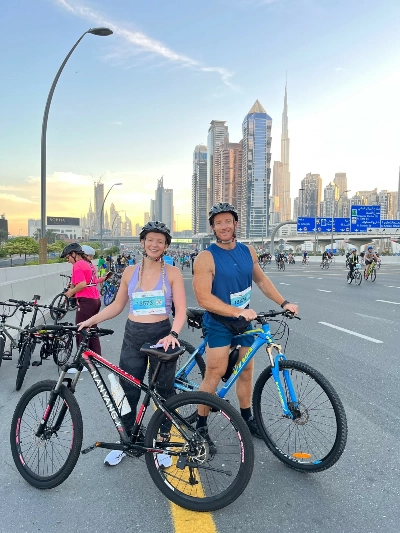
When the Dubai Fitness Challenge (DFC) launched in 2017, the city was introduced to a new concept that immediately captured the attention of fitness professional Nicky Holland. Recalling his first experience at a fitness village, Holland noted that he was struck by the sheer scale of the effort, describing the purpose-built sports facilities as an astounding achievement. That initial inspiration prompted him to organize a 30-day challenge for himself and his clients, a commitment that has persisted for nearly a decade as those same participants continue to return annually.
Over the course of nine editions, the 30×30 challenge has engaged more than 16 million participants. For Holland, who has served as a DFC Ambassador three times, the event is about more than just physical activity; it is about fostering habits that endure beyond the month-long initiative. He highlights the event’s simplicity as its greatest strength, noting that fitting 30 minutes of exercise into a busy schedule is achievable for most people. He believes the initiative is currently underrated and holds significant potential to be expanded into other countries, noting that friends and colleagues in the United Kingdom often express admiration for the movement when they see him training on Sheikh Zayed Road.
Personal milestones have also defined his experience. Holland cherishes the memory of taking his son on a bike for the first time during the Dubai Ride when the child was only eight months old. He views this as a vital opportunity to model a healthy, active lifestyle for the next generation. With the Dubai Ride presented by DP World scheduled to return on November 1, 2026, he encourages others to use the iconic route to create their own lasting memories.
As the city prepares for the upcoming challenge, which runs from October 31 to November 29, 2026, Holland observes a tangible shift in the local atmosphere. He points out that while gyms remain active, the real change is visible in public spaces like Kite Beach, where residents gather to run, cycle, rollerblade, and play sports. He advocates for the power of walking as an accessible, evidence-backed tool for improving circulation, mood, and energy levels, suggesting that starting the 30×30 challenge with a simple walk is a highly effective approach.
To help those struggling to maintain new routines, Holland recommends the practice of “habit stacking,” which involves pairing a new activity with an existing one, such as listening to a podcast while walking or taking vitamins during a morning coffee routine. By linking tasks, he argues that individuals can become more productive and successfully integrate healthy habits into their daily lives.
Looking toward the future, Holland remains optimistic about the evolution of the DFC. He envisions a time when the event might occur bi-annually or even quarterly, and he anticipates that advancements in wearable technology will play a larger role in future fitness challenges. Having worked extensively with corporate clients to implement monthly wellness programs, he hopes to see even greater business participation in the years to come. He remains excited to see how the initiative continues to grow and shape the city’s relationship with health and fitness. The report also notes that cast your mind back to 2017. The report also notes that it is perhaps the most understated proof of what Dubai Fitness Challenge was always capable of: turning a single inspiring moment into a habit that outlasts the 30 days of activity. The report also notes that i remember attending a fitness village and being amazed at the effort and set up. The report also notes that that moment of awe quickly turned into action. The report also notes that led the sessions and inspired the public to be fit, healthy and active year after year, he has clocked up the kilometres. The report also notes that there is one memory that he will cherish forever, but across nine editions.



Comments