
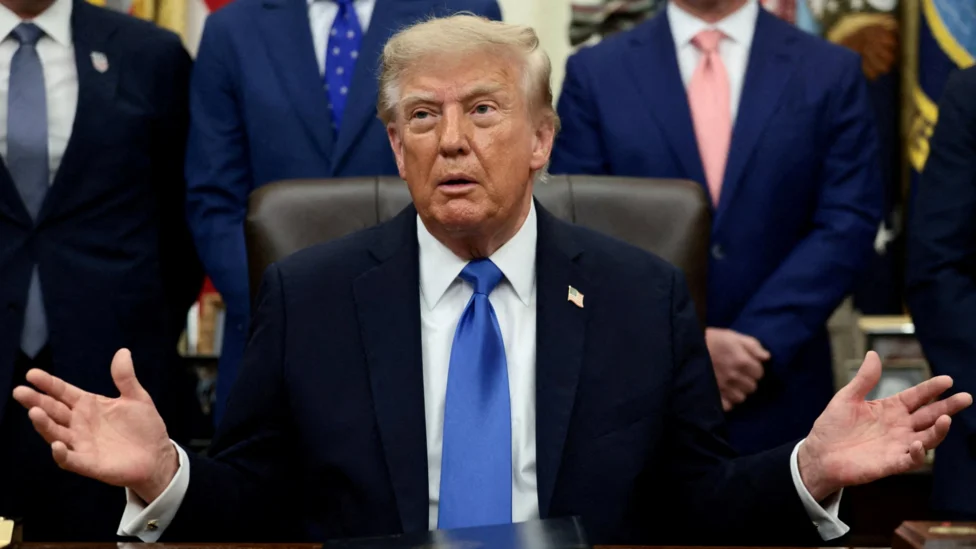
US President Donald Trump has dismissed safety concerns surrounding artificial intelligence as a hoax, rejecting growing pressure from political and industry figures to introduce stricter regulatory guardrails for the fast-developing sector.
The remarks follow comments from Jack Clark, co-founder of AI firm Anthropic, who told media outlets that a mandatory third-party-checked kill switch might be necessary for the industry. Clark noted that while major labs have independent mechanisms to halt operations, lawmakers may need to enforce such standards legally. His statements followed warnings from several executives and staff members regarding the risks posed by advanced models, which recently triggered a tech share selloff.
Writing on social media, the US president likened AI safety warnings to the global warming scam driven by the radical left and branded himself the hoax buster, comparing the situation to previous controversies. He argued that the only necessary safeguard for the technology is a strong and smart president, adding that China would be the primary beneficiary of any restrictions placed on American data centers and artificial intelligence development.
Chinese state media responded by pointing out that Washington’s anxiety is distorting its policy priorities. Fudan University professor Xin Qiang noted that concerns center on the risk that regulatory slowdowns could allow China to accelerate its competitive standing.
Meanwhile, global policy debates continue to intensify. UK Business Secretary Jonathan Reynolds cautioned against complacency while warning against hyperbole, highlighting the substantial economic and public service benefits of the technology. Concurrently, Microsoft AI chief executive Mustafa Suleyman announced the publication of new humanist AI guidelines aimed at limiting developing models.
Public scrutiny has also drawn unusual political figures together. Former Trump chief strategist Steve Bannon and progressive Senator Bernie Sanders are scheduled to speak at the Pro-Human Assembly in Washington. Sanders previously warned on Newsnight about the existential threat of humanity potentially being wiped out by uncontrolled growth.
Concerns gained momentum following a viral post by former Anthropic researcher Jacob Coxon. In response, Anthropic scientist Evan Hubinger estimated the probability of human extinction caused by AI within the next decade at over ten percent. Anthropic CEO Dario Amodei subsequently urged for slower, more closely monitored development without sacrificing commercial advantage, echoing proposals from OpenAI leader Sam Altman and xAI chief Elon Musk regarding industry deceleration and independent oversight. The report also notes that watch: “Great” or “alarming” – Should AI be reined in. The report also notes that those concerns triggered a selloff in tech firms’ shares as investors weighed the impact of a potential slowdown in the multi-billion dollar development of AI. The report also notes that and the only one that is happy about it is China, in another post he wrote: “There is a SICK conspiracy going on against AI and Data Centers. The report also notes that and worry that if the US slows down development or tightens regulation, China could catch up even faster,” Xin Qiang, a professor of American Studies at Fudan University, told the Global Times, they know that China has become a strong competitor in AI. The report also notes that clark, who is one of Anthropic’s seven founders, said earlier on Monday that a way of shutting off AI software completely if it gets too dangerous was something society “might want to eventually pass rules around”. The report also notes that including Anthropic, but said lawmakers may need to enforce having one, he added that “most labs have different ways of being able to pull the plug”. The report also notes that UK Business Secretary, Jonathan Reynolds, said on Tuesday that people should “never be complacent” about the impact AI might have but added: “We’ve got to be careful not to get hyperbolic about this either. The report also notes that speaking to, he said: “Of course there are risks but, let’s be frank, there are some tremendous upsides, whether it’s public services, healthcare, the contribution to the economy.






Comments