
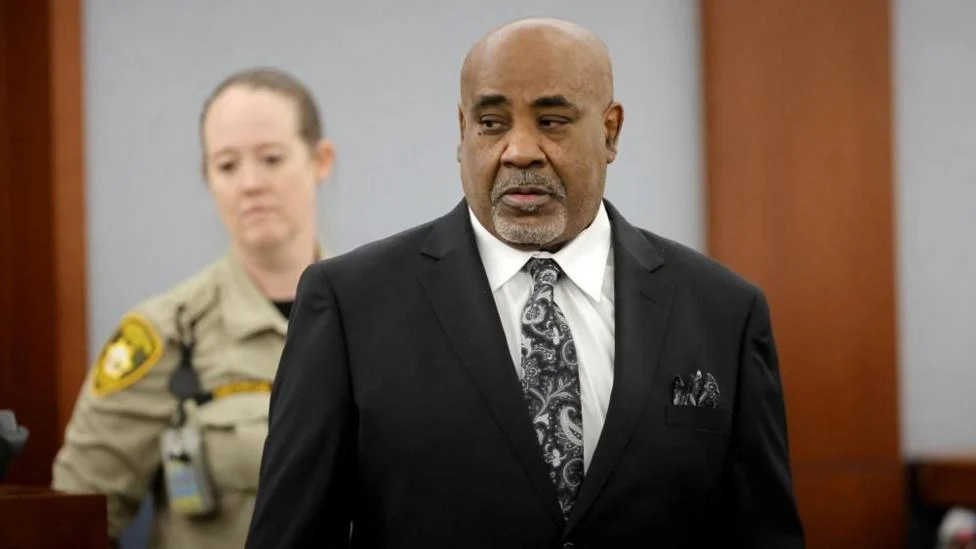
The trial of Duane “Keffe D” Davis, the man accused of orchestrating the 1996 killing of rap icon Tupac Shakur, entered a pivotal phase as jurors listened to a 2008 police interview. In the recording, Davis told detectives that he had supplied the firearm used in the drive-by shooting, but that it was his nephew, Orlando Anderson, who ultimately pulled the trigger.
Davis, now 63, faces a charge of murder with a deadly weapon. Prosecutors contend that while Davis did not physically fire the shots that ended Shakur’s life, he acted as the mastermind who provided the weapon to further the interests of the gang he led. Davis has entered a plea of not guilty to the charge.
The 2008 interview was conducted by Los Angeles Police detectives Daryn Dupree and Greg Kading during an investigation into the death of Christopher Wallace, known as The Notorious B.I.G. During the session, Davis described the moments leading up to the shooting, noting that the Cadillac he occupied pulled up alongside the car carrying Shakur. Davis claimed he initially passed the gun to Deandre “Big Dre” Smith, who declined to use it, before Anderson took the weapon and opened fire. Anderson, who died a decade before the interview took place, had consistently denied any involvement in the rapper’s death.
The prosecution’s case relies heavily on this 2008 testimony and statements made in Davis’s 2019 memoir, “Compton Street Legend.” Prosecutors argue that Davis sought retaliation for a fight involving his nephew and Shakur at a Las Vegas casino earlier on September 7, 1996. In his book, Davis wrote that the altercation provided the “ultimate green light” to target the rapper. However, Davis has since distanced himself from the memoir, claiming that parts of the text were fictionalized to boost sales.
A point of contention remains the immunity agreement discussed during the 2008 interview. Detective Kading told Davis at the time that nothing said during the session could be used against him. Prosecutors, however, argue that this agreement was voided when Davis later publicized his account in his book. Defense attorney Michael Sanft has challenged the reliability of these statements, urging jurors to question whether Davis was simply repeating “fiction” to gain attention or leverage. Sanft maintains that the prosecution’s witnesses are unreliable and that the original police investigation was deeply flawed.
The trial also touched upon alleged meetings between Davis and music mogul Sean “Diddy” Combs regarding the incident. When questioned by detectives about discussions involving the murder of Shakur and Death Row Records founder Marion “Suge” Knight, Davis indicated that the conversations concerned both men. Representatives for Combs have not provided a response to these claims.
Earlier in the week, a former Las Vegas homicide detective testified that no witnesses were able to identify the shooter at the time of the incident. Conversely, James “Mob James” McDonald, a former member of Shakur’s entourage, testified that although he did not witness the shooting, word spread quickly within the rapper’s circle about who was responsible. He described the environment as a “gang war” where people were actively being sought for retaliation following the casino fight. The report also notes that his lawyer Michael Sanft has argued that what his client had previously said of his involvement cannot be believed. The report also notes that shakur’s murder is a cold case that has gripped the public’s fascination for 30 years. The report also notes that yeah, if we would’ve been on my side, I would’ve blasted,” Davis said, according to a transcript. The report also notes that according to a transcript shown in court, as reported by Reuters, which of those four is it when you talk to him about murdering Tupac?” Kading asked. The report also notes that yeah, either one of them,” Davis responded, it was really about both of them. The report also notes that you have to corroborate everything I say in order for it to be true.
Comments