
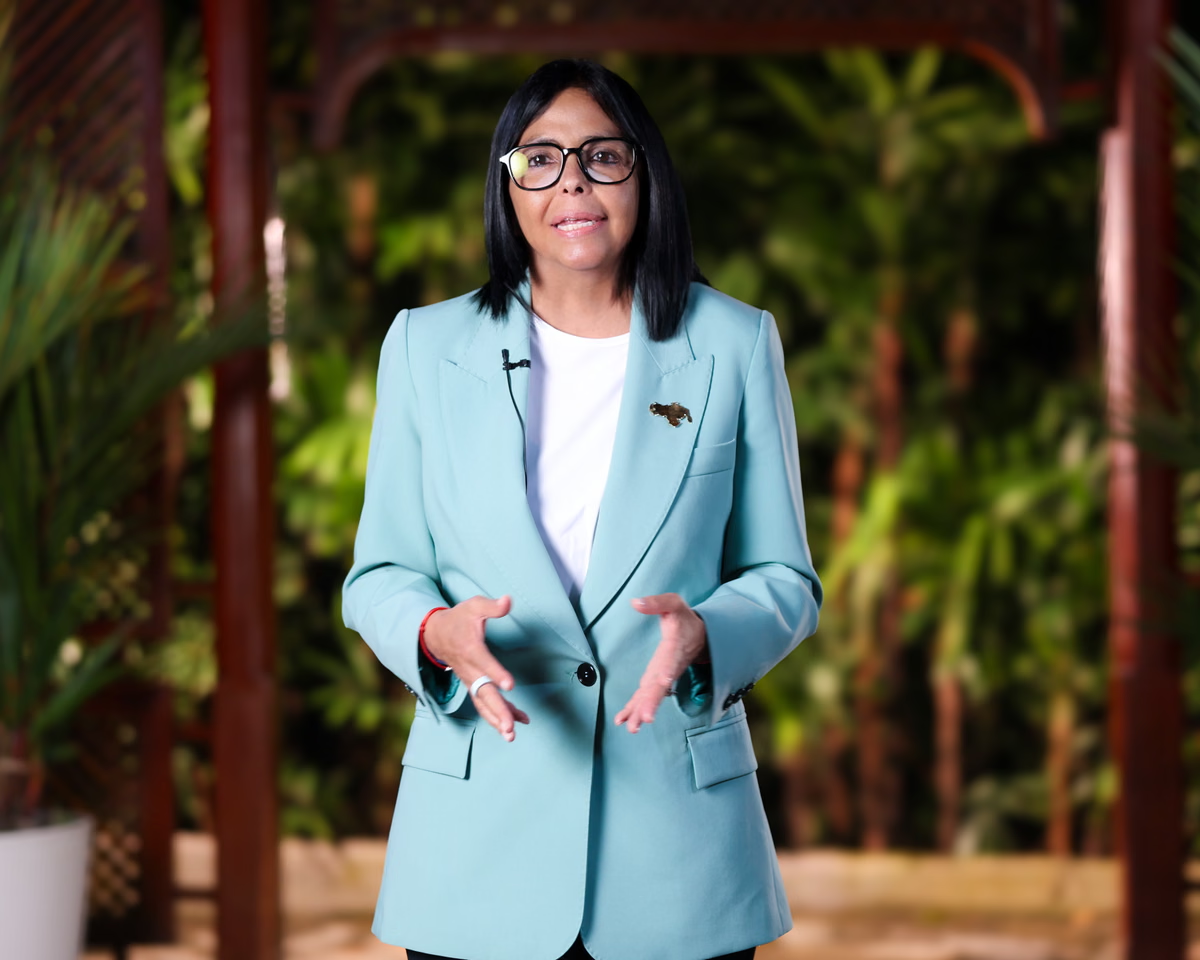
Venezuela’s interim president, Delcy Rodríguez, has publicly defended a controversial energy agreement with Donald Trump, asserting that the nation will retain sovereignty over its vast oil reserves despite the deal’s scale. Rodríguez, who took power in January following the US-led capture of Nicolás Maduro during a special forces operation in Caracas, characterized the arrangement as a vital economic opportunity.
Addressing the public in a six-minute televised broadcast on Saturday, Rodríguez pushed back against mounting criticism of what the US president has described as the “biggest oil deal in world history.” She claimed the agreement would help transform Venezuela into an “energy powerhouse,” projecting revenues exceeding $209 billion. “The benefits are endless,” she stated, emphasizing that the country’s massive underground reserves require foreign investment, technology, and infrastructure to generate actual wealth for the population.
The agreement, finalized after months of clandestine negotiations, reportedly grants Washington control over 65 billion barrels of crude. Trump, who announced the deal on Friday, hailed it as a “historic transaction” that would more than double American oil reserves. On his Truth Social platform, the US president noted that the “topping out” process would begin shortly, framing the move as a “Gift from Venezuela to the People of the United States” intended to replenish the Strategic National Reserves.
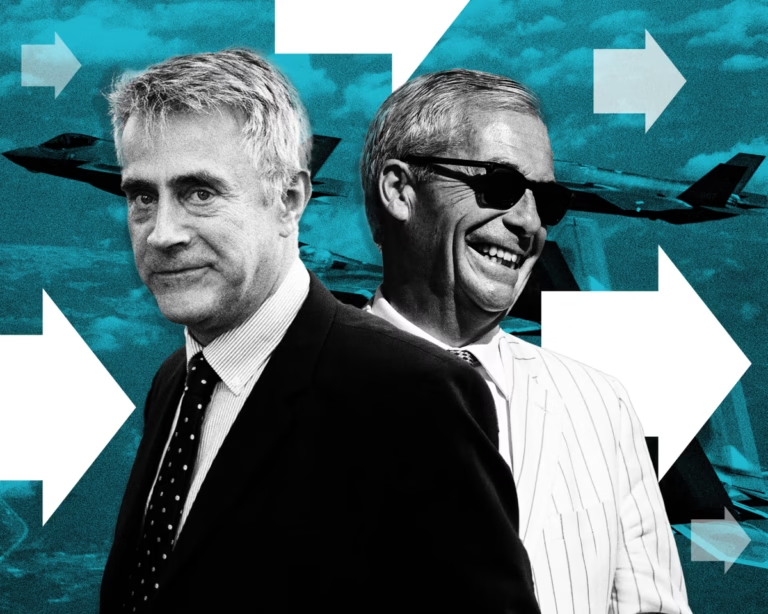
The deal involves 17 strategic oilfields with a production target of 1.5 million barrels per day. It also incorporates a private firm owned by Alejandro Betancourt, a UK-based businessman who has functioned as a primary intermediary between the Trump administration and the Venezuelan leadership.
The announcement has sparked significant outrage within Venezuela, drawing sharp rebukes from both the political opposition and members of the Chavismo movement. Critics have labeled the agreement a “massive land grab” and a “neocolonial” transaction. Rafael Ramírez, the former head of the state-owned oil company PDVSA, accused the current administration of betraying the nation, while protesters in Caracas marched with signs declaring that Venezuela is not a colony.
In response to accusations that she is surrendering national resources, Rodríguez insisted that Venezuela maintains ownership. She expressed gratitude to Trump and US Secretary of State Marco Rubio for the deal, though her stance marks a dramatic shift from her previous rhetoric. As recently as 2024, she had publicly denounced imperialist attempts to seize the country’s natural resources, and in September, she warned that the Pentagon had long sought to capture Venezuelan reserves.
The agreement is expected to involve the Pentagon’s Office of Strategic Capital, which focuses on national security-related investments. However, the deal has deepened concerns regarding the future of Venezuelan democracy. With Maduro removed and no clear timeline for elections—which Rodríguez has vaguely suggested might occur “some day”—opposition figures argue that the move undermines efforts to restore representative government.
Opposition leader Juan Pablo Guanipa criticized the arrangement on social media, arguing that long-term economic stability is only possible through free elections and the rule of law. Without these democratic foundations, Guanipa warned that the energy deal remains a fragile structure built on “pillars of clay.” Trump has previously suggested that Venezuela is not yet prepared for electoral processes, further complicating the political outlook.
The pressure on Rodríguez remains intense. Following the January raid that ousted Maduro, Trump warned her that she would face severe consequences if she failed to comply with US directives, stating she would pay a price “probably bigger than Maduro.” As the administration moves forward with the oil transfer, the government faces a growing divide between its economic promises and the domestic backlash over the loss of control over its primary natural resource. The report also notes that but having resources underground isn’t enough. The report also notes that only to appear in statistics or bookkeeping … and for us not to be able to convert and translate them into development for Venezuela.”, she added: “It’s no use having our oil reserves underground. The report also notes that on Sunday, Trump wrote on his Truth Social platform: “One of the things I am going to do with the Venezuelan Oil is fill up the Strategic National Reserves which, because of Sleepy Joe Biden, has been virtually emptied.”. The report also notes that hours after seizing Maduro on 3 January, Trump warned Rodríguez she would face an even worse fate if she failed to toe the US line. The report also notes that with an estimated 303bn barrels, compared with Saudi Arabia’s 268bn and Iran’s 208bn, the South American country has the world’s largest proven crude oil reserves. The report also notes that and I think nowhere else in the world,” Ramírez added in an interview with the newspaper El Nacional, that has never happened in Venezuela. The report also notes that on Saturday, dozens of leftwing protesters marched through Caracas with banners reading: “We are neither a colony, nor a back yard” and “Yankees go home!”. The report also notes that “We are thinking of Venezuela’s future,” claimed the politician, whose country was plunged into authoritarian rule and one of the world’s worst peacetime economic crises during Maduro’s 13-year rule.



Comments