
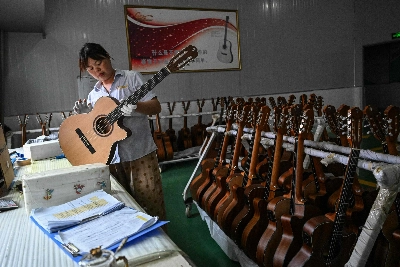
In the town of Zheng’an, located in China’s southwest Guizhou province, the local economy is defined by a single instrument. From a massive guitar sculpture in the town square to murals and even guitar-shaped trash bins, the town’s identity is unmistakable. This region, which lacked a significant guitar industry just ten years ago, now accounts for one out of every seven guitars sold globally.
The town’s rapid industrial expansion serves as a case study for China’s broader economic strategy, which leverages local conditions alongside government investment. Historically, working-age residents migrated to manufacturing hubs like Guangzhou. Zheng Chuanjiu, founder of Shenqu Guitar, was among those who left to build a business in the provincial capital. He noted that his Guangzhou staff were largely fellow villagers from Zheng’an, and the company was performing well at the time.
In 2012, local authorities launched the “return the phoenix to the nest” initiative, designed to bring skilled migrant workers back home to start their own enterprises. Zheng recalled that county officials actively reached out to him, encouraging his return to help develop the local industry. Shenqu became the first manufacturer to establish itself in the new economic zone. As the business grew, Zheng encouraged friends to join him, and today, a banner inside his factory reminds workers: “Why go far away to work when home is the best place?”
Over the last decade, 87 homegrown brands have emerged within this industrial cluster. To attract businesses, the government provided comprehensive support, including 10 years of free rent and three-year tax exemptions. Beyond financial incentives, the region benefits from a climate ideal for instrument production. Master luthier Zhang Weiyi, who moved his operations from Guangzhou in 2019, noted that while he produces only about 150 custom guitars annually, the broader industry has scaled significantly.
Collectively, Zheng’an now manufactures 2.5 million guitars each year, earning the moniker “Capital of Guitars, City of Music.” The town has become a major export hub, shipping 248 million yuan ($36 million) worth of instruments to over 40 countries in 2025. Local authorities continue to streamline export-rebate procedures, with registered enterprises receiving 147 million yuan in tax reductions and exemptions between January and July 2025.
While Chinese state subsidies have faced criticism from the U.S. and Europe regarding industries like solar panels and electric vehicles, economists like Dong Xuebing of Zhejiang University argue that such regional specialization is vital. He suggests that focusing on unique industrial foundations helps prevent population loss to major cities and fosters development in neglected areas. For the residents of Zheng’an, the impact is also cultural; Zhang observed that the town now enjoys a vibrant atmosphere where adults and children alike are frequently seen carrying guitar cases to lessons. The report also notes that “Whether the industry is big or small, whether it’s making an impact, that doesn’t really matter to me,” the 50-year-old said as he carefully sanded down a piece of ox bone to fit into the custom guitar he was making by. The report also notes that producing items ranging from bicycles to socks, there are hundreds of specialised manufacturing towns in China. The report also notes that but the speed and scale of Zheng’an’s rise make it an example of the impact of China’s industrial strategy when a combination of local and central government investment is deployed to maximise favourable local conditions. The report also notes that “After I’d been working here for a few years, many friends saw how well I was doing and came here to join me to develop the industry,” he said. The report also notes that rows upon rows of finished guitars sat neatly on racks, awaiting final tuning checks before shipment, when AFP visited Shenqu in July.








Comments