
The Black Sea has become the world’s most perilous region for commercial shipping following a dramatic escalation in hostilities between Russia and Ukraine. Throughout July, the intensity of strikes against vessels and port infrastructure resulted in more crew fatalities than the total number recorded since the conflict began in 2022. Estimates from the Turkish seafarers’ union, Türkiye Denizciler Sendikası, indicate that as many as 23 people lost their lives during July alone, with 35 ships targeted.
This surge in violence has drawn sharp condemnation from the International Maritime Organization, which warned of a broader “deterioration of maritime security around the globe.” While the region remains the primary focus, shipping lanes in the Red Sea, the Gulf of Aden, and the Strait of Hormuz also continue to face significant security challenges.
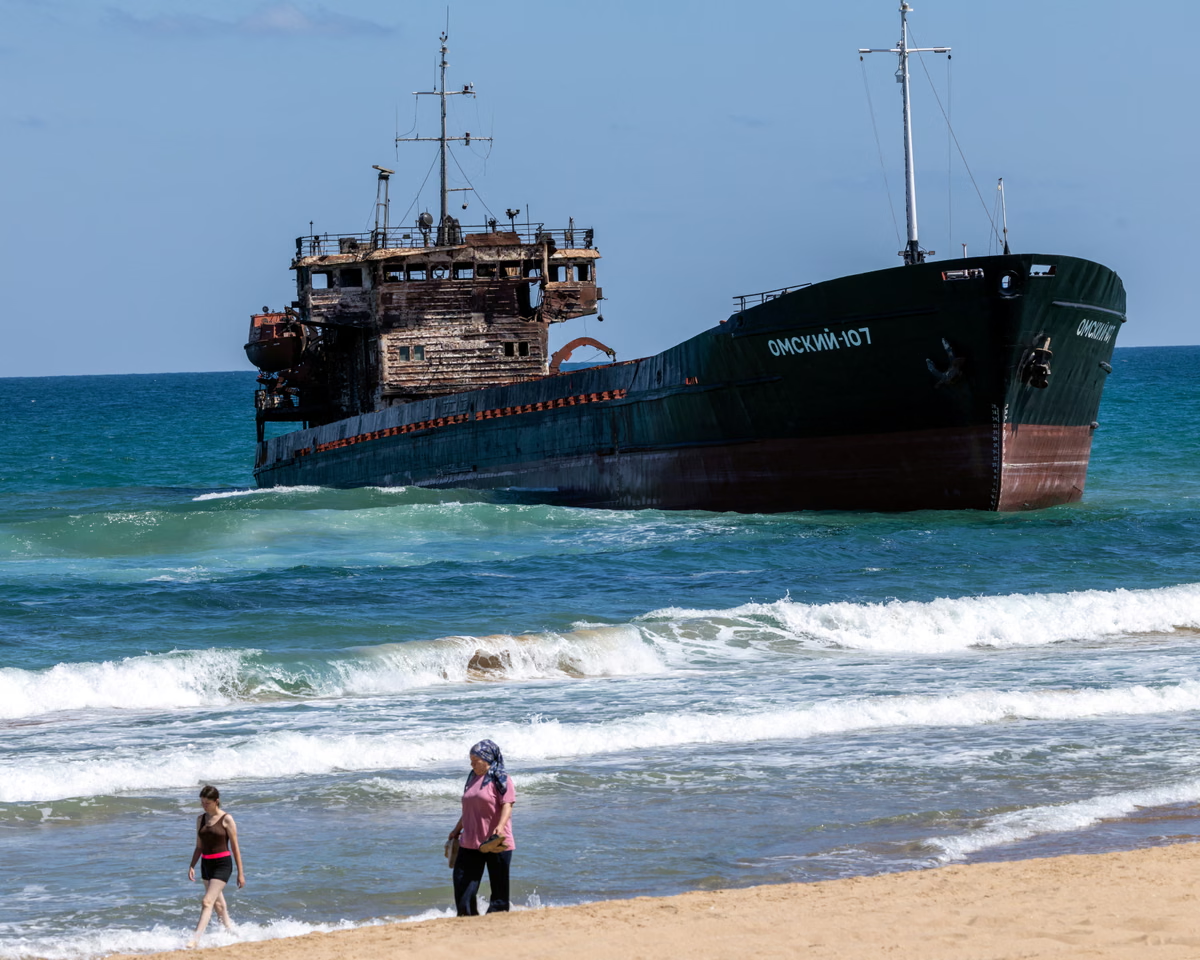
The conflict has evolved from Russia’s initial 2022 strategy of blockading Ukrainian ports like Odesa and Chornomorsk to a more volatile exchange. Ukraine has increasingly utilized drones to retaliate, targeting Russian vessels—including tankers suspected of forming a shadow fleet to bypass oil sanctions—and critical infrastructure at the port of Novorossiysk. The danger was underscored when the Russian-flagged cargo ship Omskiy-107 was struck by a drone near Novorossiysk. The crew abandoned the vessel, which then drifted for hundreds of miles before running aground on the Turkish coast.
Analysts at the maritime risk intelligence firm Vanguard note that merchant vessels are facing heightened threats due to their cargo, trading activities, and the ports they frequent. The scope of these attacks has expanded beyond immediate port approaches, creating a wider zone of danger across the Black Sea. This instability has severely hampered grain exports from both nations, which are among the world’s top producers.
Russia, the world’s largest grain exporter, has seen its capacity drop significantly; Tatiana Orlova, lead emerging markets economist at Oxford Economics, noted that Russian grain exports were estimated to be at only 40% of normal capacity in August. While Moscow has attempted to redirect trade through the Baltic, Caspian, and Pacific routes, over 70% of its seaborne grain still relies on Black Sea ports. Ukraine faces similar constraints, with the food minister reporting that the country managed to export only one-third of its potential capacity—roughly 1.4 million tonnes—using a combination of rail, road, river, and sea routes.
The resulting supply chain disruptions are fueling fears of rising food costs. Although global wheat prices remain below the peaks seen at the start of the 2022 invasion, the current instability is expected to exacerbate other global shocks, including the conflict in Iran and reduced yields due to extreme heat and El Niño. Oxford Economics forecasts that global food prices will rise by nearly 12% this year, with a further 4.8% increase projected for 2027.
Despite these grim projections, there is some degree of resilience in the global market. Orlova noted that many food-importing nations are better prepared than they were in 2022, having built up significant grain stocks. Nevertheless, the ongoing maritime volatility makes it clear that food prices will remain under significant upward pressure as the Black Sea remains a contested and dangerous theater of war. The report also notes that preventing Kyiv from exporting grain, russia first launched waves of attacks on port infrastructure and vessels anchored in Ukrainian Black Sea ports in the months after its invasion in 2022. The report also notes that “Merchant vessels are now more likely to be affected because of the ports they visit, their trading activity and the cargoes they carry. The report also notes that raising concerns the disruption will worsen the impact of other food price shocks and hurt countries reliant on imported wheat, barley and maize, the precarious maritime situation has already significantly reduced Russian and Ukrainian grain exports. The report also notes that with its produce mostly going to the Middle East and north Africa, particularly Turkey and Egypt, while Ukraine is the fifth-largest, russia is the world’s largest grain exporter. The report also notes that however, more than 70% of Russia’s seaborne grain exports are shipped from Black Sea ports, and a further 20% from the Sea of Azov, according to analysis from Oxford Economics. The report also notes that but remain below levels at the beginning of the Ukraine war in 2022, global wheat prices have been trading higher in recent weeks.







Comments