
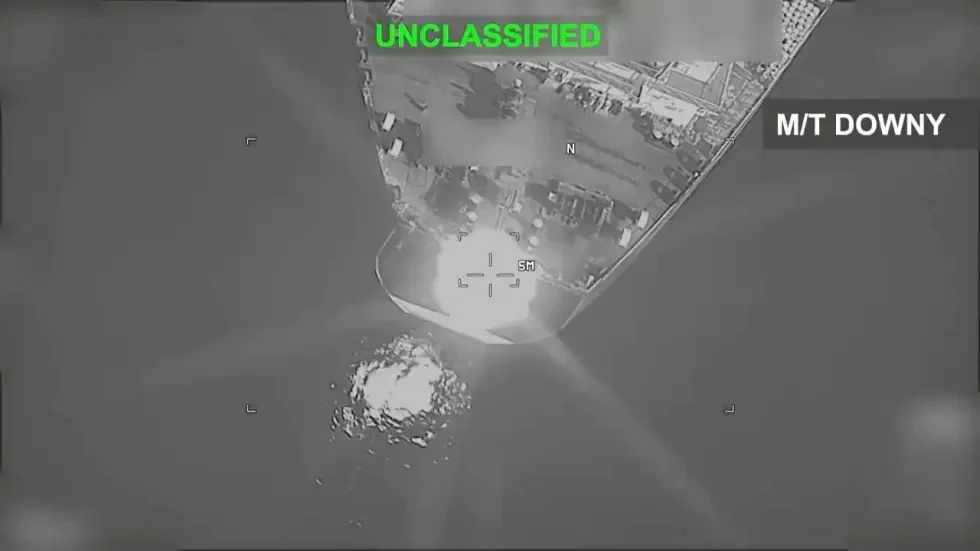
U.S. forces conducted strikes against three Iranian oil tankers on Saturday, marking a significant escalation in the ongoing regional conflict. The military action followed reports that American Navy warships were targeted by ballistic missiles while patrolling the region. Adm. Brad Cooper, head of U.S. Central Command, stated that the U.S. would, “if necessary, destroy Iran’s limited and exposed oil fleet,” characterizing the tankers as part of a shadow network supporting the Revolutionary Guard and its regional proxies.
The U.S. military reported that an aircraft carrier and a destroyer successfully evaded multiple unprovoked attacks, with no U.S. personnel suffering injuries. According to the official statement, two of the targeted Iranian oil carriers were permanently disabled, while a third, unladen vessel was destroyed. The strikes occurred near Kharg Island, Jask, and in the Gulf of Oman. Video footage of the operations was released by the U.S. military to support their account of the engagements.
Tehran responded by claiming its own forces struck back against three oil tankers and three American vessels. While these Iranian claims could not be immediately verified, a spokesperson for Iran’s joint military command warned that any further U.S. interference with Iranian shipping would result in more severe military retaliation. Iran’s Foreign Ministry condemned the U.S. actions as a war crime, asserting that Washington and its allies would bear the consequences of ongoing economic warfare.
The latest hostilities follow a week of renewed fighting that broke out after a brief period of relative calm. Earlier in the week, at least five people were killed during a U.S. bombardment in southern Iran, which included a strike on a wedding celebration. Thirteen-year-old Masoumeh Zarei, who was wounded in that attack, described being knocked unconscious when a telecommunications tower was hit. Her friend, 14-year-old Kiana Karimi, who remains in intensive care, recalled hearing five explosions that threw them to the ground.
This surge in violence comes despite President Donald Trump’s recent attempt to characterize the conflict as “small potatoes.” The current hostilities represent a return to active combat following six months of intermittent warfare that began with U.S. and Israeli strikes on February 28. Both nations have continued to inflict military and economic damage on one another, even as diplomatic efforts remain stalled.
Vice President JD Vance stated on Thursday that there is no prospect for renewed negotiations while Iran continues to target vessels, noting that major military operations had officially concluded in July. Conversely, the administration of Iranian President Masoud Pezeshkian has publicly expressed a desire for a negotiated resolution to the war. Despite these diplomatic overtures, the collapse of a mid-June memorandum of understanding regarding Iran’s nuclear program has led the U.S., Britain, France, and Germany to seek a referral of Iran to the U.N. Security Council for noncompliance.
As the blockade continues, Iran has relied on its shadow fleet to circumvent sanctions and export oil. The Strait of Hormuz remains a central point of contention, with the U.S. providing guidance to commercial ships while Iran asserts control over the waterway. Danny Citrinowicz, an Iran expert at Israel’s Institute for National Security Studies, noted that the targeting of a U.S. aircraft carrier suggests Tehran is increasingly willing to accept significant risks to threaten vital American military assets. The report also notes that earlier, Iranian state television had said that four U.S. The report also notes that missiles struck a tanker about 6 miles (10 kilometers) from Kharg Island, home to a terminal through which the country exports most of its oil. The report also notes that said its crew had been “directed to abandon ship.” The statement shared what it called video footage of the strikes. The report also notes that aircraft carrier with a ballistic missile “indicates that Tehran is becoming increasingly willing to accept risks it previously sought to avoid, including directly threatening some of the most important U.S. The report also notes that masoumeh Zarei, 13, was wounded in the attack. The report also notes that she spoke to The Associated Press at a hospital while being treated for injuries to her abdomen. The report also notes that her next memory was of waking up in a hospital.





Comments