
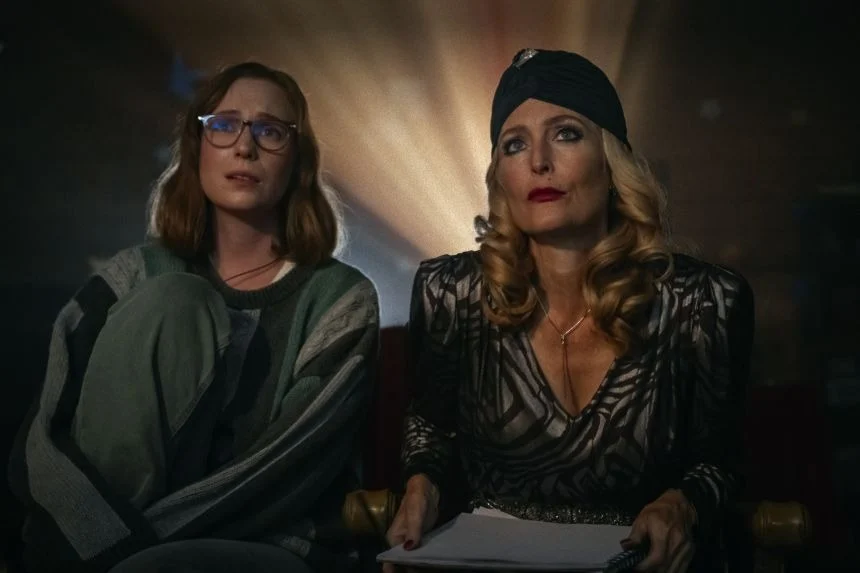
Director Jane Schoenbrun’s latest project, “Teenage Sex and Death at Camp Miasma,” serves as both a stylistic homage to 1980s slasher cinema and a deeply personal investigation into the nature of intimacy. The film, which earned the Queer Palm at the Cannes Film Festival, follows the journey of characters attempting to navigate the complexities of desire, authenticity, and self-acceptance. Featuring performances from Hannah Einbinder and Gillian Anderson, the movie represents a significant step into the mainstream for Schoenbrun, blending experimental horror with the emotional weight of a romantic comedy.
At the center of the story is Kris, an intellectual filmmaker played by Einbinder, who is tasked with revitalizing a stagnant 1980s horror franchise. Her search for inspiration leads her to Billy, the retired “final girl” from the original film, portrayed by Anderson. As the two begin a tentative romance at a remote compound, they confront their own difficulties in being truly present with a partner. For Schoenbrun, the film acts as a metaphor for the challenges of establishing a healthy sexual identity, particularly after years of dissociation. The 39-year-old trans filmmaker noted that learning to have “good sex” requires a level of self-presence that was difficult to attain prior to their own transition.
The film deliberately draws parallels between the experience of watching a scary movie and the vulnerability required for intimacy. Schoenbrun describes this as “safe danger,” a psychological space that allows individuals to confront their fears in a controlled environment. Within the narrative, this manifests through the titular “Camp Miasma,” where characters transform their anxieties into play. The director explained that the intent was to reshape traditional horror imagery into something liberatory, treating sex as a practice of honesty rather than a precursor to inevitable tragedy.
The narrative also critiques the way horror films have historically handled trans identity, utilizing the tropes of the genre to highlight the struggle of feeling disconnected from one’s own body. The character of Billy, for example, describes her first sexual encounter as a hollow, dissociative event where she felt she had to “stop being herself.” Kris shares a similar struggle, admitting that she often retreats into fantasies—such as the roles of “victim” or “slut”—to cope with the vulnerability of being with another person. This internal conflict is visualized by a silent, voyeuristic entity named Little Death, whose presence underscores the characters’ feelings of being watched and judged.
Despite the eerie atmosphere and the presence of camp-inspired gore, the film ultimately argues for the joy and power found in reclaiming one’s own body. Whether through the shared indulgence in junk food—which Schoenbrun jokingly refers to as essential for good sex—or the candid discussions between the two leads, the film portrays intimacy as a process of learning. For the director, guiding the actors through these scenes was an exercise in their own growth as both a filmmaker and a person coming into their own identity.
Ultimately, the movie suggests that the lines between fantasy and reality can be blurred to achieve a more authentic life. As the characters consummate their relationship, the boundaries of their environment break down into a vibrant, kaleidoscopic world where romance and gore coexist. By discarding the rigid scripts of the past, the characters find a way to navigate their desires with newfound freedom. It is a work that captures the tenderness and the terror of being vulnerable, presenting the act of opening oneself to another as a courageous and transformative endeavor. The report also notes that in her eyes, you can see that she’s not entirely there – she’s somewhere else, like a spectator, outside her body looking in. The report also notes that director Jane Schoenbrun’s slick new slasher fantasy film, “Teenage Sex and Death at Camp Miasma,” paints the banalities of bad sex like the one Billy (the aforementioned teen, played by Amanda Fix) has as a villain on par with Jason Voorhees or Michael Myers – and makes an argument for pursuing fantasy and pleasure as a path to self-actualization. The report also notes that a 39-year-old trans filmmaker, had to learn “after many, many years pre-transition of being just like fully dissociative and avoidant around sex.”, that’s a skill Schoenbrun. The report also notes that but it’s sex — and the struggle to be present enough to have it well — that provides the most fertile material for Schoenbrun to play with. The report also notes that in film critic and writer Payton McCarty-Simas ’ words, “it’s about how sometimes when you’re queer, it’s hard to get off.”. The report also notes that “ I Saw the TV Glow ” helmer Schoenbrun has become something of a cult sensation for their reference-rich experiments in horror, which are at once cerebral – Foucault references are dropped deftly – and emotionally hefty. The report also notes that transphobic ‘80s franchise, the titular “Camp Miasma,” with her stamp of queer approval. “They’re looking for elevated, aka woke,” quips Kris’ agent, played by a perfectly annoying Sarah Sherman, she’s a rising star who’s been recruited to resuscitate a stagnant. The report also notes that she finds the older star – played by Anderson as an elegant femme fatale with a luxurious Southern twang – living as a mysterious recluse a la Norma Desmond on the real abandoned camp where the original movie was filmed.





Comments