
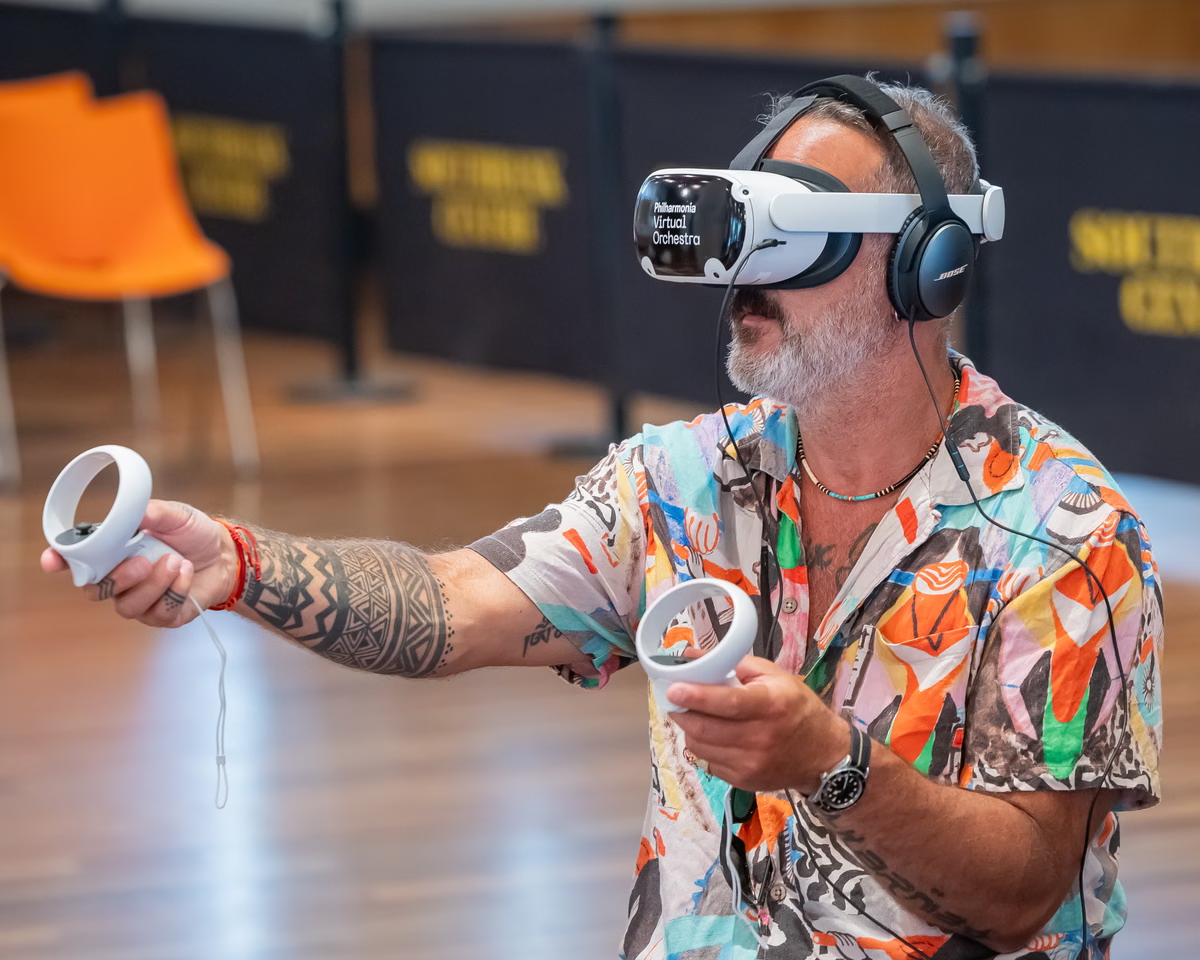
Stepping onto the stage at the Royal Festival Hall, I found myself surrounded by the Philharmonia Orchestra, ready to perform the finale of Rossini’s William Tell Overture. Despite having never touched a percussion instrument or read a musical score, I was suddenly part of the ensemble. This immersive experience is made possible by Virtual Orchestra, a new VR project developed by the Philharmonia to bridge the gap between audiences and professional musicians.
Marta Génova, the orchestra’s head of digital product and experience, guided me through the setup, ensuring my headset was secure before introducing me to the percussion options: triangle, cymbal, or timpani. After a brief tutorial from Philharmonia percussionist Tom Edwards, the performance began. As conductor Santtu-Matias Rouvali took the podium, a digital score appeared in my field of vision, guiding my timing as the strings swelled around me.
The Philharmonia has a long history of technological innovation, dating back to its 1945 founding as a specialized recording orchestra. More recently, the group has utilized digital displays to bring orchestral music to venues like the Science Museum. This latest initiative, however, is primarily educational. With GCSE Music entries dropping by 27% since 2010, the orchestra is looking for new ways to engage younger generations. CEO Thorben Dittes noted that while the orchestra cannot physically visit every school in the country, virtual reality offers a scalable solution to provide high-quality music education.
During a pilot program earlier this year, the technology was tested in 12 schools across Leicestershire, Derbyshire, and Lincolnshire. Among the 428 year 7 students who participated, 75% had never attended a classical concert before. Following the experience, 96% expressed interest in attending a live performance, and 60% felt motivated to learn an instrument. Dittes emphasized that the goal is to keep students engaged with the fundamentals of rhythm and notation through an interactive, enjoyable medium.
The experience is designed to be more than a simple game. Génova explained that the team wanted to create something genuinely useful, teaching skills that could eventually transfer to real-world musical practice. While the interface—which displays colored notes as they approach the clef—will feel familiar to fans of rhythm-based video games, the technical demands are real. Mastering the timpani requires precise wrist control, particularly during drum rolls, which proved to be the most challenging aspect of my performance.
Despite my initial hesitation, I managed to score 84% on the “hard” mode, a result confirmed by former Clean Bandit member Love Ssega. The competitive nature of the software has even caught on among the orchestra’s staff, with Dittes admitting his own score was rather poor. While the virtual experience cannot fully replicate the nuanced physical feedback of a real instrument, it serves as a powerful entry point for aspiring musicians. When asked if such technology could lead to a future career in the orchestra, Dittes remained optimistic, suggesting that if a user can demonstrate consistent skill, it might just be the path to finding the next great percussionist. The report also notes that i’ve barely had time to say “How do I hold these sticks again?” before the strings start swelling, Rouvali waves his baton and a musical score starts hurtling across the bottom of my vision. The report also notes that back when such a thing was still a novelty, and more recently they’ve provided immersive digital orchestral experiences, lighting up the walls of places such as the S, they were founded in 1945 as a “recording orchestra”. The report also notes that with GCSE Music entries falling 27% since 2010, the scheme was spurred on by recent research highlighting declining music participation in schools. The report also notes that in fact, I’ve not even seen the score. The report also notes that nervously taking my place among the virtuosos, I look around: the brass, string and woodwind sections are all warmed up and ready to be led by the energetic conductor, Santtu-Matias Rouvali. The report also notes that then I glance up at the audience: the Royal Festival Hall is packed to the rafters. The report also notes that cymbal and timpani (the last is “definitely the most fun”, Génova assures me) and after a quick run-through of the sounds you can get from your instrument, courtesy of Philharmonia percussionist Tom Edwards, you’re thrown into a rehearsal and then the actual performance, you’re offered the choice of triangle. The report also notes that oh God, I think, am I about to screw this up.





Comments