
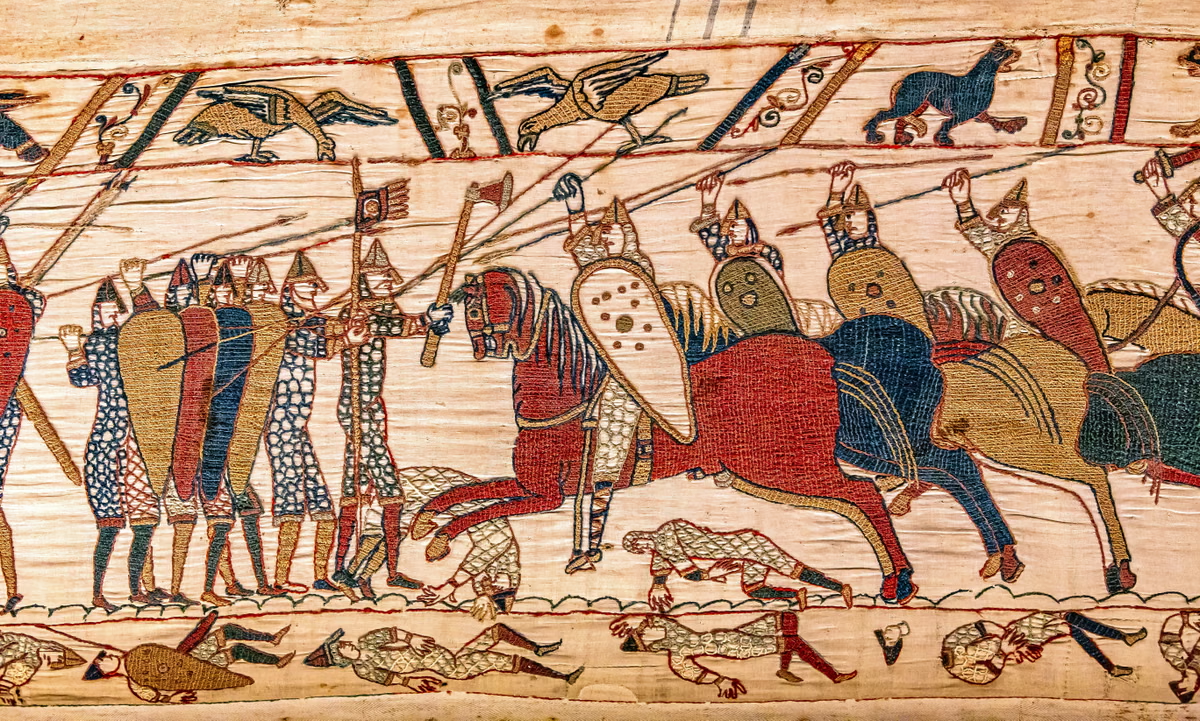
The Bayeux Tapestry defies conventional artistic standards. Its creators lacked the traditional tools of the era—such as mastery over pictorial depth, landscape perspective, or realistic portraiture—yet they produced a work of profound impact. Whether the product of a single visionary or a collective, the tapestry stands as a stunning achievement, blending horror, humor, and visual storytelling in a way that surpasses most paintings or carvings from the period. The fact that it is rendered in embroidery on a strip of linen only adds to its remarkable nature.
Currently on display at the British Museum, the tapestry is presented in a high-quality glass case that allows for an intimate viewing experience without the distraction of reflections. The exhibition path guides visitors through historical context, including armor and chronicle excerpts, before leading to a parapet that offers an initial view of the tapestry’s vibrant russet, green, and yellow threads. From there, the narrative unfolds from left to right, illuminated by precise lighting that brings the 11th-century work to life.
The narrative is remarkably fast-paced, drawing viewers into a sense of impending doom and destiny. On October 14, 1066, the newly crowned Anglo-Saxon King Harold faced the invading forces of William, Duke of Normandy, near Hastings. The resulting battle was a turning point in history, leading to a Norman victory that fundamentally altered the English nation—a feat that later invaders like Philip II of Spain, Napoleon, and Hitler would fail to replicate.
The tapestry excels in its depiction of momentum. It functions like an 11th-century precursor to Eadweard Muybridge’s motion photography. Early scenes show messengers racing across the French countryside with hair streaming behind them, while the battle sequences capture the rhythmic, escalating speed of the Norman cavalry. As the horses gather pace, the riders’ postures shift, creating a sense of forward thrust that emphasizes the disciplined, lethal nature of the Norman advance.
Beyond the central action, the borders of the tapestry are filled with a secondary world of myth and monsters. Gryphons, dragons, and birds of prey populate the margins, occasionally breaking into the main scene. While there appears to be a structural logic—with the upper border representing a more sublime, heavenly sphere and the lower border depicting earthly, sinful creatures—this is occasionally subverted, as seen when two bare-chested female centaurs appear in the top margin, seemingly exclaiming, “Lo and behold!”
The work also captures the broader human experience of the era. While the elite prepare for war, the tapestry shows peasants continuing to plow and sow their fields, a poignant reminder of the continuity of life regardless of who rules. This perspective shifts again during the violence of the battle, where the tapestry does not shy away from the grim reality of war. Bodies pile up, and the depiction of King Harold’s death, while debated by historians, visually suggests the legendary arrow-to-the-eye moment.
The final scenes offer a stark conclusion to the conflict. As the battle ends, peasants are shown stripping the fallen knights of their armor, leaving the bodies exposed. This final flourish highlights the artistic brilliance of the medieval craftspeople, who managed to render the vulnerability of the human form with surprising intimacy. Spending time with the piece, one can easily exceed the allotted 40 minutes, as the tapestry demands a close, careful look to appreciate its full, earth-shaking narrative power. The report also notes that nothing about the Bayeux tapestry makes sense according to any norms of art: its creators couldn’t do proper portraits or pictorial depth or landscapes or any of the sophisticated things we associate with timeless masterpieces. The report also notes that they have to write what it is: Ecclesia, when they depict a church. The report also notes that perhaps she was a single artist – created something so stupefying and delightful, so abundant in visual thrills, horrors and humour, it beats almost everything else ever painted or carved – let alone embroidered on a strip of linen, but these artists – or who knows. The report also notes that in front of my eyes, close enough to touch if it wasn’t behind a glass screen of such high quality you never catch a reflection, and now here it is. The report also notes that the length of a gallery, which you reach after some archaeological foreplay involving armour, quotes from chronicles and info screens, it’s laid out in its case. The report also notes that greens, yellows – after which you simply start at the beginning and follow the story rightwards, then you see the colours of the tapestry below you from a parapet – russets. The report also notes that the Bayeux tapestry shines, surrounded by darkness and picked out by finely adjusted lighting. The report also notes that oliphants, troubadours, my only quibble is the ethereal soundtrack – shouldn’t there be drums.








Comments