

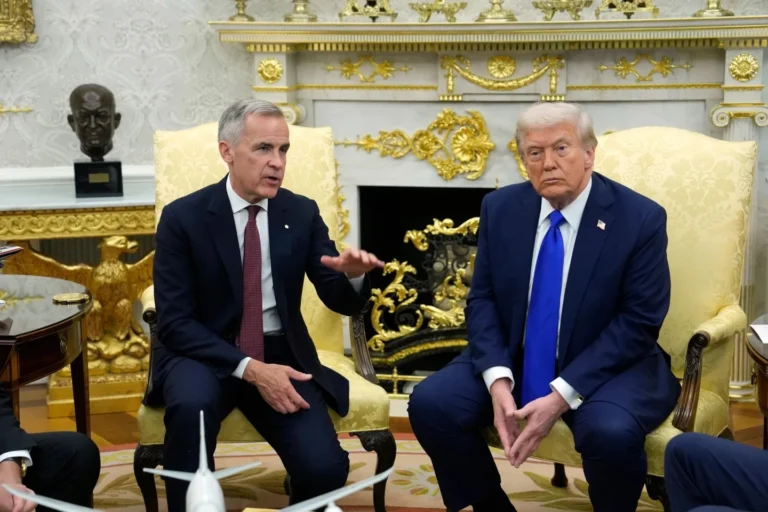
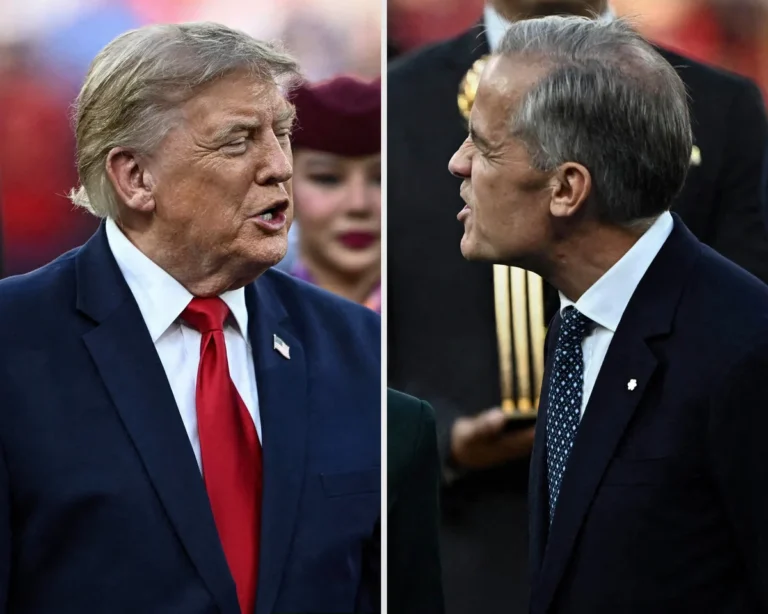
The long-standing, durable alliance between Canada and the United States has reached a breaking point following the collapse of critical trade negotiations. Prime Minister Mark Carney confirmed the shift on Friday, stating that Canada has accepted the reality that “America has changed” and that the two nations will “not return to our old relationship.”
The situation escalated early Saturday when the United States implemented 50% tariffs on approximately $20 billion worth of Canadian goods. In response, Carney announced that Canada would initiate dollar-for-dollar retaliatory measures beginning September 8. These countermeasures are set to target several key sectors, including steel, dairy, appliances, agricultural equipment, electronics, and the pulp and paper industry.
Carney had previously signaled this strategic pivot during the World Economic Forum in Davos this past January. At that time, he warned of a “rupture, not a transition” in global trade, urging Canada to bolster its domestic economy and diversify international partnerships to mitigate the risks of economic coercion. Reflecting on the current crisis in Ottawa, Carney accused the U.S. of using “economic integration as a weapon” and remarked that the American commitment to trade agreements was “written in pencil.”
The breakdown of these talks has drawn sharp criticism from Canadian leadership. Daniel Béland, a political science professor at McGill University, noted that the failure confirms a growing belief among Canadians that the current U.S. administration cannot be trusted. Beyond the immediate tariffs, President Donald Trump has pressured Canada by questioning its economic viability, suggesting it should become the 51st U.S. state, and utilizing trade policy to shift production south of the border. This approach has fueled a sense of betrayal in Canada, where the U.S. was historically viewed as the closest ally.
The impact is already visible in cross-border activity. Statistics Canada reports that travel to the U.S. has dropped significantly, with July return trips by car down nearly 29% and air travel down 27% compared to July 2024. Despite the tension, provincial leaders have largely rallied behind the Prime Minister. Saskatchewan Premier Scott Moe stated that the “old status quo is not possible,” while Ontario Premier Doug Ford commended Carney for rejecting a deal he described as detrimental to the manufacturing, auto, and steel sectors, adding that Trump “is not to be trusted whatsoever.” Former Alberta Premier Jason Kenney echoed this sentiment, stating that Canada is not “cravenly surrendering” to economic aggression.
Economic analysts warn of the risks involved in this confrontation. With nearly 75% of Canadian goods exports destined for the U.S., Ottawa faces a difficult balancing act. Royal Bank of Canada economists estimate that the current tariffs affect roughly 0.4% of Canada’s GDP, though they caution that the damage could escalate if the dispute widens. Carney acknowledged that retaliation would likely “raise costs and reduce choice for Canadians,” and he pledged that the government would provide support to affected workers and businesses.
Looking toward the future, the Business Council of Canada suggests that this shift may outlast the current administration. Goldy Hyder, the council’s president, noted that businesses are increasingly preparing for a new trade model that could persist under future U.S. leadership, whether Democratic or Republican. In response to this uncertainty, Canada has accelerated efforts to diversify its trade portfolio, signing over 20 security and trade agreements across five continents in the last year. The government is aiming to attract $1 trillion Canadian (US$730 billion) in investment by 2030 and double non-U.S. investment over the next decade. Furthermore, Ottawa and Alberta are advancing plans for a Pacific Coast oil pipeline to facilitate exports to Asian markets, further reducing dependence on the U.S. market. The report also notes that he said in Ottawa on Saturday that warning had been borne out. The report also notes that repeatedly talked about making it the 51st U.S, he has questioned Canada’s economic viability. The report also notes that for Canadians accustomed to preferential access under the 1989 Canada-U.S. The report also notes that tORONTO (AP) — For decades, Canada built much of its prosperity on privileged access to the United States. The report also notes that after the collapse of trade talks, one of the world’s closest and most durable alliances has been fundamentally altered, with both countries facing the risk of a full-scale trade war. The report also notes that the failed negotiations underscored how far the relationship had shifted. The report also notes that canada had been prepared to accept some U.S.





Comments